Question
A1. Simple Factual Activities:
Complete the following sentences:
(1) Meena stayed alone as _______________.
(2) Meena had the habit of  _______________.

     Meena is a good friend of mine. She is an LIC officer earning a good salary. But there was always something strange about her. She was forever unhappy. Whenever I met her, I would start to feel depressed. It was as though her gloom and cynicism had a way of spreading to others. She never had anything positive to say on any subject or about any person.      
     For instance, I might say to her, ‘Meena, did you know Rakesh has come first in his school ?’     
     Meena’s immediate response would be to belittle the achievement. ‘Naturally, his father is a school teacher’, she would say.      
     If I said, ‘Meena, Shwetha is a very beautiful girl, isn’t she ?’ Meena would be pessimistic. ‘When a pony is young, he looks handsome. It is age that matters. Wait for some time. Shwetha will be uglier than anyone you know.’      
     ‘Meena, it’s a beautiful day. Let’s go for a walk’. 
     ‘No, the sun is too hot and I get tired if I walk too much. Besides, who says walking is good for health ? There’s no proof.’
     That was Meena. She stayed alone in an apartment as her parents lived in Delhi. She was an only child and had the habit of complaining about anything and everything. Naturally, she wasn’t a very pleasant company and nobody wanted to visit her. Then one day, Meena was transferred to Bombay and soon we all forgot about her.
     Many years later, I found myself caught in the rain at Bombay’s Flora Fountain. It was pouring and I didn’t have an umbrella. I was standing near Akbarallys, a popular department store, waiting for the rain to subside. Suddenly, I spotted Meena. My first reaction was to run, even in that pouring rain. I was anxious to avoid being seen by her, having to listen to her never-ending complaints. However, I couldn’t escape. She had already seen me and caught hold of my hand warmly. What’s more, she was very cheerful.
     ‘Hey ! I am really excited. It’s nice to meet old friends. What are you doing here ?’
     I explained that I was in Bombay on an official work.

A2. Complex Factual Activities:
(1) What was Meena's nature like?
A3. Activities based on Vocabulary:
Find similar words:
(1) pleasant -
(2) heavy rainfall -
(3) well known -
(4) noticed -
A4. Activities based on Contextual Grammar:
Make the following sentences negative:
(1) She was forever unhappy.
(2) Meena was a pessimistic girl.
A5. Personal Response:
(1) In your opinion, how should a friend be?
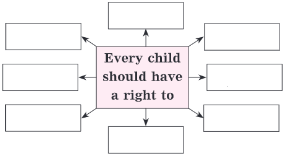
Answer

A1. Simple Factual Activity:
(1) Meena stayed alone as her parents lived in Delhi..
(2) Meena had the habit of  Complaining about anything and everything..
A2. Complex Factual Activity:
There was always something strange about Meena. She was always unhappy. Any person who came in contact with her would feel depressed. Her thoughts were negative about everything and about every person.
A3. Activities based on Vocabulary:
(1) cheerful
(2) pouring cheerful
(3) popular
(4) spotted
A4. Activities based on Contextual Grammar:

(i) She was never happy.
(ii) Meena was not an optimistic girl.
A5. Personal Response:
(1) In my opinion, a He/She friend should be loyal, honest and trustworthy. She should stand by us in our hour of need. She should be loving and caring and encourage us to do good things in our life. She should not be negative whereas she should make us smile in our difficult time.

Need a full question paper?

Generate a complete, print-ready paper with questions like this in minutes — across 16+ boards, with answer keys.

Start Generating Free

Similar questions

A1. Simple Factual Activity:
Who am I? (Identify the character)
(1) I am the washerman's son. - _______________
(2) I am the sweeper. - _______________

    Nathu grumbled to himself as he swept the steps of the Pipalnagar Bank, owned by Seth Govind Ram. He used the small broom hurriedly and carelessly, and the dust, after rising in a cloud above his head settled down again on the steps. As Nathu was
banging his pan against a dustbin, Sitaram, the washerman’s son, passed by.
    Sitaram was on his delivery round. He had a bundle of freshly pressed clothes balanced on his head.
    ‘Don’t raise such dust!’ he called out to Nathu. ‘Are you annoyed because they are still refusing to pay you an extra two rupees a month?’
    ‘I don’t wish to talk about it,’ complained the sweeper-boy. ‘I haven’t even received my regular pay. And this is the twentieth of the month. Who would think a bank would hold up a poor man’s salary? As soon as I get my money, I’m off! Not another week I work in this place.’ And Nathu banged the pan against the dustbin several times, just
to emphasize his point and giving himself confidence.
    ‘Well, I wish you luck,’ said Sitaram. ‘I’ll keep a lookout for any jobs that might suit you.’ And he plodded barefoot along the road, the big bundle ofclothes hiding most of his head and shoulders.
     At the fourth home he visited, Sitaram heard the lady of the house mention that she was in need of a sweeper. Tying his bundle together, he said; ‘I know of a sweeper boy who’s looking for work. He can start from next month. He’s with the bank just now but they aren’t giving him his pay, and he wants to leave.’
    ‘Is that so?’ said Mrs. Srivastava. ‘Well, tell him to come and see me tomorrow.’ 

A2. Complex Factual Activity:
Arrange the following sentences as per their sequence occurred in the passage:
(1) Nathu complained about his irregular pay.
(2) Nathu used the small broom hurriedly.
(3) Sitaram called out to Nathu.
(4) Nathu grumbled as he swept the steps of the bank.
A3. Activities based on Vocabulary:

Cross out the odd man:
(1) sweeper, hooligan, beggar, declare, locker
(2) hurriedly, carelessly, salary, definitely, suddenly
(3) imminent, latest, pavement, awful, shocking
(4) morning, scattering, raising, collecting, shouting
A4. Activities based on Contextual Grammar:
(1) He called out to Nathu. (Rewrite the sentence in Past Continuous Tense.)
(2) Mrs Srivastava said, "Tell him to come and see me tomorrow." (Change into indirect speech.)
A5. Personal Response:
(1) What qualities do you find in Sitaram?
A1. Simple Factual Activities:
Write whether the following sentences are True or False:
(1) Writer's journey from India to Norway is a connect between the two centre of global peace.
(2) The Nobel Committee did not invite the writer to deliver a lecture.
(3) Writer represented the sound of silence and cry of innocence.
(4) Writer humbly accepted the award on behalf of all activists.

     My dear children of the world ... Your Majesties, Your Royal Highnesses, Excellencies, distinguished members of the Norwegian Nobel Committee, dear brother Tom Harkin, brothers and sisters, and my dear daughter Malala.
      From this podium of peace and humanity, I am deeply honoured to recite a mantra from the ancient texts of wisdom, Vedas. This mantra carries a prayer, an aspiration and a resolve that has the potential to liberate humanity from all man-made crises.
      Let’s walk together. In the pursuit of global progress, not a single person should be left out or left behind in any corner of the world, from East to West, from South to North. Let’s speak together, let our minds come together! Learning from the experiences of our ancestors, let us together create knowledge for all that benefits all.
      I bow to my late parents, to my motherland India, and to the mother earth.
      With a warm heart I recall how thousands of times, I have been liberated, each time I have freed a child from slavery. In the first smile of freedom on their beautiful faces, I see the Gods smiling.
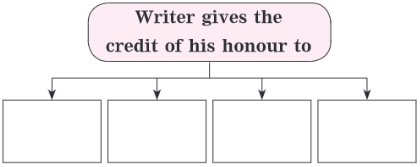
      I give the biggest credit of this honour to my movement’s Kaalu Kumar, Dhoom Das and Adarsh Kishore from India and Iqbal Masih from Pakistan who made the supreme sacrifice for protecting the freedom and dignity of children. I humbly accept this award on behalf of all such martyrs, my fellow activists across the world and my countrymen.
      My journey from the great land of Lord Buddha, Guru Nanak and Mahatma Gandhi; India to Norway is a connect between the two centres of global peace and brotherhood, ancient and modern.
      Friends, the Nobel Committee has generously invited me to present a “lecture.” Respectfully, I am unable to do that. Because, I am representing here - the sound of silence. The cry of innocence. And, the face of invisibility. I represent millions of those children who are left behind and that’s why I have kept an empty chair here as a reminder.

A2. Complex Factual Activities:
Complete the following :
Image
A3. Activities based on Vocabulary:
(1) Use the word 'credit' as a noun and a verb to make a meaningful sentence.
A4. Activities based on Contextual Grammar:
Do as directed:
(1) I humbly accept this award. (Choose the correct question tag.)
(a) do I?  (b) don't I? (c) did I? (d) didn't I?
(2) I am unable to do that.
(Make it negative without changing its meaning)
A5. Personal Response:
(1) What do you know about Kailash Satyarthi? 
A1. Simple Factual Activities:
Complete the following sentences:
(1) Soldiers called Joan _______________.
(2) Joan wanted _______________.
(3) The shortest way to save your skin is to _______________.
(4) According to Joan, their soldiers are always beaten because they fight _______________.

Poulengey : (Going to the window) Yes! Joan, come up. (Joan enters.)
Poulengey : (Gravely) Be seated, Joan.
Robert : What is your name ?
Joan : They always called me Jenny, in Lorraine. Here in France, I am Joan. The soldiers call me the Maid.
Robert : How old are you ?
Joan : Seventeen, so they tell me. It might be nineteen. I don’t remember.
Robert : I suppose you think raising a siege is as easy as chasing a cow out of a meadow. You think soldiering is anybody’s job ?
Joan : I don’t think it can be very difficult if God is on your side.
Robert : (Grimly) Have you ever seen English soldiers fighting? Have you ever seen them plundering, burning, turning the countryside into a desert ? Have you heard no tales of their prince who is the devil himself, or of the English king’s father ?
Joan : You do not understand, squire. Our soldiers are always beaten because they are fighting only to save their skins and the shortest way to save your skin is to run away. But I will teach them all to fight for France. Then, they will drive the soldiers before them like sheep. You and Polly will live to see the day when there will not be a single English soldier on the soil of France.
Robert : (To Poulengey) This may all be nonsense, Polly. But the troops might just be inspired by it though nothing that we say seems to put any fire into them. Even the Dauphin might believe it. And if she can put some fire into him, she can put it into anybody.
Robert : (Turning to Joan) Now you, listen to me and don’t cut in before I have time to think. Your orders are that you are to go to Chinon under the escort of this gentleman and three of his friends.
Joan : (Radiant, clasping her hands) Oh, thank you, squire !
Poulengey : How is she to get into the royal presence ?
Robert : I don’t know. How did she get into my presence ? I will send her to Chinon and she can say I sent her. Then, let come what may. I can do no more.
Joan : And the dress ? I may have a soldier’s dress, squire ?
Robert : Take what you please. I wash my hands off it.
Joan : (Wildly excited by her success) Come, Polly. (She dashes out.)
Robert : (Shaking Poulengey’s hand) Goodbye, old man, I am taking a big chance. Few other men would have done it.

A2. Complex Factual Activities:
(1) What shows Joan was a person of immense faith?
A3. Activities based on Vocabulary:
Find out synonyms:
(1) looting - 
(2) seriously - 
(3) following - 
(4) hayfield - 
A4. Activities based on Contextual Grammar:
Rewrite as affirmative sentences:
(1) I don't remember.
(2) YYou do not understand Squire.
A5. Personal Response:
(1) Do you love your country? Why? 
A1. Simple Factual Activities:
Image

     As a child, I had a vision of tomorrow. A vision of that cobbler boy sitting with me in my classroom.
     Now, that tomorrow has become TODAY.
     I am TODAY, and you are TODAY. TODAY it is time for every child to have a right to life, right to freedom, right to health, right to education, right to safety, right to dignity, right to equality, and right to peace.
     TODAY, beyond the darkness, I see the smiling faces of our children in the blinking stars. TODAY, in every wave of every ocean, I see my children are playing and dancing. TODAY, in every plant, in every tree, and mountain, I see our children growing freely with dignity.
     Friends, I want you to see and feel this TODAY inside you.
     My dear sisters and brothers, as I said many interesting things are happening today. May I please request you to put your hand close to your heart - close your eyes and feel the child inside you?
     I am sure you can - Now, listen to that child.Listen please.
     Today, I see thousands of Mahatma Gandhis, Nelson Mandelas and Martin Luther Kings calling on us.
     Let us democratise knowledge. Let us universalise justice. Together, let us globalise compassion!
     I call upon you in this room, and all across the world. I call for a march from exploitation to education, I call for a march from poverty to shared prosperity, a march from slavery to liberty, and a march from violence to peace.
     Let us march from ignorance to awakening. Let us march from darkness to light. Let us march from mortality to divinity.
     Let us march!  

A2. Complex Factual Activities:
Complete the following:
The writer calls all the listeners for a march.
from → _______________ to → education
from → poverty to → _______________
from → slavery to → _______________
from → _______________ to → peace
from → _______________ to → awakening
from → darkness to → _______________
from → mortality to → _______________
A3. Activities based on Vocabulary:
(1) ignorance × _______________
(2) immortality × _______________
(3) deny × _______________
(4) recognised × _______________
A4. Activities based on Contextual Grammar:
Make nouns of the following:
(1) play (2) grow (3) globalise (4) violent
A5. Personal Response:

(1) What is your vision of tomorrow? 
A1. Simple Factual Activities:
State whether you agree or disagree with the following statements:

 Group 'A' Group 'B'
 (1) A small, skinny child labourer (a) to care for our children
 (2) A Sudanese child- soldier (b) children's frightened and exhausted eyes
 (3) Satyarthi had looked into  (c) was forced to kill his friends and family
 (4) The great religions teach us (d) The world forced me to take a gun or a tool

    I have come here only to share the voices and dreams of our children - because they are all our children - [gesture to everyone in the audience]. I have looked into their frightened and exhausted eyes. I have held their injured bodies and felt their broken spirits.
    Twenty years ago, in the foothills of the Himalayas, I met a small, skinny child labourer. He asked me: “Is the world so poor that it cannot give me a toy and a book, instead of forcing me to take a gun or a tool?”
    I met with a Sudanese child-soldier. He was kidnapped by an extremist militia. As his first training lesson, he was forced to kill his friends and family. He asked me: “What is my fault?”
    Friends, all the great religions teach us to care for our children. Jesus said: “Let the children come to me; do not hinder them, for the kingdom of God belongs to them.” The Holy Quran says: “Kill not your children because of poverty.”
    Friends! There is no greater violence than to deny the dreams of our children. Therefore ... I refuse to accept that all the temples and mosques and churches and prayer houses have no place for the dreams of our children.
    I refuse to accept that the world is so poor, when just one week of global military expenditure can bring all the children to classrooms. I refuse to accept that all the laws and constitutions, police and judges are unable to protect our children.
    I refuse to accept that the shackles of slavery can ever be stronger than the quest for freedom. I REFUSE TO ACCEPT here.
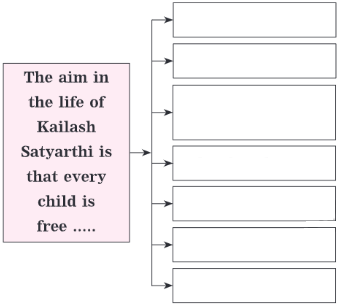
    My only aim in life is that every child is free to be a child,
- free to grow and develop,
- free to eat, sleep, and see daylight,
- free to laugh and cry,
- free to play and learn,
- free to go to school, and above all,
- free to dream.
    I have the privilege of working with many courageous people who have the same aim. We have never given up against any threat or attack and we never will.

A2. Complex Factual Activities:

Complete the following diagram/chart :
Image
A3. Activities based on Vocabulary:
Choose the correct option and write in front of the given word :
(1) extremist: _______________
(A) militant (B) robber (C) spy
(2) courageous: _______________
(A) cowards (B) brave (C) friendly
A4. Activities based on Contextual Grammar:

Rewrite the following into indirect speech:
(1) A skinny child labourer asked Satyarthi, "Is the world so poor that it cannot give me a toy and a book, instead of forcing me to take a gun or a tool?" 
A5. Personal Response:
What will you do in the following situations?
(1) If you find a child working on a brickwork site.
(2) If you come across a beggar child.

A1. Simple Factual Activity:
Say whether the following statements are True or False:
(1) When the young seagull. pretended to be falling asleep, his parents took notice of him.
(2) Flying across the young seagull, the mother dropped into his beak a piece of fish.
(3) The young seagull was fed a piece of fish by his mother.
(4) The young seagull's father was preening the feathers on his white back.

     The sun was now ascending the sky, blazing on his ledge that faced the south. He felt the heat because he had not eaten since the previous nightfall.
     He stepped slowly out to the brink of the ledge, and standing on one leg with the other leg hidden under his wing, he closed one eye, then the other, and pretended to be falling asleep. Still they took no notice of him. He saw his two brothers and his sister
lying on the plateau dozing with their heads sunk into their necks. His father was preening the feathers on his white back. Only his mother was looking at him. She was standing on a little high hump on the plateau, her white breast thrust forward. Now and
again, she tore at a piece of fish that lay at her feet and then scrapped each side of her beak on the rock. The sight of the food maddened him. How he loved to tear food that way, scrapping his beak now and again to whet it.
     “Ga, ga, ga”, he cried begging her to bring him some food. “Gaw-col-ah”, she screamed back derisively. But he kept calling plaintively, and after a minute or so he uttered a joyful scream. His mother had picked up a piece of the fish and was flying across to him with it. He leaned out eagerly, tapping the rock with his feet, trying to get nearer to her as she flew across. But when she was just opposite to him, she halted, her wings motionless, the piece of fish in her beak almost within reach of his beak. He waited a moment in surprise, wondering why she did not come nearer, and then, maddened by hunger, he dived at the fish. With a loud scream he fell outwards
and downwards into space. Then a monstrous terror seized him and his heart stood still. He could hear nothing. But it only lasted a minute. The next moment he felt his wings spread outwards. The wind rushed against his breast feathers, then under his stomach, and against his wings. He could feel the tips of his wings cutting through the air. He was not falling headlong now. He was soaring gradually downwards and outwards. He was no longer afraid. He just felt a bit dizzy.

A2. Complex Factual Activity:

(1) What were the young seagull's parents doing? 
A3. Activities based on Vocabulary:
Match the words in Column 'A' with their meanings in Column 'B':

'A''B'
(1) ascending  (a) grabbed
(2) maddened (b) flying upward into the air
(3) soaring (c) made one very angry
(4) seized (d) rising up

A4. Activities based on Contextual Grammar:
Read the following sentences carefully, underline the verbs and find out the tenses in the sentences: 
(1) The sun was ascending now.
(2) Still they took no notice of him.
A5. Personal Response:
Complete the following statements:
(1) The seagull is afraid to fly because _______________ .
(2) Young birds are afraid to make their first flight because_______________.

A1. Simple Factual Activities:
State whether you Agree or Disagree with the following statements: 
Statements
(1) The narrator made a mistake by saving the baby langur.
(2) Animals cannot convey emotions.

    For a few seconds, the mother langur looked straight into my eyes. Even today, I cannot forget that look in her eyes, showering silent gratitude on me for saving her child. I was overwhelmed by the emotion, the sentiment and the way she said thanks to me. There sat a universal mother holding a stricken child in her lap.
    Then, in a flash, she jumped with her baby clinging to her belly and reached our kitchen roof. She surveyed the area for the vicious male langur and then leapt away in the direction opposite to the place of the violent encounter.
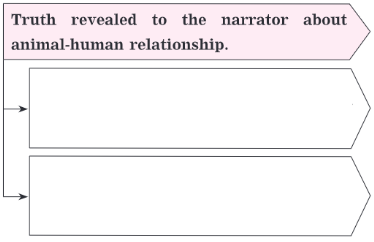
    The brief meeting with the mother and the baby langur convinced me that interspecies communication and mutual trust is indeed a reality and should anyone strike the right chord, the relationship hums into action. The mother langur showed me that food was not the only means of communication between man and animal but that there were other means of establishing a bond through trust, compassion and mutual understanding.
     Fifty-five years have passed since that day. I am now seventy years old. But I still fondly remember that ‘encounter of a special kind’.

A2. Complex Factual Activities:
Complete the web:
Image
 
A3. Activities based on Vocabulary:
Match the words in column 'A' with their meanings in column 'B':

 Column 'A'Column 'B'
 (1) to be overwhelmed by (a) to do something that makes people feel to have  sympathy with.
 (2) in a flash (b) very quickly
 (3) strike the right chord (c) belief felt equally by both people involved.
 (4) mutual trust (d) to be affected emotionally in a powerful way.

A4. Activities based on Contextual Grammar:
Rewrite the sentences as per the tenses mentioned in the brackets:
(1) The mother langur looked straight into my eyes. (Simple Present Tense.)
(2) She surveyed the area for the vicious male langur. (Simple Future Tense.)
A5. Personal Response:
(1) What did the mother langur seem to convey to the narrator?

A1. Simple Factual Activities:
Say whether the following statements are True or False:
(1) The baby langur sensed the presence of his mother.
(2) The mother langur was sitting on the floor of the coop.
(3) The writer cuddled the baby langur tightly in his bosom.
(4) The writer's attention was fixed on the revival of the baby langur.

    My attention was fixed on the revival of the baby langur. Suddenly, I had an uncanny feeling of being watched. I turned away from the coop and looked up. There sat the mother langur on our kitchen roof, watching every move I made. She simply sat there quietly, as if convinced that no harm was being done to her child.
   Meanwhile, the baby sensed the presence of his mother and started to sob and cry a little louder. I retreated from the door of the coop to allow the mother access to her baby.
    Immediately, the mother descended on the floor of the coop and picked up the baby in her arms. She gave the baby a thorough body inspection to check his injuries and then cuddled him tightly in her bosom. The baby found great solace in her caring arms. The mother sat still with the baby in her lap for a few minutes. It was almost as if she was pondering over her options and trying to figure out how she could keep the baby safe from further assault.

A2. Complex Factual Activities:
Complete the following:
(1) Mother langur simply sat quietly because _______________.
(2) The baby langur started to sob and cry because _______________.
 
A3. Activities based on Vocabulary:
Match the words in column 'A' with their meanings in column 'B':

 Column 'A'Column 'B'
 (1) to figure out (a) to find comfort and peace.
 (2) to ponder over (b) the act of checking with complete attention and care.
 (3) to find solace (c) to be able to think until you solve the problem.
 (4) thorough inspection (d) think over something deeply.

A4. Activities based on Contextual Grammar:
Do as directed:
(1) I turned away from the coop and looked up.
(Begin the sentence with - Turning ... and rewrite it.) 
(2) She gave the baby a thorough body inspection.
(Change the sentence into passive voice. Begin with The baby...)
A5. Personal Response:
(1) What is your mother's state of mind during your illness?

A1. Simple Factual Activities:
Who said to whom:
(1) "Come with me. I will take you to school."
(2) "What is your name, little one?"

     The next day Ramlal caught Bholi by the hand and said. ‘‘Come with me. I will take you to school.’’ Bholi was frightened. She did not know what a school was like. She remembered how a few days ago their old cow. Lakshmi had been turned out of
the house and sold.
     ‘‘N-n-n-n No. no-no-no’’ she shouted in terror and pulled her hand away from her father’s grip.
     ‘‘What’s the matter with you, you fool?’’ shouted Ramlal, ‘‘I am only taking you to school.’’ Then he told his wife. ‘‘Let her wear some decent clothes today. Or else what will the teachers and the other schoolgirls think of us when they see her?’’
      New clothes had never been made for Bholi. The old dresses of her sisters were passed on to her. No one cared to mend or wash her clothes. But today she was lucky to receive a clean dress which had shrunk after many washing and no longer fitted
Champa. She was even bathed and oil was rubbed into her dry and matted hair. Only then did she begin to believe that she was being taken to a place better than her home!
      When they reached the school, the children were already in their classrooms. Ramlal handed over his daughter to the headmistress. Left alone, the poor girl looked about her with fear laden eyes. There were several rooms. And in each room girls like her squatted on mats, reading from books or writing on slates. The headmistress asked        Bholi to sit down in a corner in one of the classrooms. Bholi did not know what exactly a school was like and what happened there. But she was glad to find so many girls almost of her own age present there. She hoped that one of these girls might become her friend.
      The lady teacher who was in the class was saying something to the girls but Bholi could understand nothing. She looked at the pictures on the wall. The colours fascinated her. The horse was brown just like the horse on which the Tehsildar had come to visit their village : the goat was black like the goat of their neighbour: the parrot was green like the parrots she had seen in the mango orchard : and the cow was just like their Lakshmi. And suddenly Bholi noticed that the teacher was standing by her
side, smiling at her.
      “What’s your name. little one?’’
      ‘‘Bh-Bho-Bho.’’ She could stammer no further than that.
       Then she began to cry and tears flowed from her eyes in a helpless flood. She kept her head down as she sat in her corner, not daring to look up at the girls who, she knew were still laughing at her.

A2. Complex Factual Activities:
(1) What shows that Bholi was unwilling to go to school? 
A3. Activities based on Vocabulary:
Complete the following sentences using words given in the brackets:
(disfigured, matted, fascinated)
(1) After the accident Juhi's face was _______________.
(2) It took a long time to straighten the _______________ bundle of wool.
A4. Activities based on Contextual Grammar:
(1) Change into indirect speech:
Ramlal's wife said to him, "I will tell you what to do."
(2) Rewrite as an exclamatory sentence:
The child was very fair and pretty.
A5. Personal Response:
(1) "If girls go to school, who will marry them?"-Why, do you think, that Bholi's mother thought so? 
A1. Simple Factual Activity:
State whether the following statements are True or False:
(1) The book is filled with heavy grammar and difficult technical words.
(2) The book circles round the mischief of the kids in a view of the kid.
(3) R. K. Narayan's 'Swami and Friends' is a good read for the kids and teens alike.
(4) Mischievous kids are not as sensitive as other people.

     Significance of the book...
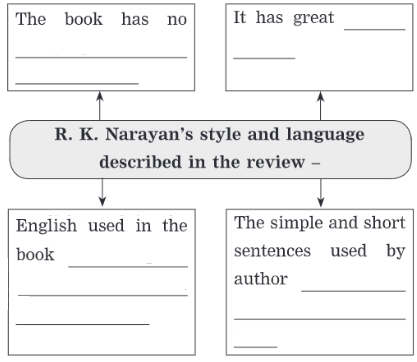
    ‘Swami and Friends’ by R. K. Narayan is not merely an interesting read that could be enjoyed from top to bottom, but the work attributes a lot of literary values even if it is a teen book ‘Swami and Friends’ is a good read for the kids and teens alike. Also the book is widely used in the Asian continent as a study text for the students who study literature as a subject at schools. This does not mean that the book is filled with heavy grammar and technical jargon. Actually the truth is in contrary to this.
     Swami and Friends is written in such simple English it is hard to imagine that it is a work of such a literary genius like R. K. Narayan. The English used in the book is both plain and simple, without any troubling words for the kids. Also the use of simple and short sentences adds to the simplicity of the book.
      It is mentioned in the description that the book is about a mischievous ten year old Indian boy, and some parents may be concerned about the influence this will have on their already mischievous children. But the book is as such, that it encompasses the
mischief of the kids in a view of the kid which is harmless and pure in his perspective. Also amidst all the mischief and naughtiness, we actually find that Swami is a loving and a tender kid who's actually very sensitive. It is also a known fact that mischievous
kids are the most sensitive and loving people of all. And R. K. Narayan does a great job conveying that to all of us.

A2. Complex Factual Activity:
Complete the web:
Image
A3. Activities based on Vocabulary:
Find the following from the passage:
(i) Noun forms of : simple, describe, naughty
(ii) Verb forms of : meaning, attribution imagination, loving
A4. Activities based on Contextual Grammar:
Add question tags:
(1) This does not mean that the book is filled with heavy Grammar.
(2) R. K. Narayan does a great job conveying ving that th to all of us.
A5. Personal Response:
(1) What difference do you find between the children of Swami's days and today's children?