Question

✓
Answer
A1. Simple Factual Activity:
(1) Sitaram was looking out for any job that might suit Nathu.
(2) The lady of the house was in need of a sweeper.
A2. Complex Factual Activity:
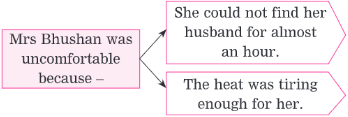
A3. Activities based on Vocabulary:
(1) photography shop
(2) midday meal
(3) customary tour
(4) large shady tamarind tree
A4. Activities based on Contextual Grammar:
(1) Mrs Bhushan went in search of her husband who was sitting in front of Kamal Kishore's photography shop.
(2) No other summer in the history of Pipalnagar was so hot as that.
A5. Personal Response:
(1) Yes, I think Mr Bhushan was absolutely right to compare his wife with a bee in flower garden. We know that bees buzz from flower to flower in gardens for collecting honey. He knew that his wife similarly used to visit many shops for selecting her clothes or only to have a look at them.
(1) Sitaram was looking out for any job that might suit Nathu.
(2) The lady of the house was in need of a sweeper.
A2. Complex Factual Activity:
A3. Activities based on Vocabulary:
(1) photography shop
(2) midday meal
(3) customary tour
(4) large shady tamarind tree
A4. Activities based on Contextual Grammar:
(1) Mrs Bhushan went in search of her husband who was sitting in front of Kamal Kishore's photography shop.
(2) No other summer in the history of Pipalnagar was so hot as that.
A5. Personal Response:
(1) Yes, I think Mr Bhushan was absolutely right to compare his wife with a bee in flower garden. We know that bees buzz from flower to flower in gardens for collecting honey. He knew that his wife similarly used to visit many shops for selecting her clothes or only to have a look at them.
Need a full question paper?
Generate a complete, print-ready paper with questions like this in minutes — across 16+ boards, with answer keys.
Explore more
Similar questions
A1. Simple Factual Activity:
Write whether the following statements are True or False:
(1) To accomplish goals, experts recommend a ten step approach.
(2) The champions have to have the skill and the will
(3) For anyone, setting goal is not easy but challenging.
(4) If we do not take action to achieve goals, we shall not achieve goals.
Champions aren’t made in gyms. Champions are made from something they have deep inside them- a desire, a dream, a vision. They have to have the skill and the will. But the will must be stronger than the skill. Successful professionals thrive in the same manner. We all have natural talents. If we use that talent to set our goal in life, we can easily get success in life. We shall not achieve our goals if we do not take action to achieve them.
Setting goals has two valuable assets - a sense of originality and a stepping stone to illuminate the path. Goals put one at the helm of life; pursuing them acknowledges a better future situation. They help to steer a course of life rather than simply drifting along and letting things happen.
Setting goals may appear easy, but, for some, it is quite challenging. Fear of failure may be avoided in the absence of any goals. After all, one has to decide what one wants to achieve in the end. To accomplish goals, experts recommend a five step approach.
SMART goals are a methodology of thinking that helps people reach success. SMART stands for specific, measurable, achievable, realistic and timebound.
A2. Complex Factual Activities:
Complete the web:
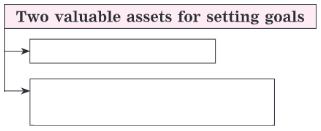
A3. Activities based on Vocabulary:
Find from the passage adjectives for:
(1) profession
(2) value
A4. Activities based on Contextual Grammar:
Do as directed:
(1) The will must be stronger than the skill.
(Select the 'positive degree' from the following.)
(a) The will must be as strong as the skill.
(b) The will must not be as strong as the skill.
(c) The skill must not be as strong as the will.
(d) The skill must be as strong as the skill.
(2) They have to have the skill and the will.
(Use 'not only...but also...'.)
A5. Personal Response:
(1) Write any one of your goal and what you will do to achieve it.
Write whether the following statements are True or False:
(1) To accomplish goals, experts recommend a ten step approach.
(2) The champions have to have the skill and the will
(3) For anyone, setting goal is not easy but challenging.
(4) If we do not take action to achieve goals, we shall not achieve goals.
Champions aren’t made in gyms. Champions are made from something they have deep inside them- a desire, a dream, a vision. They have to have the skill and the will. But the will must be stronger than the skill. Successful professionals thrive in the same manner. We all have natural talents. If we use that talent to set our goal in life, we can easily get success in life. We shall not achieve our goals if we do not take action to achieve them.
Setting goals has two valuable assets - a sense of originality and a stepping stone to illuminate the path. Goals put one at the helm of life; pursuing them acknowledges a better future situation. They help to steer a course of life rather than simply drifting along and letting things happen.
Setting goals may appear easy, but, for some, it is quite challenging. Fear of failure may be avoided in the absence of any goals. After all, one has to decide what one wants to achieve in the end. To accomplish goals, experts recommend a five step approach.
SMART goals are a methodology of thinking that helps people reach success. SMART stands for specific, measurable, achievable, realistic and timebound.
A2. Complex Factual Activities:
Complete the web:
A3. Activities based on Vocabulary:
Find from the passage adjectives for:
(1) profession
(2) value
A4. Activities based on Contextual Grammar:
Do as directed:
(1) The will must be stronger than the skill.
(Select the 'positive degree' from the following.)
(a) The will must be as strong as the skill.
(b) The will must not be as strong as the skill.
(c) The skill must not be as strong as the will.
(d) The skill must be as strong as the skill.
(2) They have to have the skill and the will.
(Use 'not only...but also...'.)
A5. Personal Response:
(1) Write any one of your goal and what you will do to achieve it.
A1. Simple Factual Activities:
State whether the following statements are Right or Wrong. Correct the wrong ones:
(i) The beggar and the young girl were playing on the road because there was a lot of traffic.
(ii) The scene of the beggar and the girl made Meena peep into her own life.
(iii) The beggar became Meena's role model.
(iv) It took Meena almost two years to put the change into effect.
‘Yes, a beggar,’ she repeated, as if to reassure me. ‘He was old and used to stay in front of my house with his five-year old granddaughter. As you know, I was a chronic pessimist. I used to give my leftovers to this beggar every day. I never spoke to him. Nor did he speak to me. One monsoon day, I looked out of my bedroom window and started cursing the rain. I don’t know why I did that because I wasn’t even getting wet. That day I couldn’t give the beggar and his granddaughter their daily quota of leftovers. They went hungry, I am sure.
‘However, what I saw from my window surprised me. The beggar and the young girl were playing on the road because there was no traffic. They were laughing, clapping and screaming joyously, as if they were in paradise. Hunger and rain did not matter.They were totally drenched and totally happy. I envied their zest for life.
‘That scene forced me to look at my own life. I realized I had so many comforts, none of which they had. But they had the most important of all assets, one which I lacked. They knew how to be happy with life as it was. I felt ashamed of myself. I even started to make a list of what I had and what I did not have. I found I had more to be grateful for than most people could imagine. That day, I decided to change my attitude towards life, using the beggar as my role model.’
After a long pause, I asked Meena how long it had taken her to change.
‘Once this realization dawned’, she said, ‘it took me almost two years to put the change into effect. Now nothing matters. I am always happy. I find happiness in every small thing, in every situation and in every person.’
‘Did you give any gurudakshina to your guru ?’ I asked.
‘No. Unfortunately, by the time I understood things, he was dead. But I sponsored his granddaughter to a boarding school as a mark of respect to him.’
A2. Complex Factual Activities:
(1) Meena sponsored the granddaughter of the beggar because _______________.
(a) she was alone in her life after his death.
(b) it was a token of respect to the beggar.
(c) she was rich and so she wanted to help.
(2) _______________ was the most important of all assets, that the beggar and his granddaughter had but the writer was lacking.
(a) Attitude towards life
(b) So many comforts
(c) Hunger.
A3. Activities based on Vocabulary:
Match the synonyms:
State whether the following statements are Right or Wrong. Correct the wrong ones:
(i) The beggar and the young girl were playing on the road because there was a lot of traffic.
(ii) The scene of the beggar and the girl made Meena peep into her own life.
(iii) The beggar became Meena's role model.
(iv) It took Meena almost two years to put the change into effect.
‘Yes, a beggar,’ she repeated, as if to reassure me. ‘He was old and used to stay in front of my house with his five-year old granddaughter. As you know, I was a chronic pessimist. I used to give my leftovers to this beggar every day. I never spoke to him. Nor did he speak to me. One monsoon day, I looked out of my bedroom window and started cursing the rain. I don’t know why I did that because I wasn’t even getting wet. That day I couldn’t give the beggar and his granddaughter their daily quota of leftovers. They went hungry, I am sure.
‘However, what I saw from my window surprised me. The beggar and the young girl were playing on the road because there was no traffic. They were laughing, clapping and screaming joyously, as if they were in paradise. Hunger and rain did not matter.They were totally drenched and totally happy. I envied their zest for life.
‘That scene forced me to look at my own life. I realized I had so many comforts, none of which they had. But they had the most important of all assets, one which I lacked. They knew how to be happy with life as it was. I felt ashamed of myself. I even started to make a list of what I had and what I did not have. I found I had more to be grateful for than most people could imagine. That day, I decided to change my attitude towards life, using the beggar as my role model.’
After a long pause, I asked Meena how long it had taken her to change.
‘Once this realization dawned’, she said, ‘it took me almost two years to put the change into effect. Now nothing matters. I am always happy. I find happiness in every small thing, in every situation and in every person.’
‘Did you give any gurudakshina to your guru ?’ I asked.
‘No. Unfortunately, by the time I understood things, he was dead. But I sponsored his granddaughter to a boarding school as a mark of respect to him.’
A2. Complex Factual Activities:
(1) Meena sponsored the granddaughter of the beggar because _______________.
(a) she was alone in her life after his death.
(b) it was a token of respect to the beggar.
(c) she was rich and so she wanted to help.
(2) _______________ was the most important of all assets, that the beggar and his granddaughter had but the writer was lacking.
(a) Attitude towards life
(b) So many comforts
(c) Hunger.
A3. Activities based on Vocabulary:
Match the synonyms:
| Column 'A' | Column 'B' |
| (1) paradise | (a) enthusiasm |
| (2) zest | (b) valuable thing |
| (3) asset | (c) wet |
| (4) drenched | (d) heaven |
A4. Activities based on Contextual Grammar:
(1) Do as directed:
He used to stay in front of my house.
(Rewrite the sentence by using 'would'.)
(2) Change the voice:
That scene forced me to look at my own life.
(Begin the sentence with "I .....)
A5. Personal Response:
(1) According to you, how can we help beggars?
A1. Simple Factual Activities:
Complete the following sentences:
(1) Soldiers called Joan _______________.
(2) Joan wanted _______________.
(3) The shortest way to save your skin is to _______________.
(4) According to Joan, their soldiers are always beaten because they fight _______________.
Poulengey : (Going to the window) Yes! Joan, come up. (Joan enters.)
Poulengey : (Gravely) Be seated, Joan.
Robert : What is your name ?
Joan : They always called me Jenny, in Lorraine. Here in France, I am Joan. The soldiers call me the Maid.
Robert : How old are you ?
Joan : Seventeen, so they tell me. It might be nineteen. I don’t remember.
Robert : I suppose you think raising a siege is as easy as chasing a cow out of a meadow. You think soldiering is anybody’s job ?
Joan : I don’t think it can be very difficult if God is on your side.
Robert : (Grimly) Have you ever seen English soldiers fighting? Have you ever seen them plundering, burning, turning the countryside into a desert ? Have you heard no tales of their prince who is the devil himself, or of the English king’s father ?
Joan : You do not understand, squire. Our soldiers are always beaten because they are fighting only to save their skins and the shortest way to save your skin is to run away. But I will teach them all to fight for France. Then, they will drive the soldiers before them like sheep. You and Polly will live to see the day when there will not be a single English soldier on the soil of France.
Robert : (To Poulengey) This may all be nonsense, Polly. But the troops might just be inspired by it though nothing that we say seems to put any fire into them. Even the Dauphin might believe it. And if she can put some fire into him, she can put it into anybody.
Robert : (Turning to Joan) Now you, listen to me and don’t cut in before I have time to think. Your orders are that you are to go to Chinon under the escort of this gentleman and three of his friends.
Joan : (Radiant, clasping her hands) Oh, thank you, squire !
Poulengey : How is she to get into the royal presence ?
Robert : I don’t know. How did she get into my presence ? I will send her to Chinon and she can say I sent her. Then, let come what may. I can do no more.
Joan : And the dress ? I may have a soldier’s dress, squire ?
Robert : Take what you please. I wash my hands off it.
Joan : (Wildly excited by her success) Come, Polly. (She dashes out.)
Robert : (Shaking Poulengey’s hand) Goodbye, old man, I am taking a big chance. Few other men would have done it.
A2. Complex Factual Activities:
(1) What shows Joan was a person of immense faith?
A3. Activities based on Vocabulary:
Find out synonyms:
(1) looting -
(2) seriously -
(3) following -
(4) hayfield -
A4. Activities based on Contextual Grammar:
Rewrite as affirmative sentences:
(1) I don't remember.
(2) YYou do not understand Squire.
A5. Personal Response:
(1) Do you love your country? Why?
Complete the following sentences:
(1) Soldiers called Joan _______________.
(2) Joan wanted _______________.
(3) The shortest way to save your skin is to _______________.
(4) According to Joan, their soldiers are always beaten because they fight _______________.
Poulengey : (Going to the window) Yes! Joan, come up. (Joan enters.)
Poulengey : (Gravely) Be seated, Joan.
Robert : What is your name ?
Joan : They always called me Jenny, in Lorraine. Here in France, I am Joan. The soldiers call me the Maid.
Robert : How old are you ?
Joan : Seventeen, so they tell me. It might be nineteen. I don’t remember.
Robert : I suppose you think raising a siege is as easy as chasing a cow out of a meadow. You think soldiering is anybody’s job ?
Joan : I don’t think it can be very difficult if God is on your side.
Robert : (Grimly) Have you ever seen English soldiers fighting? Have you ever seen them plundering, burning, turning the countryside into a desert ? Have you heard no tales of their prince who is the devil himself, or of the English king’s father ?
Joan : You do not understand, squire. Our soldiers are always beaten because they are fighting only to save their skins and the shortest way to save your skin is to run away. But I will teach them all to fight for France. Then, they will drive the soldiers before them like sheep. You and Polly will live to see the day when there will not be a single English soldier on the soil of France.
Robert : (To Poulengey) This may all be nonsense, Polly. But the troops might just be inspired by it though nothing that we say seems to put any fire into them. Even the Dauphin might believe it. And if she can put some fire into him, she can put it into anybody.
Robert : (Turning to Joan) Now you, listen to me and don’t cut in before I have time to think. Your orders are that you are to go to Chinon under the escort of this gentleman and three of his friends.
Joan : (Radiant, clasping her hands) Oh, thank you, squire !
Poulengey : How is she to get into the royal presence ?
Robert : I don’t know. How did she get into my presence ? I will send her to Chinon and she can say I sent her. Then, let come what may. I can do no more.
Joan : And the dress ? I may have a soldier’s dress, squire ?
Robert : Take what you please. I wash my hands off it.
Joan : (Wildly excited by her success) Come, Polly. (She dashes out.)
Robert : (Shaking Poulengey’s hand) Goodbye, old man, I am taking a big chance. Few other men would have done it.
A2. Complex Factual Activities:
(1) What shows Joan was a person of immense faith?
A3. Activities based on Vocabulary:
Find out synonyms:
(1) looting -
(2) seriously -
(3) following -
(4) hayfield -
A4. Activities based on Contextual Grammar:
Rewrite as affirmative sentences:
(1) I don't remember.
(2) YYou do not understand Squire.
A5. Personal Response:
(1) Do you love your country? Why?
A1. Simple Factual Activity:
Complete the sentences using the information from the passage:
(1) Sitaram was looking out for any job _______________ .
(2) The lady of the house was _______________.
Nathu grumbled to himself as he swept the steps of the Pipalnagar Bank, owned by Seth Govind Ram. He used the small broom hurriedly and carelessly, and the dust, after rising in a cloud above his head settled down again on the steps. As Nathu was
banging his pan against a dustbin, Sitaram, the washerman’s son, passed by.
Sitaram was on his delivery round. He had a bundle of freshly pressed clothes balanced on his head.
‘Don’t raise such dust!’ he called out to Nathu. ‘Are you annoyed because they are still refusing to pay you an extra two rupees a month?’
‘I don’t wish to talk about it,’ complained the sweeper-boy. ‘I haven’t even received my regular pay. And this is the twentieth of the month. Who would think a bank would hold up a poor man’s salary? As soon as I get my money, I’m off! Not another week I work in this place.’ And Nathu banged the pan against the dustbin several times, just
to emphasize his point and giving himself confidence.
‘Well, I wish you luck,’ said Sitaram. ‘I’ll keep a lookout for any jobs that might suit you.’ And he plodded barefoot along the road, the big bundle ofclothes hiding most of his head and shoulders.
At the fourth home he visited, Sitaram heard the lady of the house mention that she was in need of a sweeper. Tying his bundle together, he said; ‘I know of a sweeper boy who’s looking for work. He can start from next month. He’s with the bank just now but they aren’t giving him his pay, and he wants to leave.’
‘Is that so?’ said Mrs. Srivastava. ‘Well, tell him to come and see me tomorrow.’
A2. Complex Factual Activity:
Write in your own words a few sentences about the following:
(i) Nathu
A3. Activities based on Vocabulary:
Do as directed:
(1) He called out to Nathu. (Rewrite the sentence in Past Continuous Tense.)
(2) Mrs Srivastava said, "Tell him to come and see me tomorrow." (Change into indirect speech.)
A4. Activities based on Contextual Grammar:
Complete the sentences using the information from the passage:
(1) Sitaram was looking out for any job _______________ .
(2) The lady of the house was _______________.
Nathu grumbled to himself as he swept the steps of the Pipalnagar Bank, owned by Seth Govind Ram. He used the small broom hurriedly and carelessly, and the dust, after rising in a cloud above his head settled down again on the steps. As Nathu was
banging his pan against a dustbin, Sitaram, the washerman’s son, passed by.
Sitaram was on his delivery round. He had a bundle of freshly pressed clothes balanced on his head.
‘Don’t raise such dust!’ he called out to Nathu. ‘Are you annoyed because they are still refusing to pay you an extra two rupees a month?’
‘I don’t wish to talk about it,’ complained the sweeper-boy. ‘I haven’t even received my regular pay. And this is the twentieth of the month. Who would think a bank would hold up a poor man’s salary? As soon as I get my money, I’m off! Not another week I work in this place.’ And Nathu banged the pan against the dustbin several times, just
to emphasize his point and giving himself confidence.
‘Well, I wish you luck,’ said Sitaram. ‘I’ll keep a lookout for any jobs that might suit you.’ And he plodded barefoot along the road, the big bundle ofclothes hiding most of his head and shoulders.
At the fourth home he visited, Sitaram heard the lady of the house mention that she was in need of a sweeper. Tying his bundle together, he said; ‘I know of a sweeper boy who’s looking for work. He can start from next month. He’s with the bank just now but they aren’t giving him his pay, and he wants to leave.’
‘Is that so?’ said Mrs. Srivastava. ‘Well, tell him to come and see me tomorrow.’
A2. Complex Factual Activity:
Write in your own words a few sentences about the following:
(i) Nathu
A3. Activities based on Vocabulary:
Do as directed:
(1) He called out to Nathu. (Rewrite the sentence in Past Continuous Tense.)
(2) Mrs Srivastava said, "Tell him to come and see me tomorrow." (Change into indirect speech.)
A4. Activities based on Contextual Grammar:
| Column 'A' | Column 'B' |
| (1) small | (a) man |
| (2) pressed | (b) pay |
| (3) regular | (c) clothes |
| (4) poor | (d) broom |
A5. Personal Response:
(1) What makes you angry? What do you do then?
A1. Simple Factual Activities:
State whether you Agree or Disagree with the following statements:
Statements
(1) The narrator made a mistake by saving the baby langur.
(2) Animals cannot convey emotions.
For a few seconds, the mother langur looked straight into my eyes. Even today, I cannot forget that look in her eyes, showering silent gratitude on me for saving her child. I was overwhelmed by the emotion, the sentiment and the way she said thanks to me. There sat a universal mother holding a stricken child in her lap.
Then, in a flash, she jumped with her baby clinging to her belly and reached our kitchen roof. She surveyed the area for the vicious male langur and then leapt away in the direction opposite to the place of the violent encounter.
The brief meeting with the mother and the baby langur convinced me that interspecies communication and mutual trust is indeed a reality and should anyone strike the right chord, the relationship hums into action. The mother langur showed me that food was not the only means of communication between man and animal but that there were other means of establishing a bond through trust, compassion and mutual understanding.
Fifty-five years have passed since that day. I am now seventy years old. But I still fondly remember that ‘encounter of a special kind’.
State whether you Agree or Disagree with the following statements:
Statements
(1) The narrator made a mistake by saving the baby langur.
(2) Animals cannot convey emotions.
For a few seconds, the mother langur looked straight into my eyes. Even today, I cannot forget that look in her eyes, showering silent gratitude on me for saving her child. I was overwhelmed by the emotion, the sentiment and the way she said thanks to me. There sat a universal mother holding a stricken child in her lap.
Then, in a flash, she jumped with her baby clinging to her belly and reached our kitchen roof. She surveyed the area for the vicious male langur and then leapt away in the direction opposite to the place of the violent encounter.
The brief meeting with the mother and the baby langur convinced me that interspecies communication and mutual trust is indeed a reality and should anyone strike the right chord, the relationship hums into action. The mother langur showed me that food was not the only means of communication between man and animal but that there were other means of establishing a bond through trust, compassion and mutual understanding.
Fifty-five years have passed since that day. I am now seventy years old. But I still fondly remember that ‘encounter of a special kind’.
A2. Complex Factual Activities:
Complete the web: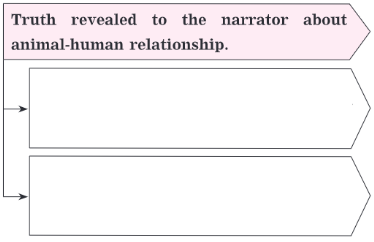
A3. Activities based on Vocabulary:
Match the words in column 'A' with their meanings in column 'B':
| Column 'A' | Column 'B' |
| (1) to be overwhelmed by | (a) to do something that makes people feel to have sympathy with. |
| (2) in a flash | (b) very quickly |
| (3) strike the right chord | (c) belief felt equally by both people involved. |
| (4) mutual trust | (d) to be affected emotionally in a powerful way. |
A4. Activities based on Contextual Grammar:
Rewrite the sentences as per the tenses mentioned in the brackets:
(1) The mother langur looked straight into my eyes. (Simple Present Tense.)
(2) She surveyed the area for the vicious male langur. (Simple Future Tense.)
A5. Personal Response:
(1) What did the mother langur seem to convey to the narrator?
A1. Simple Factual Activity:
Complete the sentences with the help of the information in the passage:
(1) For reducing weight, exercise, diet and stress- free thoughts should be _______________.
(2) Vision, wishes, intentions and dreams spark off imagination and encourage us _______________.
Time-bound: Establish time parameters around each goal, as it will help increase focus and accountability. To reduce weight we know how to go about it. But without consistent time - bound action, it never becomes a reality. It may be exercise, diet and stress-free thoughts. All these have to be practised and implemented without hesitation, doubt or indifference, but within a deadline.
Visions, wishes, intentions and dreams are all valuable. They spark off imagination and encourage us to define where we want to reach. In order to get there, however, we need to bring life images, down to earth and plan to execute our strategies. The quality and quantity of energy we put forth, directly impact the results. Life is something like a trumpet. If we don’t put anything in, we can’t get anything out.
Success is a walk in the dark. Finding the right footing, precisely mastering the skills and getting to the next place, all depend on how we approach and
tackle the problem. The best way to get from where we are, to where we want to be is to find the footing of our next step. When we take the next step, it should support and hold us without a crack.
A2. Complex Factual Activity:
Complete the web:
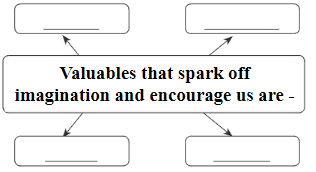
A3. Activities based on Vocabulary:
Write antonyms for the following words :
(1) wrong ×
(2) decrease ×
(3) discourage ×
(4) light ×
A4. Activities based on Contextual Grammar:
(1) Establish time parameters around each goal. (Rewrite the sentence beginning with 'Let' and change the sentence into passive voice.)
(2) If we don't put anything in, we can't get anything out. (Rewrite the sentence using 'unless' in the beginning.)
A5. Personal Response:
(1) Write any four qualities of a successful person.
Complete the sentences with the help of the information in the passage:
(1) For reducing weight, exercise, diet and stress- free thoughts should be _______________.
(2) Vision, wishes, intentions and dreams spark off imagination and encourage us _______________.
Time-bound: Establish time parameters around each goal, as it will help increase focus and accountability. To reduce weight we know how to go about it. But without consistent time - bound action, it never becomes a reality. It may be exercise, diet and stress-free thoughts. All these have to be practised and implemented without hesitation, doubt or indifference, but within a deadline.
Visions, wishes, intentions and dreams are all valuable. They spark off imagination and encourage us to define where we want to reach. In order to get there, however, we need to bring life images, down to earth and plan to execute our strategies. The quality and quantity of energy we put forth, directly impact the results. Life is something like a trumpet. If we don’t put anything in, we can’t get anything out.
Success is a walk in the dark. Finding the right footing, precisely mastering the skills and getting to the next place, all depend on how we approach and
tackle the problem. The best way to get from where we are, to where we want to be is to find the footing of our next step. When we take the next step, it should support and hold us without a crack.
A2. Complex Factual Activity:
Complete the web:
A3. Activities based on Vocabulary:
Write antonyms for the following words :
(1) wrong ×
(2) decrease ×
(3) discourage ×
(4) light ×
A4. Activities based on Contextual Grammar:
(1) Establish time parameters around each goal. (Rewrite the sentence beginning with 'Let' and change the sentence into passive voice.)
(2) If we don't put anything in, we can't get anything out. (Rewrite the sentence using 'unless' in the beginning.)
A5. Personal Response:
(1) Write any four qualities of a successful person.
A1. Simple Factual Activities:
Complete the following sentences:
(1) Meena stayed alone as _______________.
(2) Meena had the habit of _______________.
Meena is a good friend of mine. She is an LIC officer earning a good salary. But there was always something strange about her. She was forever unhappy. Whenever I met her, I would start to feel depressed. It was as though her gloom and cynicism had a way of spreading to others. She never had anything positive to say on any subject or about any person.
For instance, I might say to her, ‘Meena, did you know Rakesh has come first in his school ?’
Meena’s immediate response would be to belittle the achievement. ‘Naturally, his father is a school teacher’, she would say.
If I said, ‘Meena, Shwetha is a very beautiful girl, isn’t she ?’ Meena would be pessimistic. ‘When a pony is young, he looks handsome. It is age that matters. Wait for some time. Shwetha will be uglier than anyone you know.’
‘Meena, it’s a beautiful day. Let’s go for a walk’.
‘No, the sun is too hot and I get tired if I walk too much. Besides, who says walking is good for health ? There’s no proof.’
That was Meena. She stayed alone in an apartment as her parents lived in Delhi. She was an only child and had the habit of complaining about anything and everything. Naturally, she wasn’t a very pleasant company and nobody wanted to visit her. Then one day, Meena was transferred to Bombay and soon we all forgot about her.
Many years later, I found myself caught in the rain at Bombay’s Flora Fountain. It was pouring and I didn’t have an umbrella. I was standing near Akbarallys, a popular department store, waiting for the rain to subside. Suddenly, I spotted Meena. My first reaction was to run, even in that pouring rain. I was anxious to avoid being seen by her, having to listen to her never-ending complaints. However, I couldn’t escape. She had already seen me and caught hold of my hand warmly. What’s more, she was very cheerful.
‘Hey ! I am really excited. It’s nice to meet old friends. What are you doing here ?’
I explained that I was in Bombay on an official work.
A2. Complex Factual Activities:
(1) What was Meena's nature like?
A3. Activities based on Vocabulary:
Find similar words:
(1) pleasant -
(2) heavy rainfall -
(3) well known -
(4) noticed -
A4. Activities based on Contextual Grammar:
Make the following sentences negative:
(1) She was forever unhappy.
(2) Meena was a pessimistic girl.
A5. Personal Response:
(1) In your opinion, how should a friend be?
Complete the following sentences:
(1) Meena stayed alone as _______________.
(2) Meena had the habit of _______________.
Meena is a good friend of mine. She is an LIC officer earning a good salary. But there was always something strange about her. She was forever unhappy. Whenever I met her, I would start to feel depressed. It was as though her gloom and cynicism had a way of spreading to others. She never had anything positive to say on any subject or about any person.
For instance, I might say to her, ‘Meena, did you know Rakesh has come first in his school ?’
Meena’s immediate response would be to belittle the achievement. ‘Naturally, his father is a school teacher’, she would say.
If I said, ‘Meena, Shwetha is a very beautiful girl, isn’t she ?’ Meena would be pessimistic. ‘When a pony is young, he looks handsome. It is age that matters. Wait for some time. Shwetha will be uglier than anyone you know.’
‘Meena, it’s a beautiful day. Let’s go for a walk’.
‘No, the sun is too hot and I get tired if I walk too much. Besides, who says walking is good for health ? There’s no proof.’
That was Meena. She stayed alone in an apartment as her parents lived in Delhi. She was an only child and had the habit of complaining about anything and everything. Naturally, she wasn’t a very pleasant company and nobody wanted to visit her. Then one day, Meena was transferred to Bombay and soon we all forgot about her.
Many years later, I found myself caught in the rain at Bombay’s Flora Fountain. It was pouring and I didn’t have an umbrella. I was standing near Akbarallys, a popular department store, waiting for the rain to subside. Suddenly, I spotted Meena. My first reaction was to run, even in that pouring rain. I was anxious to avoid being seen by her, having to listen to her never-ending complaints. However, I couldn’t escape. She had already seen me and caught hold of my hand warmly. What’s more, she was very cheerful.
‘Hey ! I am really excited. It’s nice to meet old friends. What are you doing here ?’
I explained that I was in Bombay on an official work.
A2. Complex Factual Activities:
(1) What was Meena's nature like?
A3. Activities based on Vocabulary:
Find similar words:
(1) pleasant -
(2) heavy rainfall -
(3) well known -
(4) noticed -
A4. Activities based on Contextual Grammar:
Make the following sentences negative:
(1) She was forever unhappy.
(2) Meena was a pessimistic girl.
A5. Personal Response:
(1) In your opinion, how should a friend be?
A1. Simple Factual Activity:
Fill in the blanks and complete the sentences:
(1) The number of World Heritage Sites in 2009 were _______________.
(2) _______________ of the World Heritage Sites are considered mixed.
TYPES OF WORLD HERITAGE SITES
As of 2009, there are 890 World Heritage Sites that are located in 148 countries (map). 689 of these sites are cultural and include places like the Sydney Opera House in Australia and the Historic Center of Vienna in Austria. 176 are natural and feature such locations as the U.S.'s Yellowstone and Grand Canyon National Parks. 25 of the World Heritage Sites are considered mixed i.e. natural and cultural Peru's Machu Picchu is one of these. Italy has the highest number of World Heritage Sites with 44.
India has 36 (28 cultural, 7 natural and 1 mixed) World Heritage Sites. The World Heritage Committee has divided the world’s countries into five geographic zones which include (1) Africa, (2) Arab States, (3) Asia Pacific (including Australia and Oceania), (4)
Europe and North America and (5) Latin America and the Caribbean.
WORLD HERITAGE SITES IN DANGER
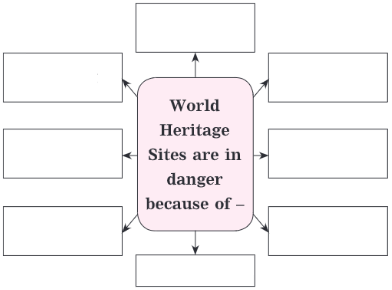
Like many natural and historic cultural sites around the world, many World Heritage Sites are in danger of being destroyed or lost due to war, poaching, natural disasters like earthquakes, uncontrolled urbanization, heavy tourist traffic and environmental factors like air pollution and acid rain. World Heritage Sites that are in danger are inscribed on a separate List of World Heritage Sites in Danger which allows the World Heritage Committee to allocate resources from the World Heritage Fund to that site. In addition, different plans are put into place to protect and/or restore the site. If however, a site loses the characteristics which allowed for it to be originally included on the World Heritage List, the World Heritage Committee can choose to delete the site from the list. To learn more about World Heritage Sites, visit the World Heritage Centre’s website at whc.unesco.org.
A2. Complex Factual Activity:
Complete the following Web by giving reasons why World Heritage sites are in danger :
A3. Activities based on Vocabulary:
Find from the passage the nouns of the following:
(1) locate
(2) urbanize
(3) pollute
(4) add
A4. Activities based on Contextual Grammar:
Write the following sentences using 'not only... but also' and 'as well as' in two separate sentences:
(1) Opera House in Australia and the Historic Center of Vienna in Austria are cultural sites of the World Heritage.
A5. Personal Response:
(1) What is the role of the 'World Heritage Sites' in promoting tourism in any country?
Fill in the blanks and complete the sentences:
(1) The number of World Heritage Sites in 2009 were _______________.
(2) _______________ of the World Heritage Sites are considered mixed.
TYPES OF WORLD HERITAGE SITES
As of 2009, there are 890 World Heritage Sites that are located in 148 countries (map). 689 of these sites are cultural and include places like the Sydney Opera House in Australia and the Historic Center of Vienna in Austria. 176 are natural and feature such locations as the U.S.'s Yellowstone and Grand Canyon National Parks. 25 of the World Heritage Sites are considered mixed i.e. natural and cultural Peru's Machu Picchu is one of these. Italy has the highest number of World Heritage Sites with 44.
India has 36 (28 cultural, 7 natural and 1 mixed) World Heritage Sites. The World Heritage Committee has divided the world’s countries into five geographic zones which include (1) Africa, (2) Arab States, (3) Asia Pacific (including Australia and Oceania), (4)
Europe and North America and (5) Latin America and the Caribbean.
WORLD HERITAGE SITES IN DANGER
Like many natural and historic cultural sites around the world, many World Heritage Sites are in danger of being destroyed or lost due to war, poaching, natural disasters like earthquakes, uncontrolled urbanization, heavy tourist traffic and environmental factors like air pollution and acid rain. World Heritage Sites that are in danger are inscribed on a separate List of World Heritage Sites in Danger which allows the World Heritage Committee to allocate resources from the World Heritage Fund to that site. In addition, different plans are put into place to protect and/or restore the site. If however, a site loses the characteristics which allowed for it to be originally included on the World Heritage List, the World Heritage Committee can choose to delete the site from the list. To learn more about World Heritage Sites, visit the World Heritage Centre’s website at whc.unesco.org.
A2. Complex Factual Activity:
Complete the following Web by giving reasons why World Heritage sites are in danger :
A3. Activities based on Vocabulary:
Find from the passage the nouns of the following:
(1) locate
(2) urbanize
(3) pollute
(4) add
A4. Activities based on Contextual Grammar:
Write the following sentences using 'not only... but also' and 'as well as' in two separate sentences:
(1) Opera House in Australia and the Historic Center of Vienna in Austria are cultural sites of the World Heritage.
A5. Personal Response:
(1) What is the role of the 'World Heritage Sites' in promoting tourism in any country?
A1. Simple Factual Activities:
Name the following:
(1) Original name of Madame Curie.
(2) Her place of birth.
The history of men’s progress from the darkness of ignorance to the glorious light of knowledge and enlightenment is full of chapters that tell of extraordinary men and women. These men and women worked with great courage, commitment, dedication and singleness of purpose in their effort to attain what seemed to be unattainable. These men and women were driven in their effort to uncover the truth and mystery of the universe with an indomitable spirit which characterises the human spirit. And this is the spirit that drove Columbus and Vasco de Gama to sail to the unknown seas, Robert Peary to race to the Pole, Sir Ronald Ross to fight against malaria, Hillary and Tenzing to reach the top of Everest, and Armstrong and his team to go to the moon.
One great woman who dedicated her life to the cause of science and to the welfare of humanity is Madame Curie, the discoverer of radium. The mere statement that Madame Curie discovered the radium will never tell the true story of the extraordinary courage, determination and singleness of purpose that this noble woman showed in the face of extreme poverty, pain and suffering that comes along with such condition.
Born Maria Sklodowska in Warsaw, Poland on November, 7 1867, Marie Curie’s childhood dream was to study science in Paris, but her father could not afford the expense for this. So Maria took a job as a governess and saved a little money. With that little money she finally went to Sorbonne, the University of Paris, to study science. Her father could send her only a small amount and her life in the university was a disheartening experience in poverty and hunger. She lived only on bread, butter and tea, and she often fainted for lack of food. In spite of all this she pursued her studies indomitably and she topped her class with Honours in Physics and Mathematics.
It was at the university that she met a Frenchman, Pierre Curie, a brilliant but poor scientist. Then they together began to work in a shabby laboratory. Soon, their friendship turned into love and in less than a year, in July, 1895, they were married. The couple then took a flat in Paris with scarcely any furniture in it except their books, a lamp, a white wooden table and two chairs.
After the birth of a daughter, Irene, the next year, Marie and Pierre set up a laboratory in a wooden shed near their flat, It had a leaky skylight and an earthen floor. Here Marie, after her daily household work, settled down to study.
A2. Complex Factual Activities:
Complete the following sentences:
(1) Madame Curie dedicated her life to the cause _______________ and to the _______________.
(2) The qualities that great achievers possess are _______________ and _______________.
A3. Activities based on Vocabulary:
Find out the words from the passage which mean:
(1) unbeatable
(2) discouraging
(3) hardly
(4) illiteracy
A4. Activities based on Contextual Grammar:
(1) took a job as a governess and saved a little money. (Rewrite using 'by' + ing.)
(2) Marie Curie's childhood dream was to study science in Paris, but her father could not afford the expense for this. (Rewrite using "Though')
A5. Personal Response:
(1) Describe your favourite scientist.
Name the following:
(1) Original name of Madame Curie.
(2) Her place of birth.
The history of men’s progress from the darkness of ignorance to the glorious light of knowledge and enlightenment is full of chapters that tell of extraordinary men and women. These men and women worked with great courage, commitment, dedication and singleness of purpose in their effort to attain what seemed to be unattainable. These men and women were driven in their effort to uncover the truth and mystery of the universe with an indomitable spirit which characterises the human spirit. And this is the spirit that drove Columbus and Vasco de Gama to sail to the unknown seas, Robert Peary to race to the Pole, Sir Ronald Ross to fight against malaria, Hillary and Tenzing to reach the top of Everest, and Armstrong and his team to go to the moon.
One great woman who dedicated her life to the cause of science and to the welfare of humanity is Madame Curie, the discoverer of radium. The mere statement that Madame Curie discovered the radium will never tell the true story of the extraordinary courage, determination and singleness of purpose that this noble woman showed in the face of extreme poverty, pain and suffering that comes along with such condition.
Born Maria Sklodowska in Warsaw, Poland on November, 7 1867, Marie Curie’s childhood dream was to study science in Paris, but her father could not afford the expense for this. So Maria took a job as a governess and saved a little money. With that little money she finally went to Sorbonne, the University of Paris, to study science. Her father could send her only a small amount and her life in the university was a disheartening experience in poverty and hunger. She lived only on bread, butter and tea, and she often fainted for lack of food. In spite of all this she pursued her studies indomitably and she topped her class with Honours in Physics and Mathematics.
It was at the university that she met a Frenchman, Pierre Curie, a brilliant but poor scientist. Then they together began to work in a shabby laboratory. Soon, their friendship turned into love and in less than a year, in July, 1895, they were married. The couple then took a flat in Paris with scarcely any furniture in it except their books, a lamp, a white wooden table and two chairs.
After the birth of a daughter, Irene, the next year, Marie and Pierre set up a laboratory in a wooden shed near their flat, It had a leaky skylight and an earthen floor. Here Marie, after her daily household work, settled down to study.
A2. Complex Factual Activities:
Complete the following sentences:
(1) Madame Curie dedicated her life to the cause _______________ and to the _______________.
(2) The qualities that great achievers possess are _______________ and _______________.
A3. Activities based on Vocabulary:
Find out the words from the passage which mean:
(1) unbeatable
(2) discouraging
(3) hardly
(4) illiteracy
A4. Activities based on Contextual Grammar:
(1) took a job as a governess and saved a little money. (Rewrite using 'by' + ing.)
(2) Marie Curie's childhood dream was to study science in Paris, but her father could not afford the expense for this. (Rewrite using "Though')
A5. Personal Response:
(1) Describe your favourite scientist.
A1. Simple Factual Activities:
Choose the correct alternative and complete the following sentences:
(1) Bholi is compared with _______________.
(a) a dumb cow (b) a kind cow (c) a dead cow
(2) _______________ was not ready to get married.
(a) Bishamber (b) Bholi (c) Bholi's friend
The bridegroom lifted the garland of yellow marigolds. A woman slipped back the silken veil from the bride’s face. Bishamber took a quick glance. The garland remained poised in his hands. The bride slowly pulled down the veil over her face.
“Have you seen her ?” said Bishamber to the friend next to him. “She has pockmarks on her face.”
“So what ? You are not young either.”
“Maybe. But if I am to marry her, her father must give me five thousand rupees.”
Ramlal went and placed his turban - his honour - at Bishamber’s feet. “Do not humiliate me so. Take two thousand rupees.”
“No. Five thousand, or we go back. Keep your daughter.”
“Be a little considerate, please. If you go back, I can never show my face in the village.”
“Then out with five thousand.”
Tears streaming down his face, Ramlal went in, opened the safe and counted out the notes. He placed the bundle at the bridegroom’s feet.
On Bishamber’s greedy face appeared a triumphant smile. He had gambled and won. “Give me the garland,” he announced.
Once again the veil was slipped back from the bride face but this time her eyes were not downcast. She was looking up, looking straight at her prospective husband, and in her eyes there was neither anger nor hate, only cold contempt.
Bishamber raised the garland to place it round the bride’s neck but before he could do so, Bholi’s hand struck out like a streak of lightening and garland was flung into the fire. She got up and threw away the veil.
“Pitaji” said Bholi in a clear loud voice; and her father, mother, sisters, brothers, relations and neighbours were startled to hear her speak without even the slightest stammer.
“Pitaji”, take back your money. I am not going to marry this man.”
Ramlal was thunderstruck. The guests began to whisper, “So shameless! So ugly and so shameless !”
“Bholi, are you crazy ?” shouted Ramlal. “You want to disgrace your family? Have some regard for out izzat!”
“For the sake of your izzat,” said Bholi, “I was willing to marry this lame old man. But I will not have such a mean, greedy and contemptible coward as my husband. I won’t, I won’t, I won’t.”
What a shameless girl! We all thought she was a harmless dumb cow.”
A2. Complex Factual Activities:
(1) What shocked the family members?
A3. Activities based on Vocabulary:
Find out synonyms from the passage for the following words:
(1) humiliate
(2) contempt
(3) prospective
(4) startled
A4. Activities based on Contextual Grammar:
Rewrite the following into indirect speech:
(1) "Be a little considerate, please. If you go back, I can never show my face in the village." "Then out with five thousand."
(2) "Pitaji, take back your money. I am not going to marry this man." "Bholi, are you crazy?" shouted Ramlal.
A5. Personal Response:
(1) What did you learn from Bholi's action of not getting married to Bishamber?
Choose the correct alternative and complete the following sentences:
(1) Bholi is compared with _______________.
(a) a dumb cow (b) a kind cow (c) a dead cow
(2) _______________ was not ready to get married.
(a) Bishamber (b) Bholi (c) Bholi's friend
The bridegroom lifted the garland of yellow marigolds. A woman slipped back the silken veil from the bride’s face. Bishamber took a quick glance. The garland remained poised in his hands. The bride slowly pulled down the veil over her face.
“Have you seen her ?” said Bishamber to the friend next to him. “She has pockmarks on her face.”
“So what ? You are not young either.”
“Maybe. But if I am to marry her, her father must give me five thousand rupees.”
Ramlal went and placed his turban - his honour - at Bishamber’s feet. “Do not humiliate me so. Take two thousand rupees.”
“No. Five thousand, or we go back. Keep your daughter.”
“Be a little considerate, please. If you go back, I can never show my face in the village.”
“Then out with five thousand.”
Tears streaming down his face, Ramlal went in, opened the safe and counted out the notes. He placed the bundle at the bridegroom’s feet.
On Bishamber’s greedy face appeared a triumphant smile. He had gambled and won. “Give me the garland,” he announced.
Once again the veil was slipped back from the bride face but this time her eyes were not downcast. She was looking up, looking straight at her prospective husband, and in her eyes there was neither anger nor hate, only cold contempt.
Bishamber raised the garland to place it round the bride’s neck but before he could do so, Bholi’s hand struck out like a streak of lightening and garland was flung into the fire. She got up and threw away the veil.
“Pitaji” said Bholi in a clear loud voice; and her father, mother, sisters, brothers, relations and neighbours were startled to hear her speak without even the slightest stammer.
“Pitaji”, take back your money. I am not going to marry this man.”
Ramlal was thunderstruck. The guests began to whisper, “So shameless! So ugly and so shameless !”
“Bholi, are you crazy ?” shouted Ramlal. “You want to disgrace your family? Have some regard for out izzat!”
“For the sake of your izzat,” said Bholi, “I was willing to marry this lame old man. But I will not have such a mean, greedy and contemptible coward as my husband. I won’t, I won’t, I won’t.”
What a shameless girl! We all thought she was a harmless dumb cow.”
A2. Complex Factual Activities:
(1) What shocked the family members?
A3. Activities based on Vocabulary:
Find out synonyms from the passage for the following words:
(1) humiliate
(2) contempt
(3) prospective
(4) startled
A4. Activities based on Contextual Grammar:
Rewrite the following into indirect speech:
(1) "Be a little considerate, please. If you go back, I can never show my face in the village." "Then out with five thousand."
(2) "Pitaji, take back your money. I am not going to marry this man." "Bholi, are you crazy?" shouted Ramlal.
A5. Personal Response:
(1) What did you learn from Bholi's action of not getting married to Bishamber?