Questions

Read passage and do the activities: [10M][TEXTUAL]

Take a timed test

13 questions · self-marked practice — reveal the answer and mark yourself.

Question 110 Marks
A1. Simple Factual Activities:
State whether the following statements are Right or Wrong:
(1) We should have vision for today not tomorrow.
(2) If we close our eyes and feel the child inside us, we can listen to that child.
(3) Mahatına Gandhi, Nelson Mandela and Martin Luther King are calling on us.
(4) Satyarthi's vision of tomorrow is to see that cobbler's boy sitting with him in his classroom.

     As a child, I had a vision of tomorrow. A vision of that cobbler boy sitting with me in my classroom.
     Now, that tomorrow has become TODAY.
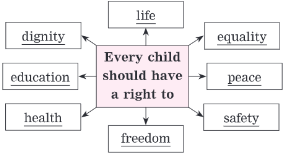
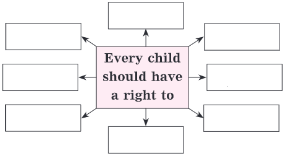
     I am TODAY, and you are TODAY. TODAY it is time for every child to have a right to life, right to freedom, right to health, right to education, right to safety, right to dignity, right to equality, and right to peace.
     TODAY, beyond the darkness, I see the smiling faces of our children in the blinking stars. TODAY, in every wave of every ocean, I see my children are playing and dancing. TODAY, in every plant, in every tree, and mountain, I see our children growing freely with dignity.
     Friends, I want you to see and feel this TODAY inside you.
     My dear sisters and brothers, as I said many interesting things are happening today. May I please request you to put your hand close to your heart - close your eyes and feel the child inside you?
     I am sure you can - Now, listen to that child.Listen please.
     Today, I see thousands of Mahatma Gandhis, Nelson Mandelas and Martin Luther Kings calling on us.
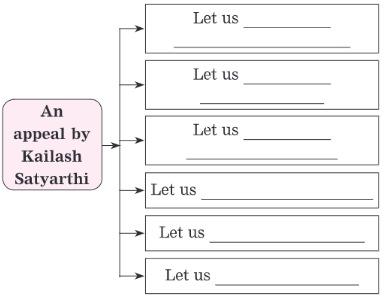
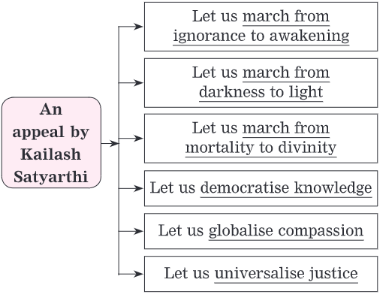
     Let us democratise knowledge. Let us universalise justice. Together, let us globalise compassion!
     I call upon you in this room, and all across the world. I call for a march from exploitation to education, I call for a march from poverty to shared prosperity, a march from slavery to liberty, and a march from violence to peace.
     Let us march from ignorance to awakening. Let us march from darkness to light. Let us march from mortality to divinity.
     Let us march!  

A2. Complex Factual Activities:
Complete the following web-chart :
Image
A3. Activities based on Vocabulary:
Write the infinitive forms of the following and use any two of them in your own sentences:
(1) dancing
(2) playing
(3) growing 
(4) happening 
A4. Activities based on Contextual Grammar:
Make nouns of the following:
(1) universal
(2) global
(3) knowledge
(4) exploitation
A5. Personal Response:
(1) What do you mean by 'Every child has a right to life'? 
Answer
A1. Simple Factual Activities:
(1) Right
(2) Right
(3) Right
(4) Right
A2. Complex Factual Activities:
Image
A3. Activities based on Vocabulary:
(1) dancing - to dance
(2) playing - to play
(3) growing - to grow
(4) happening - to happen
Sentences:
(1) Anish wanted to dance in the procession but his father did not allow him.
(2) It is our duty to grow more and more trees to save the planet Earth.
A4. Activities based on Contextual Grammar:
(1) universal - universalize
(2) global - globalize
(3) knowledge - know
(4) exploitation - exploit
A5. Personal Response:
(1) The right to life is a moral principle based on the belief that a human being has the right to live. Every child has some inherent right to life which is protected by laws. No one shall be arbitrarily deprived of his life. So it is our duty to protect every child and help him/her to live a happy and healthy life.
View full question & answer
Question 210 Marks
A1. Simple Factual Activities:
Image

     As a child, I had a vision of tomorrow. A vision of that cobbler boy sitting with me in my classroom.
     Now, that tomorrow has become TODAY.
     I am TODAY, and you are TODAY. TODAY it is time for every child to have a right to life, right to freedom, right to health, right to education, right to safety, right to dignity, right to equality, and right to peace.
     TODAY, beyond the darkness, I see the smiling faces of our children in the blinking stars. TODAY, in every wave of every ocean, I see my children are playing and dancing. TODAY, in every plant, in every tree, and mountain, I see our children growing freely with dignity.
     Friends, I want you to see and feel this TODAY inside you.
     My dear sisters and brothers, as I said many interesting things are happening today. May I please request you to put your hand close to your heart - close your eyes and feel the child inside you?
     I am sure you can - Now, listen to that child.Listen please.
     Today, I see thousands of Mahatma Gandhis, Nelson Mandelas and Martin Luther Kings calling on us.
     Let us democratise knowledge. Let us universalise justice. Together, let us globalise compassion!
     I call upon you in this room, and all across the world. I call for a march from exploitation to education, I call for a march from poverty to shared prosperity, a march from slavery to liberty, and a march from violence to peace.
     Let us march from ignorance to awakening. Let us march from darkness to light. Let us march from mortality to divinity.
     Let us march!  

A2. Complex Factual Activities:
Complete the following:
The writer calls all the listeners for a march.
from → _______________ to → education
from → poverty to → _______________
from → slavery to → _______________
from → _______________ to → peace
from → _______________ to → awakening
from → darkness to → _______________
from → mortality to → _______________
A3. Activities based on Vocabulary:
(1) ignorance × _______________
(2) immortality × _______________
(3) deny × _______________
(4) recognised × _______________
A4. Activities based on Contextual Grammar:
Make nouns of the following:
(1) play (2) grow (3) globalise (4) violent
A5. Personal Response:

(1) What is your vision of tomorrow? 
Answer
A1. Simple Factual Activities:
Image
A2. Complex Factual Activities:
The writer calls all the listeners for a march.
from → exploitation to → education
from → poverty to → shared prosperity
from → slavery to → liberty
from → violence to → peace
from → ignorance to → awakening
from → darkness to → light
from → mortality to → divinity
A3. Activities based on Vocabulary:
(1) ignorance × knowledge
(2) immortality × mortality
(3) deny × admit
(4) recognised × unrecognised
A4. Activities based on Contextual Grammar:
(1) play - play, player
(2) grow - growth
(3) globalise - globe, globalisation
(4) violent violence
A5. Personal Response:
(1) My vision for tomorrow is to empower the people with a vision to have the confidence and ability to achieve their dream. If I help them to gain their confidence, they will work hard to achieve their goal. Ultimately they will help the nation to prosper.
View full question & answer
Question 310 Marks
A1. Simple Factual Activities:
Make a list of the problems that we are facing and creating violence against children -

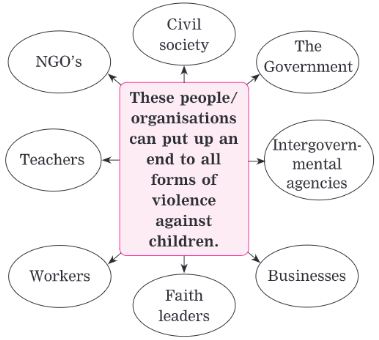
     I call upon all the governments, intergovernmental agencies, businesses, faith leaders, workers, teachers and NGOs, and each one of us, to put an end to all forms of violence against children. Slavery, trafficking, child marriages, child labour, sexual abuse, and illiteracy these things have no place in any civilised society.
     Friends, we can do this. Governments must make child - friendly policies, and invest in education and young people. Businesses must be more responsible, accountable and open to innovative partnerships.Intergovernmental agencies must work together to accelerate action. Global civil society must rise above the business-as-usual and fragmented agendas. Faith leaders and institutions, and all of us must stand with our children.
     We must be bold, we must be ambitious, and we must have the will. We must keep our promises. Over fifty years ago, on the first day of my school, I met a cobbler boy, my age sitting outside the gate of my school. I asked my teachers: “Why is he working outside? Why is he not with us in the school?” My teachers had no answer. One day, I
gathered the courage to ask the boys’ father. He said: “Sir, I have never thought about it. We are born to work.”
     His answer made me angry. It still makes me angry.

A2. Complex Factual Activities:
Image
A3. Activities based on Vocabulary:

Find out the describing words used for the following noun and make your own sentences by using any combination:
(1) _______________ agencies
(2) _______________ partnership
A4. Activities based on Contextual Grammar:
Make the sentences affirmative:
(1) My teacher had no answer.
(2) I have never thought about it.
A5. Personal Response:
(1) Why should we stop 'Child labour'?
Answer
A1. Simple Factual Activities:
(1) slavery  (2) trafficking  (3) child marriage
(4) child labour  (5) sexual abuse  (6) illiteracy
A2. Complex Factual Activities:
Image
A3. Activities based on Vocabulary:
(1) intergovernmental agencies
(2) innovative partnership
Sentence: In a developing country like India, intergovernmental agencies play important role in the process of development.
A4. Activities based on Contextual Grammar:
(1) My teacher was speechless.
(2) I have always ignored it.
A5. Personal Response:
(1) 'Child labour' is a stigma on our society. It is sure to interfere with his/her right to education. It is also harmful to their physical, mental, spiritual, moral and social development. It is harmful to the development of any country, as the child is the future citizen of every country. So we should stop child labour and child exploitation.
View full question & answer
Question 410 Marks
A1. Simple Factual Activities:
Make a list of the problems that we are facing and creating violence against children -

     I call upon all the governments, intergovernmental agencies, businesses, faith leaders, workers, teachers and NGOs, and each one of us, to put an end to all forms of violence against children. Slavery, trafficking, child marriages, child labour, sexual abuse, and illiteracy these things have no place in any civilised society.
     Friends, we can do this. Governments must make child - friendly policies, and invest in education and young people. Businesses must be more responsible, accountable and open to innovative partnerships.Intergovernmental agencies must work together to accelerate action. Global civil society must rise above the business-as-usual and fragmented agendas. Faith leaders and institutions, and all of us must stand with our children.
     We must be bold, we must be ambitious, and we must have the will. We must keep our promises. Over fifty years ago, on the first day of my school, I met a cobbler boy, my age sitting outside the gate of my school. I asked my teachers: “Why is he working outside? Why is he not with us in the school?” My teachers had no answer. One day, I
gathered the courage to ask the boys’ father. He said: “Sir, I have never thought about it. We are born to work.”
     His answer made me angry. It still makes me angry.

A2. Complex Factual Activities:
Complete the following sentences :
(1) Government should make _______________.
(2) _______________ and _______________ must stand with our children.
A3. Activities based on Vocabulary:
Find out the describing words used for the following noun and make your own sentences by using any combination:
(1) _______________ agencies
(2) _______________ partnership
A4. Activities based on Contextual Grammar:
Rewrite as indirect speech:
(1) I asked my teachers, "Why is he working outside? Why is he not with us in the school?"
(2) The boy's father said to the writer, "I have never thought about it. We are born to work."
A5. Personal Response:
(1) Why should the government invest in education and young people?
Answer
A1. Simple Factual Activities:
(1) slavery  (2) trafficking  (3) child marriage
(4) child labour  (5) sexual abuse  (6) illiteracy
A2. Complex Factual Activities:
(1) Government should make child-friendly policies and invest in education and young people.
(2) Faith leaders, institutions and all of us must stand with our children.
A3. Activities based on Vocabulary:
(1) intergovernmental agencies
(2) innovative partnership
Sentence: In a developing country like India, intergovernmental agencies play important role in the process of development.
A4. Activities based on Contextual Grammar:
(1) I asked my teacher why he was working outside and why he was not with them in the school.
(2) The boy's father told the writer that he had never thought about it. He further told him that they were born to work.
A5. Personal Response:
(1) Education is the systematic process of gaining knowledge and skills. It has positive impact on our life. It also promotes national interest. It is the backbone of developing countries. If the governinent invests in education and young people, they help the nation to develop as they are called real nation builders and future of the country so the government should invest in education and young people.
View full question & answer
Question 510 Marks
A1. Simple Factual Activities:
Complete the sentences:
(1) A tiny bird was rushing towards _________.
(2) A heavy fire had broken out in the _________.
(3) The speaker is appealing to globalise _________.
(4) The tiny bird was going to _________.

     We can do it ...
     You may ask that - what can one person do? I would recall a story of my childhood: A heavy fire had broken out in the forest. All the animals were running away, including lion, the king of the forest. Suddenly, then he saw a tiny bird rushing towards the fire. He asked the bird, “What are you doing?” To the lion’s surprise, the bird replied “I am going to extinguish the fire.” The lion laughed and said, “How can you do it keeping just one drop of water, in your beak?” The bird was adamant, and she said, “I am doing my bit.”
     Eighteen years ago, millions of individuals marched across the globe. And demanded a new international law for the abolition of worst form of child labour, and it has happened, we did it, millions of individuals did it.
     Friends! We live in an age of rapid globalisation. We are connected through high-speed Internet. We exchange our goods and services in one single global market. Thousands of flights every day connect us from one corner to another corner of the globe. But there is one serious disconnect and there is a lack of compassion. Let us inculcate and transform these individuals’ compassion into a global compassion.
Let us globalise compassion.
     Mahatma Gandhi said, “If we are to teach real peace in this world... we shall have to begin with the children.” I humbly add, let us unite the world through the compassion for our children.
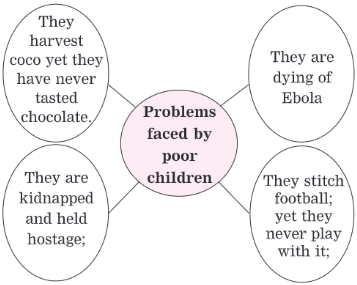
     I ask - Whose children are they who stitch footballs, yet never played with one?
     Whose children are they who harvest cocoa, yet have never tasted chocolate?
     Whose children are they who are dying of Ebola?
     Whose children are they who are kidnapped and held hostage?
     They are all our children.
     I remember an eight-year-old girl we rescued from intergenerational forced labour from stone quarries. When she was sitting in my car right after her rescue, she asked me: “Why did you not come earlier?”
     Her angry question still shakes me – and has the power to shake the whole world. Her question is for all of us. What are we doing? What are we waiting for? How many girls will we allow to go without rescue?
     Children are questioning our inaction and watching our actions. We need collective actions with a sense of urgency.
     Every single minute matters, every single child matters, every single childhood matters.
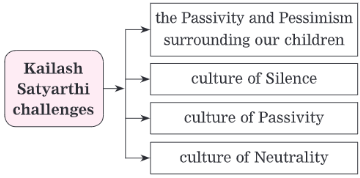
     Therefore, I challenge the passivity and pessimism surrounding our children. I challenge this culture of silence and this culture of passivity, this culture of neutrality.

A2. Complex Factual Activities:

Complete the following web:
Image

A3. Activities based on Vocabulary:
(1) Use the word 'stitch' as a Noun and a Verb in separate meaningful sentences.
A4. Activities based on Contextual Grammar:
Add a question tag:
(1) We are connected through high-speed internet.
(2) We exchange our goods and services in one single global market.
A5. Personal Response:
(1) What lesson does the story of the lion and the tiny bird teach us? 
Answer
A1. Simple Factual Activities:
(1) A tiny bird was rushing towards the fire.
(2) A heavy fire had broken out in the forest.
(3) The speaker is appealing to globalise compassion.
(4) The tiny bird was going to extinguish the fire.
A2. Complex Factual Activities:
Image
A3. Activities based on Vocabulary:

(1) The tailor was asked to stitch the clothes quickly. (verb)
(2) The wound needed eight stitches. (noun)
A4. Activities based on Contextual Grammar:
(1) We are connected through high-speed internet, aren't we?
(2) We exchange our goods and services in one single global market, don't we?
A5. Personal Response:
(1) I think the story of the lion and the tiny bird teaches us not to belittle other individials  who at least do something and make an effort. No matter how small it is in our eyes but it might be big in result. Small things shouldn't be valued too little sometimes. Big things always start from something small.
View full question & answer
Question 610 Marks
A1. Simple Factual Activities:
Answer in few words:
(1) The age in which we live -
(2) The serious disconnect of the world -
(3) We can unite the world through -
(4) Children are questioning and watching our-

     We can do it ...
     You may ask that - what can one person do? I would recall a story of my childhood: A heavy fire had broken out in the forest. All the animals were running away, including lion, the king of the forest. Suddenly, then he saw a tiny bird rushing towards the fire. He asked the bird, “What are you doing?” To the lion’s surprise, the bird replied “I am going to extinguish the fire.” The lion laughed and said, “How can you do it keeping just one drop of water, in your beak?” The bird was adamant, and she said, “I am doing my bit.”
     Eighteen years ago, millions of individuals marched across the globe. And demanded a new international law for the abolition of worst form of child labour, and it has happened, we did it, millions of individuals did it.
     Friends! We live in an age of rapid globalisation. We are connected through high-speed Internet. We exchange our goods and services in one single global market. Thousands of flights every day connect us from one corner to another corner of the globe. But there is one serious disconnect and there is a lack of compassion. Let us inculcate and transform these individuals’ compassion into a global compassion.
Let us globalise compassion.
     Mahatma Gandhi said, “If we are to teach real peace in this world... we shall have to begin with the children.” I humbly add, let us unite the world through the compassion for our children.
     I ask - Whose children are they who stitch footballs, yet never played with one?
     Whose children are they who harvest cocoa, yet have never tasted chocolate?
     Whose children are they who are dying of Ebola?
     Whose children are they who are kidnapped and held hostage?
     They are all our children.
     I remember an eight-year-old girl we rescued from intergenerational forced labour from stone quarries. When she was sitting in my car right after her rescue, she asked me: “Why did you not come earlier?”
     Her angry question still shakes me – and has the power to shake the whole world. Her question is for all of us. What are we doing? What are we waiting for? How many girls will we allow to go without rescue?
     Children are questioning our inaction and watching our actions. We need collective actions with a sense of urgency.
     Every single minute matters, every single child matters, every single childhood matters.
     Therefore, I challenge the passivity and pessimism surrounding our children. I challenge this culture of silence and this culture of passivity, this culture of neutrality.

A2. Complex Factual Activities:

Complete the following web:
Image

A3. Activities based on Vocabulary:
Find out the describing words used for the following nouns and make your own sentence by using any one combination:
(1) _______________ globalisation
(2) _______________ compassion
A4. Activities based on Contextual Grammar:
Change these sentences into indirect speech:
(1) The lion asked the bird, "What are you doing?"
(2) The bird said to the lion, "I am going to extinguish the fire."
A5. Personal Response:
(1) What will you do for our country?
Answer
A1. Simple Factual Activities:
(1) rapid globalisation
(2) lack of compassion
(3) the compassion for our children
(4) inactions and actions
A2. Complex Factual Activities:
Image
A3. Activities based on Vocabulary:

(1) rapid globalisation
(2) global compassion
Sentence: Due to rapid globalisation we have been facing number of problems.
A4. Activities based on Contextual Grammar:
(1) The lion asked the bird what it was doing.
(2) The bird told the lion that it was going to extinguish the fire.
A5. Personal Response:
(1) First I will try to take higher education. 1 will try to use that knowledge for the developement of our country as much as possible. I will also help the people to take education so that they will also help our country to prosper and become a developed country.
View full question & answer
Question 710 Marks
A1. Simple Factual Activities:
(1) Complete the following sentences:
Small groups, local organisations and individuals are  _______________ .
(2) Name the following:
The daughters of Kailash Satyarthi mentioned in this passage: 

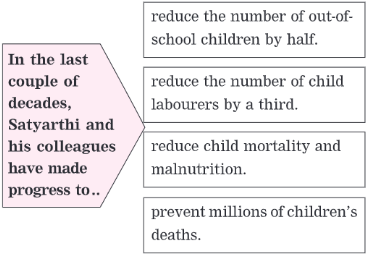
     We have made progress in the last couple of decades. We have reduced the number of out-ofschool children by half. We have reduced the number of child labourers by a third. We have reduced child mortality and malnutrition, and we have prevented millions of child deaths.
     But, let us make no mistake, great challenges still remain.
     Friends! The biggest challenge or biggest crisis knocking on the doors of humankind is fear and intolerance.
     We have utterly failed our children in imparting an education. An education that gives the meaning and objective of life. An education that gives a sense of global citizenship among the youth.
     I am afraid that the day is not very far away when the cumulative result of this failure, will culminate in an unprecedented violence, and that will be suicidal for humankind.
     Rights, security, hope can only be restored through education.
     Young people like Malala ... I’ve started calling her my daughter Malala not just Malala ... So my daughter Malala and other daughters including Kayanat.. in fact.. two Kayanats, and Shazia, and the daughters from Africa, and from all over the world. They are rising up and choosing peace over violence, tolerance over extremism, and courage over fear.
     The solutions are emerging. But these solutions cannot be found in the deliberations in conferences alone, and cannot be found in prescriptions from a distance.
     They lie in small groups and local organisations and individuals, who are confronting with the problem every day. Even if they remain unacknowledged, unrecognised and unknown to the world the solution are with them.

A2. Complex Factual Activities:
Complete the following web stating the sign of progress mentioned by Satyarthi :
Image
A3. Activities based on Vocabulary:

Find out the describing words used for the following nouns and make your own sentences by using any three combinations:
(1) challenges
(2) organisations
(3) citizenship
(4) groups
A4. Activities based on Contextual Grammar:

(1) Find out and write four sentences from the passage that are in Present Perfect Tense:
A5. Personal Response:
(1) What is the role of education in nation building? 
Answer
A1. Simple Factual Activities:
(1) Small groups, local organisations and individuals are confronting with the problem every day..
(2) Malala, Kayanat and Shazia
A2. Complex Factual Activities:
Image
A3. Activities based on Vocabulary:

(1) great challenges
(2) local organisations
(3) global citizenship
(4) small groups
Sentences:
(1) Global citizenship nurtures personal respect and respect for others.
A4. Activities based on Contextual Grammar:
(1) We have made progress in the last couple of decades.
(2) We have reduced the number of out of school children by half.
(3) We have reduced the child labourers by a third.
(4) We have prevented millions of child deaths.
A5. Personal Response:
(1) Education plays a very critical and crucial role in deciding the growth of a nation. Educated citizens of the country bring fame, wealth and prosperity to the country which helps in development of a country. People who are educated think and work to achieve the dream of any country. Education helps in dream building so education is a big invaluable asset in nation building.
View full question & answer
Question 810 Marks
A1. Simple Factual Activities:
Complete the following sentences:
(1) Even though we have made progress in the last couple of decades, we are facing _______________ .
(2) _______________ gives a sense of global citizenship among the youth.

     We have made progress in the last couple of decades. We have reduced the number of out-ofschool children by half. We have reduced the number of child labourers by a third. We have reduced child mortality and malnutrition, and we have prevented millions of child deaths.
     But, let us make no mistake, great challenges still remain.
     Friends! The biggest challenge or biggest crisis knocking on the doors of humankind is fear and intolerance.
     We have utterly failed our children in imparting an education. An education that gives the meaning and objective of life. An education that gives a sense of global citizenship among the youth.
     I am afraid that the day is not very far away when the cumulative result of this failure, will culminate in an unprecedented violence, and that will be suicidal for humankind.
     Rights, security, hope can only be restored through education.
     Young people like Malala ... I’ve started calling her my daughter Malala not just Malala ... So my daughter Malala and other daughters including Kayanat.. in fact.. two Kayanats, and Shazia, and the daughters from Africa, and from all over the world. They are rising up and choosing peace over violence, tolerance over extremism, and courage over fear.
     The solutions are emerging. But these solutions cannot be found in the deliberations in conferences alone, and cannot be found in prescriptions from a distance.
     They lie in small groups and local organisations and individuals, who are confronting with the problem every day. Even if they remain unacknowledged, unrecognised and unknown to the world the solution are with them.

A2. Complex Factual Activities:

(1) What are the children's issues highlighted by Kailash Satyarthi in this passage? 
A3. Activities based on Vocabulary:
Choose the correct option and write in front of the given word:
(1) culminate : _______________
(A) destroy (B) succeed (C) rise to a peak
(2) crisis:  _______________
(A) unstable situation(B) problems (C) difficulty
A4. Activities based on Contextual Grammar:

Complete the following sentences with the help of the sentence given below:
The biggest challenge knocking on the doors of humankind is fear and intolerance.
(1) No other challenge knocking _______________ is as big as _______________.
(2) Fear and intolerance are bigger than  ______________________________.
A5. Personal Response:
(1) What efforts will you take to enrol the out-of-school out-of children? 
Answer
A1. Simple Factual Activities:
(1) Even though we have made progress in the last couple of decades, we are facing great challenges.
(2) An education gives a sense of global citizenship among the youth.
A2. Complex Factual Activities:
(1) The children's issues highlighted by Kailash Satyarthi in this passage are-
- The burning problem in India-child labour.
- The Right of children to free and compulsory education.
- Mortality and malnutrition.
- Child labour as a human rights issue as well as a welfare matter and charitable cause.
A3. Activities based on Vocabulary:
(1) (C) rise to a peak
(2) (A) unstable situation 
A4. Activities based on Contextual Grammar:
(1) No other challenge knocking on the doors of humankind is as big as fear and intolerance.
(2) Fear and intolerance are bigger than any other challenge knocking on the doors of humankind.
A5. Personal Response:
(1) If I see any children out of school, I will tell them the importance of education in their life. I will also tell them about the Right of Children to Free and Compulsory Education. By convincing them I will help them to take admission in schools nearby so that they can stand and face the life independently and get success in their life. Also, I shall try to convince their parents to send their children to school
View full question & answer
Question 910 Marks
A1. Simple Factual Activities:
State whether you agree or disagree with the following statements:

 Group 'A' Group 'B'
 (1) A small, skinny child labourer (a) to care for our children
 (2) A Sudanese child- soldier (b) children's frightened and exhausted eyes
 (3) Satyarthi had looked into  (c) was forced to kill his friends and family
 (4) The great religions teach us (d) The world forced me to take a gun or a tool

    I have come here only to share the voices and dreams of our children - because they are all our children - [gesture to everyone in the audience]. I have looked into their frightened and exhausted eyes. I have held their injured bodies and felt their broken spirits.
    Twenty years ago, in the foothills of the Himalayas, I met a small, skinny child labourer. He asked me: “Is the world so poor that it cannot give me a toy and a book, instead of forcing me to take a gun or a tool?”
    I met with a Sudanese child-soldier. He was kidnapped by an extremist militia. As his first training lesson, he was forced to kill his friends and family. He asked me: “What is my fault?”
    Friends, all the great religions teach us to care for our children. Jesus said: “Let the children come to me; do not hinder them, for the kingdom of God belongs to them.” The Holy Quran says: “Kill not your children because of poverty.”
    Friends! There is no greater violence than to deny the dreams of our children. Therefore ... I refuse to accept that all the temples and mosques and churches and prayer houses have no place for the dreams of our children.
    I refuse to accept that the world is so poor, when just one week of global military expenditure can bring all the children to classrooms. I refuse to accept that all the laws and constitutions, police and judges are unable to protect our children.
    I refuse to accept that the shackles of slavery can ever be stronger than the quest for freedom. I REFUSE TO ACCEPT here.
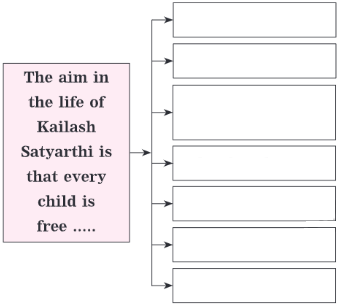
    My only aim in life is that every child is free to be a child,
- free to grow and develop,
- free to eat, sleep, and see daylight,
- free to laugh and cry,
- free to play and learn,
- free to go to school, and above all,
- free to dream.
    I have the privilege of working with many courageous people who have the same aim. We have never given up against any threat or attack and we never will.

A2. Complex Factual Activities:

Complete the following diagram/chart :
Image
A3. Activities based on Vocabulary:
Choose the correct option and write in front of the given word :
(1) extremist: _______________
(A) militant (B) robber (C) spy
(2) courageous: _______________
(A) cowards (B) brave (C) friendly
A4. Activities based on Contextual Grammar:

Rewrite the following into indirect speech:
(1) A skinny child labourer asked Satyarthi, "Is the world so poor that it cannot give me a toy and a book, instead of forcing me to take a gun or a tool?" 
A5. Personal Response:
What will you do in the following situations?
(1) If you find a child working on a brickwork site.
(2) If you come across a beggar child.

Answer
A1. Simple Factual Activities:
(1) A small, skinny child labourer - The world forced me to take a gun or a tool
(2) A Sudanese child soldier - was forced to kill his friends and family.
(3) Satyarthi  had looked into - children's frightened and exhausted eyes
(4) The great religions teach us - to care for our children
A2. Complex Factual Activities:
(1) that all the temples and mosques and churches and prayer houses have no place for the dreams of our children.
(2) just one week of global military expenditure can bring all the children to classrooms.
(3) All the laws and constitutions, police and judges are unable to protect our children.
(4) The shackles of slavery can be stronger than the quest for freedom.
A3. Activities based on Vocabulary:
(1) (A) militant
(2) (B) brave
Sentence: Extremist militia is an active force found in Sudan.
A4. Activities based on Contextual Grammar:
A skinny child labourer asked Satyarthi if the world was so poor that it could not give him a toy and a book, instead of forcing him to take a gun or a tool.
A5. Personal Response:
(1) I will tell his parents not to do so, instead to send him to a school nearby.
(2) I will tell the child, it is not good to beg. I will also tell him the importance of schooling and help him to go to school.
View full question & answer
Question 1010 Marks
A1. Simple Factual Activities:
State whether you agree or disagree with the following statements:
(1) The Holy Quran says the kingdom of God belongs to the children.
(2) Jesus says not to kill your children because of poverty.
(3) Denying the dreams of our children is greater violence.
(4) The writer has never given up against any threat or attack.

    I have come here only to share the voices and dreams of our children - because they are all our children - [gesture to everyone in the audience]. I have looked into their frightened and exhausted eyes. I have held their injured bodies and felt their broken spirits.
    Twenty years ago, in the foothills of the Himalayas, I met a small, skinny child labourer. He asked me: “Is the world so poor that it cannot give me a toy and a book, instead of forcing me to take a gun or a tool?”
    I met with a Sudanese child-soldier. He was kidnapped by an extremist militia. As his first training lesson, he was forced to kill his friends and family. He asked me: “What is my fault?”
    Friends, all the great religions teach us to care for our children. Jesus said: “Let the children come to me; do not hinder them, for the kingdom of God belongs to them.” The Holy Quran says: “Kill not your children because of poverty.”
    Friends! There is no greater violence than to deny the dreams of our children. Therefore ... I refuse to accept that all the temples and mosques and churches and prayer houses have no place for the dreams of our children.
    I refuse to accept that the world is so poor, when just one week of global military expenditure can bring all the children to classrooms. I refuse to accept that all the laws and constitutions, police and judges are unable to protect our children.
    I refuse to accept that the shackles of slavery can ever be stronger than the quest for freedom. I REFUSE TO ACCEPT here.
    My only aim in life is that every child is free to be a child,
- free to grow and develop,
- free to eat, sleep, and see daylight,
- free to laugh and cry,
- free to play and learn,
- free to go to school, and above all,
- free to dream.
    I have the privilege of working with many courageous people who have the same aim. We have never given up against any threat or attack and we never will.

A2. Complex Factual Activities:

Complete the following sentences:
(1) Satyarthi refuses to accept:
A3. Activities based on Vocabulary:
Find out the describing words used for the following nouns and make sentence on any one combination:
(1) _______________ militia
(2) _______________ eyes
A4. Activities based on Contextual Grammar:
Change the voice:
(1)He was kidnapped by an extremist militia.
(Begin the sentence with "An extremist militia....)
(2) He was forced to kill his friends and family.
(Begin the sentence with "They....".)
A5. Personal Response:
What will you do in the following situations?
(1) If you see a child working in a restaurant.
(2) If you find a child working on a construction site.
Answer
A1. Simple Factual Activities:
(1) Disagree
(2) Disagree
(3) Agree
(4) Agree
A2. Complex Factual Activities:
(1) that all the temples and mosques and churches and prayer houses have no place for the dreams of our children.
(2) just one week of global military expenditure can bring all the children to classrooms.
(3) All the laws and constitutions, police and judges are unable to protect our children.
(4) The shackles of slavery can be stronger than the quest for freedom.
A3. Activities based on Vocabulary:
(1) extremist militia
(2) exhausted eyes.
Sentence: Extremist militia is an active force found in Sudan.
A4. Activities based on Contextual Grammar:
(1) An extremist militia kidnapped him.
(2) They forced him to kill his friends and family.
A5. Personal Response:
(1) I will lodge a complaint against the owner under the Child Labour Act, 1986.
(2)  I will lodge a complaint in the police station nearby and convince them to send him to a nearby school.
View full question & answer
Question 1110 Marks
A1. Simple Factual Activities:
Write whether the following sentences are True or False:
(1) Writer's journey from India to Norway is a connect between the two centre of global peace.
(2) The Nobel Committee did not invite the writer to deliver a lecture.
(3) Writer represented the sound of silence and cry of innocence.
(4) Writer humbly accepted the award on behalf of all activists.

     My dear children of the world ... Your Majesties, Your Royal Highnesses, Excellencies, distinguished members of the Norwegian Nobel Committee, dear brother Tom Harkin, brothers and sisters, and my dear daughter Malala.
      From this podium of peace and humanity, I am deeply honoured to recite a mantra from the ancient texts of wisdom, Vedas. This mantra carries a prayer, an aspiration and a resolve that has the potential to liberate humanity from all man-made crises.
      Let’s walk together. In the pursuit of global progress, not a single person should be left out or left behind in any corner of the world, from East to West, from South to North. Let’s speak together, let our minds come together! Learning from the experiences of our ancestors, let us together create knowledge for all that benefits all.
      I bow to my late parents, to my motherland India, and to the mother earth.
      With a warm heart I recall how thousands of times, I have been liberated, each time I have freed a child from slavery. In the first smile of freedom on their beautiful faces, I see the Gods smiling.
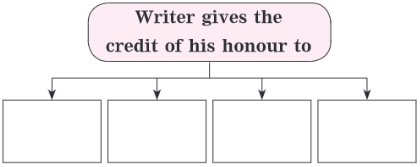
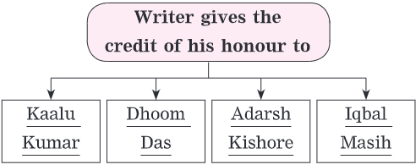
      I give the biggest credit of this honour to my movement’s Kaalu Kumar, Dhoom Das and Adarsh Kishore from India and Iqbal Masih from Pakistan who made the supreme sacrifice for protecting the freedom and dignity of children. I humbly accept this award on behalf of all such martyrs, my fellow activists across the world and my countrymen.
      My journey from the great land of Lord Buddha, Guru Nanak and Mahatma Gandhi; India to Norway is a connect between the two centres of global peace and brotherhood, ancient and modern.
      Friends, the Nobel Committee has generously invited me to present a “lecture.” Respectfully, I am unable to do that. Because, I am representing here - the sound of silence. The cry of innocence. And, the face of invisibility. I represent millions of those children who are left behind and that’s why I have kept an empty chair here as a reminder.

A2. Complex Factual Activities:
Complete the following :
Image
A3. Activities based on Vocabulary:
(1) Use the word 'credit' as a noun and a verb to make a meaningful sentence.
A4. Activities based on Contextual Grammar:
Do as directed:
(1) I humbly accept this award. (Choose the correct question tag.)
(a) do I?  (b) don't I? (c) did I? (d) didn't I?
(2) I am unable to do that.
(Make it negative without changing its meaning)
A5. Personal Response:
(1) What do you know about Kailash Satyarthi? 
Answer
A1. Simple Factual Activities:
(1) True
(2) False
(3) True
(4) True
A2. Complex Factual Activities:
Image
A3. Activities based on Vocabulary:
(1) Noun - The bank refused to extend their credit.
(2) Verb - She has been wrongly credited as the author.
A4. Activities based on Contextual Grammar:
(1) I humbly accept this award, don't I?
(2) I cannot do that/1 am not able to do that.
A5. Personal Response:
(1) Kailash Satyarthi is an activist who fought for the Indian children's rights. He is a Nobel Peace Prize recipient and the Founder of Bachpan Bachao Andolan. He and his team at the Bachpan Bachao Andolan have liberated more than 86,000 children in India from child labour, slavery and trafficking. He is basically from Vidisha in Madhya Pradesh.
View full question & answer
Question 1210 Marks
A1. Simple Factual Activities:
Answer in one word: 
(1) The motherland of Kailash Satyarthi
(2) The country which Iqbal Masih represents
(3) The place where Nobel Prize distribution programme was held
(4) The ancient texts of wisdom

     My dear children of the world ... Your Majesties, Your Royal Highnesses, Excellencies, distinguished members of the Norwegian Nobel Committee, dear brother Tom Harkin, brothers and sisters, and my dear daughter Malala.
      From this podium of peace and humanity, I am deeply honoured to recite a mantra from the ancient texts of wisdom, Vedas. This mantra carries a prayer, an aspiration and a resolve that has the potential to liberate humanity from all man-made crises.
      Let’s walk together. In the pursuit of global progress, not a single person should be left out or left behind in any corner of the world, from East to West, from South to North. Let’s speak together, let our minds come together! Learning from the experiences of our ancestors, let us together create knowledge for all that benefits all.
      I bow to my late parents, to my motherland India, and to the mother earth.
      With a warm heart I recall how thousands of times, I have been liberated, each time I have freed a child from slavery. In the first smile of freedom on their beautiful faces, I see the Gods smiling.
      I give the biggest credit of this honour to my movement’s Kaalu Kumar, Dhoom Das and Adarsh Kishore from India and Iqbal Masih from Pakistan who made the supreme sacrifice for protecting the freedom and dignity of children. I humbly accept this award on behalf of all such martyrs, my fellow activists across the world and my countrymen.
      My journey from the great land of Lord Buddha, Guru Nanak and Mahatma Gandhi; India to Norway is a connect between the two centres of global peace and brotherhood, ancient and modern.
      Friends, the Nobel Committee has generously invited me to present a “lecture.” Respectfully, I am unable to do that. Because, I am representing here - the sound of silence. The cry of innocence. And, the face of invisibility. I represent millions of those children who are left behind and that’s why I have kept an empty chair here as a reminder.

A2. Complex Factual Activities:
Complete the following sentences:
(1) The writer humbly accepts this award on behalf of all  _______________.
(2) The journey of the writer, that is India to Norway is a _______________.
A3. Activities based on Vocabulary:
Write the describing words for the following nouns from the passage:
(1) credit
(2) sacrifices
(3) chair
(4) pence
A4. Activities based on Contextual Grammar:
Make adjectives of:
(1) honour
(2) create
(3) silence
(4) peace
A5. Personal Response:
(1) Suggest any four ways to establish peace in the world.
Answer
A1. Simple Factual Activities:
(1) India
(2) Pakistan
(3) Norway
(4) Vedas
A2. Complex Factual Activities:
(1) The writer humbly accepts this award on behalf of all martyrs, his fellow activists across the world and his countrymen.
(2) The journey of the writer, that is India to Norway is a connect between two centres of global peace and brotherhood, ancient and modern.
A3. Activities based on Vocabulary:
(1) biggest credit
(2) supreme sacrifices
(3) empty chair
(4) global pence
A4. Activities based on Contextual Grammar:
(1) honour - honourable
(2) create - creative
(3) silence - silent
(4) peace - peaceful.
A5. Personal Response:
Some ways to establish peace in the world are .....
(1) Teach every child how to be kind to vulnerable people, the homeless, disabled and old people from their childhood.
(2) Show every child how to achieve calmness and peace of mind through deep breathing.
View full question & answer
Question 1310 Marks
A1. Simple Factual Activities:
Name the following:
(1) The greatest personalities from the great land-India.
(2) The American politician, attorney and author mentioned in the speech -e help beggars? 

     My dear children of the world ... Your Majesties, Your Royal Highnesses, Excellencies, distinguished members of the Norwegian Nobel Committee, dear brother Tom Harkin, brothers and sisters, and my dear daughter Malala.
      From this podium of peace and humanity, I am deeply honoured to recite a mantra from the ancient texts of wisdom, Vedas. This mantra carries a prayer, an aspiration and a resolve that has the potential to liberate humanity from all man-made crises.
      Let’s walk together. In the pursuit of global progress, not a single person should be left out or left behind in any corner of the world, from East to West, from South to North. Let’s speak together, let our minds come together! Learning from the experiences of our ancestors, let us together create knowledge for all that benefits all.
      I bow to my late parents, to my motherland India, and to the mother earth.
      With a warm heart I recall how thousands of times, I have been liberated, each time I have freed a child from slavery. In the first smile of freedom on their beautiful faces, I see the Gods smiling.
      I give the biggest credit of this honour to my movement’s Kaalu Kumar, Dhoom Das and Adarsh Kishore from India and Iqbal Masih from Pakistan who made the supreme sacrifice for protecting the freedom and dignity of children. I humbly accept this award on behalf of all such martyrs, my fellow activists across the world and my countrymen.
      My journey from the great land of Lord Buddha, Guru Nanak and Mahatma Gandhi; India to Norway is a connect between the two centres of global peace and brotherhood, ancient and modern.
      Friends, the Nobel Committee has generously invited me to present a “lecture.” Respectfully, I am unable to do that. Because, I am representing here - the sound of silence. The cry of innocence. And, the face of invisibility. I represent millions of those children who are left behind and that’s why I have kept an empty chair here as a reminder.

A2. Complex Factual Activities:
Complete the following sentences:
(1) We can create knowledge for all that benefits all by _______________.
(2) The mantras that carries a prayer has the potential to _______________.
A3. Activities based on Vocabulary:
Find out the describing words used for the following nouns and make your own sentences using any one combinations:
(1) sacrifice  (2) faces
A4. Activities based on Contextual Grammar:
Name the tense:
(1) The Nobel committee has generously invited ine to present a 'Lecture.'
(2) I am representing the millions of children.
A5. Personal Response:
(1) What do you know about Kailash Satyarthi? 
Answer
A1. Simple Factual Activities:
(1) Lord Buddha, Guru Nanak and Mahatma Gandhi.
(2) Tom Harkin.
A2. Complex Factual Activities:
(1) We can create knowledge for all that benefits all by learning from the experiences of our ancestors.
(2) The mantras that carries a prayer has the potential to liberate humanity from all man- made crises.
A3. Activities based on Vocabulary:
(1) supreme sacrifice
(2) beautiful faces
Sentence:
We should never forget the supreme sacrifice of our martyrs.
A4. Activities based on Contextual Grammar:
(1) Present Perfect Tense
(2) Present Continuous Tense
A5. Personal Response:
(1) Kailash Satyarthi is an activist who fought for the Indian children's rights. He is a Nobel Peace Prize recipient and the Founder of Bachpan Bachao Andolan. He and his team at the Bachpan Bachao Andolan have liberated more than 86,000 children in India from child labour, slavery and trafficking. He is basically from Vidisha in Madhya Pradesh.
View full question & answer