Question
A1. Simple Factual Activities:
State whether you Agree or Disagree with the following statements:
Image

Interviewer : Do you think interest in boxing in India will ever go beyond the Olympics ?
Mary Kom : Yes, I am sure that in a few years boxing will be very popular among everyone in India, all the year round.
Interviewer : How aware are Indian women of their nutritional requirements ? Diet and nutrition must’ve been a key factor in your conditioning for the Olympics. Do you think nutrition is a neglected area in Indian sports ?
Mary Kom : The awareness is growing now among the female athletes when it comes to nutritional requirements. Nutrition has definitely been a neglected area in Indian sports. I had to gain 3 kgs since I had to fight in the 51kg event instead of the usual 48kgs that I fight in. So I had to focus on what to eat. I gained weight by eating the right kind of healthy food rather than bad saturated fats.
Interviewer : How big a role did OGQ play in shaping the boxing scene in India for the better ?
Mary Kom : OGQ really played an important part in my success. They helped me out whenever I needed something. They took care of everything, which helped me focus on my boxing and kept me stress - free.
Interviewer : What’s your opinion on the future of Indian boxing ?
Mary Kom : The future is very bright and I am sure many more boxers will get medals for us.
Interviewer : Do you find it difficult to convince your children not to fight when they watch you go out and do it in style all the time ?
Mary Kom : Well, I have twins and yes, sometimes it becomes really difficult to keep them under control.
Interviewer : Will you train your kids to become boxers as well ?
Mary Kom : I haven’t really thought about it. As of now, just let their mother box !
Interviewer : You have broken several stereotypes about the women in India by showing that women can compete with men in any field. But how good are you at the ‘traditional’ feminine activities like cooking ?
Mary Kom : Well, I am good at cooking and other household work too.
Interviewer : Would you be interested in coaching Indian women in boxing one day ?
Mary Kom : Let’s see. In the future, may be yes.
Interviewer : What do you prefer being called -Super Mom or Super Boxer ?
Mary Kom : I love being a mom. That’s the best thing that has ever happened to me. 
Awards and recognitions
• Arjuna Award (Boxing) in 2003
• Padma Shree (Sports) in 2006
• Contender for Rajiv Gandhi Khel Ratna Award in 2007
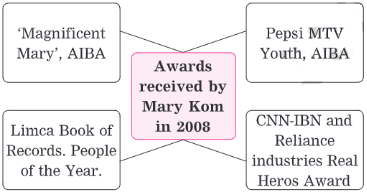
• People of the Year - Limca Book of Records in 2007
• CNN-IBN and Reliance Industries Real Heroes Award in 2008
• Pepsi MTV Youth, AIBA in 2008
• ‘Magnificent Mary’, AIBA in 2008
• Felicitation by Zomi Student’s Federation (ZSF) at New Lamka YPA Hall in 2008
• Rajiv Gandhi Khel Ratna award in 2009
• International Boxing Association’s Ambassador for Women’s Boxing in 2009
• Sportswoman of the year, Sahara Sports Award in 2010.

A2. Complex Factual Activities:
(1) How did Mary Kom increase her weight?
A3. Activities based on Vocabulary:
Write down the full forms of-
(1) OGQ - 
(2) CNN - 
A4. Activities based on Contextual Grammar:
Identify the tense:
(1) Sometimes it becomes really difficult to keep them under control.
(2) They took care of everything.
A5. Personal Response:
(1) What is Mary Kom more proud of being a boxer or a mother? 
Answer

A1. Simple Factual Activities:
Image
A2. Complex Factual Activities:
(1) According to Mary, diet and nutrition must be the key factor in conditioning body, but that is a neglected area in Indian sports. She had to focus on what to eat. When she started diet and nutritions, she put on weight by 3 kg. And she could compete in 51 kg event instead of usual 48 kg.
A3. Activities based on Vocabulary:
Write down the full forms of-
(1) OGQ - Olympic Gold Quest
(2) CNN - Cable News Network
A4. Activities based on Contextual Grammar:
(1) Simple Present Tense
(2) Simple Past Tense
A5. Personal Response:

(1) It is well said, "The hand that rocks the cradle rules the world. She is more proud of being a mother because she knows with her hands she can make lives of her kids. Mother is next to God-in fact a visible God, so even on the ground she thinks about her children. Children are the first priority in her life, because she has to nurture her children and bring them up with love and care.

Need a full question paper?

Generate a complete, print-ready paper with questions like this in minutes — across 16+ boards, with answer keys.

Start Generating Free

Similar questions

A1. Simple Factual Activity:
Name the following:
(1) The country where Mount Huangshan is situated in
(2) The famous dam in Egypt on River Nile

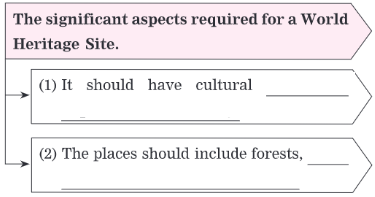
     A World Heritage Site is a site determined by the United Nations Educational, Scientific and Cultural Organization (UNESCO) to have significant cultural or natural importance to humanity. As such the sites are protected and maintained by the
International World Heritage Programme which is administered by the UNESCO World Heritage Committee. Because World Heritage Sites are places that are significant culturally and naturally, they vary in type and include forests, lakes, monuments, buildings and cities.
    World Heritage Sites can also be a combination of both cultural and natural areas. For example, Mount Huangshan in China is a site with significance to human culture because it played a role in historical Chinese art and literature. The mountain is also
significant because of its physical landscape characteristics.
     Although the idea of protecting cultural and natural heritage sites around the world began in the early twentieth century, momentum for its actual creation was not until the 1950s. In 1954, Egypt started plans to build the Aswan High Dam to collect and control water from the Nile River. The initial plan for the dam’s construction would have flooded the valley containing the Abu Simbel Temples and scores of ancient Egyptian artefacts. To protect the temples and artifacts, UNESCO launched an international campaign in 1959 that called for the dismantling and movement of the temples to higher ground. The project cost an estimated US $80 million, $40 million of which came from 50 different countries. Because of the project’s success, UNESCO and the
International Council on Monuments and Sites initiated a draft convention to create an international organization responsible for protecting cultural heritage
 
A2. Complex Factual Activity:
Complete the web:
Image
A3. Activities based on Vocabulary:
Look at the words and their meanings.Underline the correct alternatives:
(i) determine: (a) think over (b) decide (c) ask for (d) look over
(ii) monument: (a) statue (b) pillar (c) memorial building (d) fort
A4. Activities based on Contextual Grammar:
This does not mean that the book is filled with heavy Grammar.Rewrite the following sentences using 'not only ... but also' and 'as well as in two separate sentences:
(1) World Heritage Sites can be a combination of both cultural and natural areas.
A5. Personal Response:
(1) What are our duties towards preservation of any historical site?
A1. Simple Factual Activity:
Complete the following sentences:
(1) The inventory of the State Party is called _______________.
(2) Tentative List is included on the _______________ File.

     BECOMING A WORLD HERITAGE SITE
     There are five steps in becoming a World Heritage Site, the first of which is for a country or State Party to take an inventory of its significant cultural and natural sites. This is called the Tentative List and it is important because nominations to the World Heritage List will not be considered unless the nominated site was first included on the Tentative List. Next, countries are then able to select sites from their Tentative Lists to be included on a Nomination File. The third step is a review of the Nomination File by two Advisory Bodies consisting of the International Council on Monuments and Sites and the World Conservation Union, who then make recommendations to the World Heritage Committee. The World Heritage Committee meets once a year to review these recommendations and decide which sites will be added to the World Heritage List. The final step in becoming a World Heritage Site is determining whether or not a nominated site meets at least one of ten selection criteria. If the site meets these criteria, it can then be inscribed on the World Heritage List. Once a site goes through this process and is chosen, it remains the property of the country on whose territory it sits, but it also becomes considered within the international community.
 
A2. Complex Factual Activity:
Complete the following flow-chart by choosing from the options given below to show how any site of any country can become a World Heritage Site: 
(1) Inclusion of the name of a site from the tentative list to the nomination file.
(2) Name of the site is inscribed on the World Heritage list after meeting the criteria.
(3) Inclusion of the name of site for the nomination in a tentative list after an inventory in the country or the state.
(4) Decision of the World Heritage Committee after the review of the nominated file.
(5) A review of the file included by the advisory bodies.
A3. Activities based on Vocabulary:
Match the words in Column 'A' with their meanings in Column 'B':

 Column 'A' Column 'B'
 (1) inventory (a) fixed basis to judge
 (2) territory (b) suggestions
 (3) criteria (c) region
 (4) recommendations (d) a written list of material

A4. Activities based on Contextual Grammar:
Add a tailtag :
(1) There are five steps in becoming a World. Heritage Site, _______________?
(2) It remains the property of the country, ______________
A5. Personal Response:
(1) Why, do you think, should we preserve the World Heritage Sites?

A1. Simple Factual Activities:
Who said to whom?

 Sentence Who saidTo whom
 (1) "Then, what's the secret of your energy?"   
 (2) "A beggar changed my life."  

    ‘Then stay with me tonight,’ she said. ‘Let’s chat. Do you know that, old friends and memories are precious and rare ?’
     I couldn’t believe it. Was this really Meena ? I pinched myself hard to be sure it wasn’t a dream. But Meena was really standing there, right in front of me, squeezing my hand, smiling, and yes, she did look happy. In the three years she had been in Bangalore, I had never once seen her smiling like that. A few strands of grey in her hair reminded me that years had passed. There were a few wrinkles in her face, but the truth was that she looked more attractive than ever before.
     Finally, I managed to say, ‘No Meena, I can’t stay with you tonight. I have to attend a dinner. Give me your card and I’ll keep in touch with you, I promise.’
     For a moment, Meena looked disappointed, ‘Let’s go and have tea at least’, she insisted.
     ‘But Meena, it’s pouring.’
     ‘So what ? We’ll buy an umbrella and then go to the Grand Hotel,’ she said.
     ‘We won’t get a taxi in this rain’, I grumbled.
     ‘So what ? We’ll walk’.
      I was very surprised. This wasn’t the same Meena I had known. Today, she seemed ready to make any number of adjustments.
      We reached the Grand Hotel drenched. By then the only thought in my mind was to find out who or what had brought about such a change in the pessimistic Meena I had known. I was quite curious.
      ‘Tell me Meena, is there a Prince Charming who has managed to change you so ?’
       Meena was surprised by my question. ‘No, there isn’t anyone like that’, she said.
       ‘Then what’s the secret of your energy?’ I asked, like Tendulkar does in the  advertisement.
       She smiled, ‘A beggar changed my life.’ I was absolutely dumbfounded and she could see it.

A2. Complex Factual Activities:
Choose the correct alternative and complete the following sentences:
(1) The only thought in the writer's mind till they reached the Grand Hotel was _______________.
(a) why the rain was not stopping.
(b) what had brought about such a change in Meena.
(c) how the beggar had changed the entire life of Meena.
(2) The writer wanted to attend _______________.
(a) a marriage party.
(b) a dinner.
(c) a birthday party.
A3. Activities based on Vocabulary:
Find out antonyms for the following from the passage:
(1) lie ×   _____________
(2) dry ×  _____________
(3) common ×  _____________
(4) wrong ×  _____________.
A4. Activities based on Contextual Grammar:
Change into indirect speech:
(1) "We won't get a taxi in this rain," I grumbled.
(2) "So what? We'll buy an umbrella and then go to the Grand Hotel," she said.
A5. Personal Response:
(1) What, according to you, is the difference between an optimistic person and a pessimistic person?

A1. Simple Factual Activities:
Answer in one-two words:
(1) Coach
(2) Interviewer
(3) Place of Training
(4) Total medals won in 2012 Olympics by India

     In an exclusive interview with Sportskeeda correspondent Taruka Srivastava, Olympic Bronze medalist Mary Kom talked about her preparation for the Olympics and her elation at winning a medal.
Interviewer : First things first- you’re the first Indian female boxer to win an Olympics medal for India. Has the feeling completely sunk in ?
Mary Kom : I am really happy with my achievement and yes it is yet to sink in. I am just so exhilarated.
Interviewer : You were the only female representative from India in boxing. Did that put additional pressure on you?
Mary Kom : No, not at all. I was pretty confident about myself. I knew.
Interviewer : Your coach Charles Atkinson was not allowed to accompany you to the Olympics. How did that affect your preparations ?
Mary Kom : Well I did miss him there but thankfully, we had already done our homework and I was well prepared.
Interviewer : During your preparations for the Olympics, you sparred with the male boxers of the Indian contigent. Who was your favourite sparring partner ?
Mary Kom : (Laughs) Well, I trained hard in Pune and the male boxers were kind enough to practise with me whenever I required them. To name a favourite would be unfair.
Interviewer : You were quoted saying “Adams was very clever, a counter - puncher but, although she carried power, she wasn’t very tactical. I was scoring but the judges were not pressing the buttons.” Do you think dodgy judging was part of the reason for
your loss in the semi - finals?
Mary Kom : Yes, I think some of the decisions were unfortunate and did not work to my benefit.
Interviewer : India managed just 6 medals in the 2012 Olympics even though we are a nation of 1.3 billion people. Where do you think a change is required to help us win medals that are proportionate with our population ?
Mary Kom : I think more and more people should take up sports as a full - time career if we want more gold medals. More corporates should come in and sponsor players so that the players don’t have any financial pressure and can just focus on their games.

A2. Complex Factual Activities:
(1) What failed to pressurize Mary Kom during the Olympics? 
A3. Activities based on Vocabulary:
Make sentences of your own using the following words:
(1) elation:
(2) sponsor:
A4. Activities based on Contextual Grammar:
Do as directed:
(1) Charles Atkinson was not allowed to accompany Mary to the Olympics.
(Make it affirmative.)
(2) Some of the decisions did not work to my benefit. (Make it Affirmative.)
A5. Personal Response:
(1) Do you think financial support is very necessary for the sportsmen? Why? 
A1. Simple Factual Activities:
Write whether the following sentences are True or False:
(1) Writer's journey from India to Norway is a connect between the two centre of global peace.
(2) The Nobel Committee did not invite the writer to deliver a lecture.
(3) Writer represented the sound of silence and cry of innocence.
(4) Writer humbly accepted the award on behalf of all activists.

     My dear children of the world ... Your Majesties, Your Royal Highnesses, Excellencies, distinguished members of the Norwegian Nobel Committee, dear brother Tom Harkin, brothers and sisters, and my dear daughter Malala.
      From this podium of peace and humanity, I am deeply honoured to recite a mantra from the ancient texts of wisdom, Vedas. This mantra carries a prayer, an aspiration and a resolve that has the potential to liberate humanity from all man-made crises.
      Let’s walk together. In the pursuit of global progress, not a single person should be left out or left behind in any corner of the world, from East to West, from South to North. Let’s speak together, let our minds come together! Learning from the experiences of our ancestors, let us together create knowledge for all that benefits all.
      I bow to my late parents, to my motherland India, and to the mother earth.
      With a warm heart I recall how thousands of times, I have been liberated, each time I have freed a child from slavery. In the first smile of freedom on their beautiful faces, I see the Gods smiling.
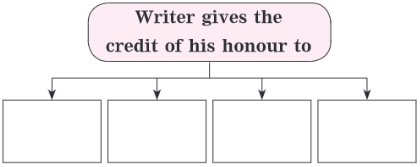
      I give the biggest credit of this honour to my movement’s Kaalu Kumar, Dhoom Das and Adarsh Kishore from India and Iqbal Masih from Pakistan who made the supreme sacrifice for protecting the freedom and dignity of children. I humbly accept this award on behalf of all such martyrs, my fellow activists across the world and my countrymen.
      My journey from the great land of Lord Buddha, Guru Nanak and Mahatma Gandhi; India to Norway is a connect between the two centres of global peace and brotherhood, ancient and modern.
      Friends, the Nobel Committee has generously invited me to present a “lecture.” Respectfully, I am unable to do that. Because, I am representing here - the sound of silence. The cry of innocence. And, the face of invisibility. I represent millions of those children who are left behind and that’s why I have kept an empty chair here as a reminder.

A2. Complex Factual Activities:
Complete the following :
Image
A3. Activities based on Vocabulary:
(1) Use the word 'credit' as a noun and a verb to make a meaningful sentence.
A4. Activities based on Contextual Grammar:
Do as directed:
(1) I humbly accept this award. (Choose the correct question tag.)
(a) do I?  (b) don't I? (c) did I? (d) didn't I?
(2) I am unable to do that.
(Make it negative without changing its meaning)
A5. Personal Response:
(1) What do you know about Kailash Satyarthi? 
A1. Simple Factual Activities:
Complete the following sentences using the information given in the passage:
(1) The langur baby was listless and _______________.
(2) The writer's parents and sisters had come out on the veranda and _______________.

    The changed circumstances and the sudden unexpected attack from unknown quarters forced the langur to drop the baby from the sloping roof over the veranda. The baby was listless and appeared to be dead. As its body started to slide down, the excitement of the pack of dogs grew manifold at the prospect of a good kill and meal. Keeping the dogs at bay with the stick, I managed to catch hold of the baby langur’s tail just as it tipped over the edge of the tiled roof. The baby appeared inert and lifeless. It was indeed a male baby.
   By this time, my parents and sisters had come out on to the veranda and were witnessing my rescue operation. Some of our neighbours had also gathered in the distance.
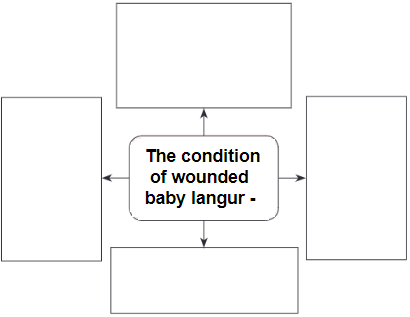
    I took the baby langur to our backyard and gently laid him on the floor inside the poultry coop. His body was full of deep bite marks and scratches. Blood was oozing from some of the wounds. The baby remained motionless. My father provided first aid to clean the wounds and stop the bleeding. I was relieved to find out that the baby was breathing, even though his breaths were shallow.
   Splashes of cold water made the baby stir and after a few shaky attempts, he sat up. He was in state of shock and started trembling like a leaf in the wind. His two little twinkling eyes welled up with tears and he started to sob with a muffled cry - just like a human child would after experiencing trauma. I offered him a peeled banana which he
accepted with his unsteady hand and began taking hesitant bites.

A2. Complex Factual Activities:
Complete the following web and describe the condition of wounded baby langur:
 Image
A3. Activities based on Vocabulary:
Find from the passage present participles and past participles used as adjectives:
(1) Present Participles: __________ roof, __________ eyes.
(2) Past Participles: __________ attack, __________ quarter, __________ cry, __________ banana.
A4. Activities based on Contextual Grammar:
(1) They were witnessing my rescue operation. (Simple Past Tense.)
(2) He was in a state of shock. (Past Perfect Tense.)
A5. Personal Response:
(1) Have you ever saved a puppy/dog or any other animal from naughty children who were throwing stones at him? Write about your experience.
A1. Simple Factual Activities:
State whether the following statements are True or False:
(1) Bishamber was a young bridegroom. 
(2) Ramlal had never dreamt that his fourth daughter Bholi would have such a grand wedding.
(3) When Bholi was brought near the sacred fire she was in a red silken bridal dress.
(4) Bholi felt herself lucky to get a well-to-do bridegroom like Bishamber.

    Thus the years passed.
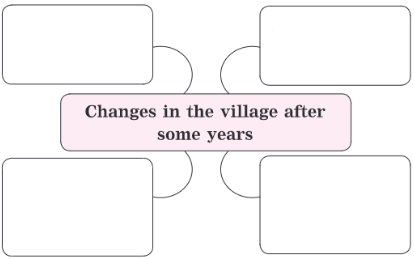
    The village became a small town. The little primary school became high school. There were now a cinema under a tin shed and a cotton ginning mill. The mail train began to stop at their railway station.
     One night, after dinner, Ramlal said to his wife, “Then, shall I accept Bishamber’s proposal?”
    “Yes, certainly” his wife said. “Bholi will be lucky to get such a well to do bridegroom. A big shop, a house of his own and I hear several thousands in the bank. Moreover, he is not asking for any dowry”.
    “That’s right, but he is not so young, you know -almost the same age as I am- and he also limps. Moreover, the children from his first wife are quite grown up”.
    “So what does it matter ?” his wife replied. “Forty five or fifty-it is no great age for a man. We are lucky that he is from another village and does not know about her pockmarks and her lack of sense. If we don’t accept this proposal, she may remain
unmarried all her life.”
    “Yes, but I wonder what Bholi will say”.
    “What will that witless one say ? She is like a dumb cow.”
    “May be you are right”, muttered Ramlal. In the other corner of the courtyard, Bholi lay awake on her cot, and listened to her parents’ whispered conversation.
     Bishamber Nath was a well - to - do grocer. He came with a big party of friends and relations with him for the wedding. A brass band playing a popular tune from an Indian film headed the procession, with the bridegroom riding a decorated horse. Ramlal was
overjoyed to see such pomp and splendour. He had never dreamt that his fourth daughter would have such a grand wedding. Bholi’s elder sisters who had come for the occasion were envious of her luck.
     When the auspicious moment came the priest said, “Bring the bride”. Bholi, clad in a red silken bridal dress, was led to bride’s place near the sacred fire.
    “Garland the bride,” one of his friends prompted Bishamber Nath.

A2. Complex Factual Activities:
Complete the following web :
Image
A3. Activities based on Vocabulary:
Complete the following sentences using the words given in the brackets:
(envious, procession, overjoyed)
(1) Most of the youngsters like to dance in marriage _______________.
(2) He was _______________ to see his friend after a long time.
A4. Activities based on Contextual Grammar:
Change the following sentences in indirect speech:
(1) "What will that witless one say? She is like a dumb cow". "May be you are right," muttered Ramlal.
(2) "Yes, certainly," his wife said, "Bholi will be lucky to get such a well-to-do bridegroom."
A5. Personal Response:
(1) What is your opinion about Bholi's bridegroom? Should she get married to him?
A1. Simple Factual Activities:
Put ✔ or ✘ in front of the following sentences :
(1) Bholi was the beloved daughter of Ramlal.
(2) Bholi used to wear old dresses of her sisters.
(3) Bholi was happy to see so many girls of her age in the school.
(4) All the girls in the school were laughing at Bholi.

     The next day Ramlal caught Bholi by the hand and said. ‘‘Come with me. I will take you to school.’’ Bholi was frightened. She did not know what a school was like. She remembered how a few days ago their old cow. Lakshmi had been turned out of
the house and sold.
     ‘‘N-n-n-n No. no-no-no’’ she shouted in terror and pulled her hand away from her father’s grip.
     ‘‘What’s the matter with you, you fool?’’ shouted Ramlal, ‘‘I am only taking you to school.’’ Then he told his wife. ‘‘Let her wear some decent clothes today. Or else what will the teachers and the other schoolgirls think of us when they see her?’’
      New clothes had never been made for Bholi. The old dresses of her sisters were passed on to her. No one cared to mend or wash her clothes. But today she was lucky to receive a clean dress which had shrunk after many washing and no longer fitted
Champa. She was even bathed and oil was rubbed into her dry and matted hair. Only then did she begin to believe that she was being taken to a place better than her home!
      When they reached the school, the children were already in their classrooms. Ramlal handed over his daughter to the headmistress. Left alone, the poor girl looked about her with fear laden eyes. There were several rooms. And in each room girls like her squatted on mats, reading from books or writing on slates. The headmistress asked        Bholi to sit down in a corner in one of the classrooms. Bholi did not know what exactly a school was like and what happened there. But she was glad to find so many girls almost of her own age present there. She hoped that one of these girls might become her friend.
      The lady teacher who was in the class was saying something to the girls but Bholi could understand nothing. She looked at the pictures on the wall. The colours fascinated her. The horse was brown just like the horse on which the Tehsildar had come to visit their village : the goat was black like the goat of their neighbour: the parrot was green like the parrots she had seen in the mango orchard : and the cow was just like their Lakshmi. And suddenly Bholi noticed that the teacher was standing by her
side, smiling at her.
      “What’s your name. little one?’’
      ‘‘Bh-Bho-Bho.’’ She could stammer no further than that.
       Then she began to cry and tears flowed from her eyes in a helpless flood. She kept her head down as she sat in her corner, not daring to look up at the girls who, she knew were still laughing at her.

A2. Complex Factual Activities:
(1) How did Bholi's parents change her appearance? 
A3. Activities based on Vocabulary:
Find out synonyms for the following:
(1) attracted
(2) repair
A4. Activities based on Contextual Grammar:
(1) Rewrite as an exclamatory sentence:
The child was very fair and pretty.
(2) Correct the error in the following sentence. Focus on verbs and subject:
New clothes was never made for Bholi.
A5. Personal Response:
(1) "If girls go to school, who will marry them?"-Why, do you think, that Bholi's mother thought so?
A1. Simple Factual Activities:
Name the following:
(1) Scientist who discovered the properties of uranium -
(2) Two radioactive elements discovered by Curies -
(3) An admirer of the Curies.
(4) A black, very hard and expensive substance.S

      Marie was specially interested in a substance called uranium which was obtained from pitchblende, a black, very hard and very expensive substance. Uranium was known to give off very powerful rays by which men could see through many substances. Now Marie discovered that what was left after obtaining uranium was even more powerful. Later on, Pierre and Marie found that there was not one, but two new substances giving off these rays although they had not yet been able to obtain either of them. They called one of them Polonium, in honour of her country. Poland and the other was called Radium. Radium is the most powerful of the radio-active elements. And radio-active elements can give off rays which can penetrate substances that are opaque to light. There was another French scientist called Henri Becquerel, who in 1896 had discovered that uranium possessed this property. But Polonium and Radium possessed radio-active in much higher degree.
     The Curies now began to work with greater enthusiasm, but they were poor and pitchblende itself was an extremely expensive substance, which they could not afford to buy in large quantity. They, however, sacrificed all the luxuries of life to save money to buy whatever little amount of pitchblende they could. They lived in utter penury, not buying costly food and warm clothes for the extremely cold Parisian winter. Often they could not sleep during the cold nights due to lack of warmth. Overwork seriously affected Madame Curie’s health. Often she was forced to leave the laboratory to take a much needed rest. Her husband begged her to give up the struggle, but she resolutely refused. Marie was driven by a mad determination to discover the mystery of radium. With courage she faced all the miseries of a life of poverty and carried on with her research along with her husband who loved and supported her.
      Luck, however, favoured the Curies and a windfall came to them. It was a gift of a ton of pitchblende from the emperor of Austria, who was an admirer of the Curies. It was the most precious gift the Curies had received and in their shabby laboratory they toiled along, boiled and burnt, overpowered by heat in summer and frozen with cold in winter.

A2. Complex Factual Activities:
(1) Which gift did she receive from the emperor of Austria? Why was it the most precious for them? 
A3. Activities based on Vocabulary:
Find out antonyms for the following from the passage:
(1) economical ×
(2) poverty × 
(3) chill × 
(4) worthless ×
A4. Activities based on Contextual Grammar:
Change the degree:
(1) Pitchblende is one of the most expensive substances.
A5. Personal Response:
(1) Which of the two scientists was greater than the other? Say why.
A1. Simple Factual Activities:
Complete the following web: 
Image

To see a world in a grain of sand
     And a heaven in a wild flower,
Hold infinity in the palm of your hand
      And eternity in an hour
    We instinctively turn to outdoor activities and nature as a way of relaxing and enhancing our wellbeing. Nature soothes and nurtures. Nature fulfils and motivates. Nature whispers and commands.
    Are you listening?
    When I do, it leaves me in complete awe.
    We have a hibiscus plant in our garden. Every fortnight a flower blooms on it big, bright and tender. Through the day it smiles with the sun and dances with the wind, but as evening approaches, it starts wilting. The morning after, it withers completely and by evening it falls and becomes one with the earth again. The flower comes to life only for a day, yet it does so in full splendour. What if we too lived our life, however short, to its fullest?
    We went to a rocky beach and saw the spread of the majestic ocean and the rocks alongside, carved, sculpted and shaped by the water. Water is so gentle, rock so hard, yet, as the water flows over it every day, for years, the rock gives in. It takes the shape that the water commands. Our problems are so colossal and we are so small, yet if we persist.... 

A2. Complex Factual Activities:
The writer explains the contrast features of 'water' and 'rock' in the text. Write all the features of both water and rock in the given table: 
A3. Activities based on Vocabulary:
Match the pairs of antonyms.

 Words Antonyms
 (1) gentle (a) small
 (2) colossal (b) long
 (3) short (c) quit
 (4) persist (d) hard

A4. Activities based on Contextual Grammar:
Frame Wh-questions to get the underlined parts as answers:
(1) The flower comes to life only for a day.
(2) We saw the spread of the majestic ocean.
A5. Personal Response:
(1) Explain the line Nature whispers and commands.'