Question
A1. Simple Factual Activities:
Complete the following sentences using the information given in the passage:
(1) The langur baby was listless and _______________.
(2) The writer's parents and sisters had come out on the veranda and _______________.

    The changed circumstances and the sudden unexpected attack from unknown quarters forced the langur to drop the baby from the sloping roof over the veranda. The baby was listless and appeared to be dead. As its body started to slide down, the excitement of the pack of dogs grew manifold at the prospect of a good kill and meal. Keeping the dogs at bay with the stick, I managed to catch hold of the baby langur’s tail just as it tipped over the edge of the tiled roof. The baby appeared inert and lifeless. It was indeed a male baby.
   By this time, my parents and sisters had come out on to the veranda and were witnessing my rescue operation. Some of our neighbours had also gathered in the distance.
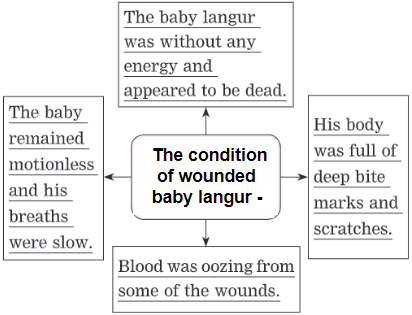
    I took the baby langur to our backyard and gently laid him on the floor inside the poultry coop. His body was full of deep bite marks and scratches. Blood was oozing from some of the wounds. The baby remained motionless. My father provided first aid to clean the wounds and stop the bleeding. I was relieved to find out that the baby was breathing, even though his breaths were shallow.
   Splashes of cold water made the baby stir and after a few shaky attempts, he sat up. He was in state of shock and started trembling like a leaf in the wind. His two little twinkling eyes welled up with tears and he started to sob with a muffled cry - just like a human child would after experiencing trauma. I offered him a peeled banana which he
accepted with his unsteady hand and began taking hesitant bites.

A2. Complex Factual Activities:
Complete the following web and describe the condition of wounded baby langur:
 Image
A3. Activities based on Vocabulary:
Find from the passage present participles and past participles used as adjectives:
(1) Present Participles: __________ roof, __________ eyes.
(2) Past Participles: __________ attack, __________ quarter, __________ cry, __________ banana.
A4. Activities based on Contextual Grammar:
(1) They were witnessing my rescue operation. (Simple Past Tense.)
(2) He was in a state of shock. (Past Perfect Tense.)
A5. Personal Response:
(1) Have you ever saved a puppy/dog or any other animal from naughty children who were throwing stones at him? Write about your experience.
Answer

A1. Simple Factual Activities:
(1) The langur baby was listless and appeared to be dead.
(2) The writer's parents and sisters had come out on the veranda and were witnessing his rescue operation.
A2. Complex Factual Activities:
Image
A3. Activities based on Vocabulary:
(1) Present Participles: sloping roof, twinkling eyes.
(2) Past Participles: unexpected attack, unknown quarter, muffled cry, peeled banana.
A4. Activities based on Contextual Grammar:
(1) They witnessed my rescue operation.
(2) He had been in a state of shock.
A5. Personal Response:
(1) Yes, I have saved a dog who was in such a situation. Though the stones thrown by the urchins did not hit the dog very much, he was frightened to death and was running helter skelter. I gathered a long stick and shouted at them. Then I hit one of the boys with the stick and they ran away. The dog had gratitude in his eyes for me.

Need a full question paper?

Generate a complete, print-ready paper with questions like this in minutes — across 16+ boards, with answer keys.

Start Generating Free

Similar questions

A1. Simple Factual Activities:
Say whether the following statements are True or False:
(1) A big male langur did not intend to kill the baby langur.
(2) The narrator ignored the commotion at first.
(3) The narrator rushed to the veranda to see where his family was.
(4) According to the custom of animal clan, a dominant male protects another male baby or adult.

   Suddenly, I heard a group of street dogs barking furiously in the distance. I chose to ignore the commotion thinking that the pack of dogs might have cornered a hapless pig. But soon, the barking became louder and more aggressive and the alarmed cawing of a flock of crows added to the cacophony. I also heard the disturbance approaching closer.       
    Curiosity got the better of me. Leaving the book aside, I rushed to the veranda to see what was going on.
    I glanced towards the roof of the club house and saw something horrible. A big male langur, apparently the leader of its group, was holding a baby langur in his hands and mercilessly biting it all over with a definite intent to kill. The helpless mother of the baby and other lesser members of the langur group were scattered on the roofs of the buildings nearby watching the baby being killed. I recalled the terrible custom in the animal clan according to which a dominant male usually does not allow another male baby or adult to survive within its group.
    Without losing any time, I gathered a stout stick in one hand and hurled a piece of stone at the marauding langur. The langur was so infuriated that it hardly took any notice of my assault. But then I started throwing more stones. The dogs on their part raised their pitch of cry.

A2. Complex Factual Activities:
(1) What wicked custom is practised by animals who live in groups?
A3. Activities based on Vocabulary:
Match the phrases given in Column 'A' with their meanings in Column 'B':

Column 'A'Column 'B'
 (1) to take notice of (a) overpowered someone
 (2) got the better of (b) was happening
 (3) pitch of cry (c) to observe and give attention
 (4) was going on (d) high sound of cry

A4. Activities based on Contextual Grammar:
(1) Rewrite the sentence as per the tense mentioned in the brackets:
The big male langur was holding a baby langur in his hands. (Past Perfect Continuous Tense.)
(2) Do as directed:
I started throwing more stones.(Begin with 'More stones were ....')
A5. Personal Response:
(1) Do you think that the custom of baby killing by dominant male in animal clan is good? Explain.

A1. Simple Factual Activities:
Complete the following sentences with the correct alternatives: 
(1) After her victory in the Manipur State, Mary Kom's career started in _______________.
(a) 2001 (b) 2009 (c) 2005 (d) 2000
(2) Mary Kom made her International debut in _______________.
(a) United Kingdom (b) U.S.A (c) United States (d) Manipur

   There had to be one successful story if Indians were to survive in sports and we have that story now. Enough has been said about this great warrior who conquered the world. This warrior is none other than Mary Mangte Kom-the Komqueror and the Komrade. She is famed as a five times World Boxing Champion and the only boxer to win a medal in every one of the six world championships. In the 2012 Olympics, she became the first Indian woman boxer to qualify and win a bronze medal in the 51
kg flyweight category of Boxing.
     Kom was born in Kangthei village, Moirang Lamkhai in Churachandpur district of rural Manipur in eastern India. She came from a poor family. Her parents, Mangte Tonpa Kom and Mangte Akham Kom were tenant farmers who worked in jhum fields.
Kom grew up in humble surroundings, helping her parents with farm related chores, going to school and learning athletics initially and later boxing simultaneously. Her father was a keen wrestler in his younger age.
     She had an eager interest in athletics since childhood and the success of Dingko Singh a fellow Manipuri returned from the 1998 Bangkok Asian games with a gold medal, Kom recollects, had inspired many youngsters in Manipur to try boxing
and she too thought of giving it a try.
     Mary Kom’s career started in 2000 after her victory in the Manipur State women’s boxing championship and the regional championship in West Bengal. In 2001, she started competing at international level. She was only 18 years old when she made her
international debut at the first AIBA Women’s World Boxing Championship in United States, winning a silver medal in the 48 kg weight category. Her greatness is reinforced by the way she apoligized to the whole nation for not being able to win the Gold. She is a legend for sure and an idol for all the sportswomen to look up to.

A2. Complex Factual Activities:
Arrange the following sentences as per their sequence occurred in the passage: 
(a) Mary Kom made her international debut when she was 18 years old.
(b) Dingko Singh won gold medal in 1998 Bangkok Asian games.
(c) Mary Kom started her career after winning Manipur State Women's Boxing Championship.
(d) Mary Kom is a legend for sure.
A3. Activities based on Vocabulary:
Match the following with their opposites:

WordsOpposites
 (1) success (a) young
 (2) winning (b) unable
 (3) old  (c) failure
 (4) able (d) losing

A4. Activities based on Contextual Grammar:
Do as directed:
(1) She is a legend for sure.
(a) is she? (b) does she? (c) isn't she? (d) doesn't she?
(2) She was 18 years old. (Frame 'Wh' question to get the underlined part as an answer) 
A5. Personal Response:
(1) What makes the writer call Mary Kom 'a legend'?

A1. Simple Factual Activity:
Complete the sentences with the help of the information in the passage:
(1) For reducing weight, exercise, diet and stress- free thoughts should be _______________.
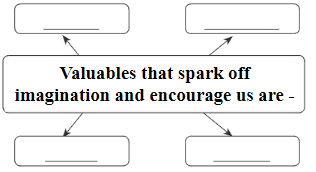
(2) Vision, wishes, intentions and dreams spark off imagination and encourage us _______________.

    Time-bound: Establish time parameters around each goal, as it will help increase focus and accountability. To reduce weight we know how to go about it. But without consistent time - bound action, it never becomes a reality. It may be exercise, diet and stress-free thoughts. All these have to be practised and implemented without hesitation, doubt or indifference, but within a deadline.
    Visions, wishes, intentions and dreams are all valuable. They spark off imagination and encourage us to define where we want to reach. In order to get there, however, we need to bring life images, down to earth and plan to execute our strategies. The quality and quantity of energy we put forth, directly impact the results. Life is something like a trumpet. If we don’t put anything in, we can’t get anything out.
     Success is a walk in the dark. Finding the right footing, precisely mastering the skills and getting to the next place, all depend on how we approach and
tackle the problem. The best way to get from where we are, to where we want to be is to find the footing of our next step. When we take the next step, it should support and hold us without a crack.

A2. Complex Factual Activity:

Complete the web: 
Image
A3. Activities based on Vocabulary:
Write antonyms for the following words :
(1) wrong ×
(2) decrease × 
(3) discourage × 
(4) light × 
A4. Activities based on Contextual Grammar:
(1) Establish time parameters around each goal. (Rewrite the sentence beginning with 'Let' and change the sentence into passive voice.)
(2) If we don't put anything in, we can't get anything out. (Rewrite the sentence using 'unless' in the beginning.)
A5. Personal Response:
(1) Write any four qualities of a successful person.
A1. Simple Factual Activity:
Complete the following sentences using information in the passage:
(1) He flapped his wings once and _______________.
(2) He turned his beak sideways and cawed _______________.

    Then he completely forgot that he had not always been able to fly, and commended himself to dive and soar and curve, shrieking shrilly.
    He was near the sea now, flying straight over it, facing straight out over the ocean. He saw a vast green sea beneath him, with little ridges moving over it and he turned his beak sideways and cawed amusedly.
    His parents and his brothers and sister had landed on this green flooring ahead of him. They were beckoning to him, calling shrilly. He dropped his legs to stand on the green sea. His legs sank into it. He screamed with fright and attempted to rise again flapping his wings. But he was tired and weak with hunger and he could not rise, exhausted by the strange exercise. His feet sank into the green sea, and then his belly touched it and he sank no farther. He was floating on it, and around him his family was screaming, praising him and their beaks were offering him scraps of dog-fish. He had made his first flight.

A2. Complex Factual Activity:
(1) What did the young seagull forget? What did he do then? 
A3. Activities based on Vocabulary:
Read the following words and make meaningful sentences of your own by using them:*(1) beckon
(2) curveting
A4. Activities based on Contextual Grammar:
Do as directed:
(1) He was near the sea now. (Frame a Wh-question to get the underlined as an answer.)
(2) But he was tired and weak with hunger. (Use 'not only but also'.)
A5. Personal Response:
(1) How does your family help you to achieve your goal?
A1. Simple Factual Activities:
Pick out from the passage 2 lines each that prove the following: 
(1) Her (Joan's) confidence
(2) Her courage

    The war fought between England and France from 1337 to 1453 has come to be known as the Hundred Years War. Joan was a peasant girl born in eastern
France who led the French army to several victories during this war.
    This play begins at the time when all of northern France and some parts of the south-west were under foreign control. The English controlled some parts and the Burgundians controlled the others. The city of New Orleans, one of the few remaining French cities was held by the English. The year is 1429. Captain Robert de Baudricourt, a military officer is seated at the table. His steward stands facing him.
Robert : I told you to throw the girl out. You have fifty armed soldiers and dozens of strong servants to carry out my orders. Are they afraid of her ?
Steward : No sir, we are afraid of you, but she puts courage in us. She really doesn’t seem to be afraid of anything. Perhaps you could frighten her, sir.
Robert : (grimly) Perhaps, where is she now ?
Steward : Down in the courtyard, sir.
(Robert goes to the window and asks the soldiers to send the girl up)
(The girl enters. She is a well-built, strong country girl of 17 to 18 years. The squire’s glare neither frightens her nor stops her. She speaks confidently.)
Joan : Good morning, captain squire. You are to give me a horse and armour and some soldiers, and send me to the Dauphin.
Robert : This girl is mad. Why didn’t you tell me so, you blockhead ?
Steward : Sir, do not anger her. Give her what she wants.
Robert : I shall send you back to your father with orders to put you under lock and
key.
Joan : You think you will, squire. But it won’t happen that way. You said you would not see me. But here I am.
Robert : So, you are assuming that I’ll give
you what you want.
Joan : Yes, squire. (Continues busily) A horse will cost sixteen francs. It is a big
amount of money. But I can save it on the armour. I don’t need beautiful armour made to my measure. I can find a soldier’s armour that will fit me well enough. I shall not want many soldiers. The Dauphin will give me, all I need, to free Orleans.
Robert : (Shocked) To free Orleans !
Joan : (Simply) Yes, squire. Three men will be enough for you to send with me.
Polly and Jack have promised to come with me.
Robert : You mean Monsieur de Poulengey ?
Joan : Yes, Squire Jack will come willingly. He is a very kind gentleman, and gives me money to give to the poor. I think John Godsave will come, and Dick the Archer, and their servants, John of Honecourt and Julian. There will be no trouble for you, squire. I have arranged it all. You have only to give the order.

A2. Complex Factual Activities:
(1) Why did Joan not ask for many soldiers from the Captain Squire? 
A3. Activities based on Vocabulary:
Give one word for the following:
(1) A person of high rank
(2) A stupid person
(3) To take for granted
(4) Military unit consisting of armoured fighting vehicles
A4. Activities based on Contextual Grammar:
Make the following sentences affirmative without any change of meaning:
(1) Sir, do not anger her.
(2) I shall not want many soldiers.
A5. Personal Response:
(1) Describe any brave lady as Joan of Arc, from India who fought for her nation.
A1. Simple Factual Activity:
Complete the sentences using the information from the passage:
(1) Mr Srivastava was talking to Kamal Kishore the owner of the photography shop.
(2) Sitaram was glad that he had been of service to both a customer and his friend.

      And Sitaram, glad that he had been of service to both a customer and his friend, hoisted his bag on his shoulders and went his way.
      Mrs. Srivastava had to do some shopping. She gave instructions to the ayah about looking after the baby, and told the cook not to be late with the midday meal. Then she set out for the Pipalnagar market place, to make her customary tour of the cloth shops.
      A large shady tamarind tree grew at one end of the bazaar, and it was here that Mrs. Srivastava found her friend Mrs. Bhushan sheltering from the heat. Mrs. Bhushan was fanning herself with a large handkerchief. She complained of the summer, which she affirmed, was definitely the hottest in the history of Pipalnagar. She then showed Mrs. Srivastava a sample of the cloth she was going to buy, and for five minutes they discussed its shade, texture and design. Having exhausted this topic, Mrs. Srivastava
said, ‘Do you know, my dear, that Seth Govind Ram’s bank can’t even pay its employees? Only this morning I heard a complaint from their sweeper, who hasn’t received his wages for over a month!’
     ‘Shocking!’ remarked Mrs. Bhushan. ‘If they can’t pay the sweeper they must be in a bad way. None of the others could be getting paid either.’
     She left Mrs. Srivastava at the tamarind tree and went in search of her husband, who was sitting in front of Kamal Kishore’s photography shop, talking with the owner.
    ‘So there you are!’ cried Mrs. Bhushan. ‘I’ve been looking for you for almost an hour. Where did you disappear ?’
    ‘Nowhere,’ replied Mr. Bhushan. ‘Had you remained stationary in one shop, I might have found you. But you go from one shop to another, like a bee in a flower garden.’
    ‘Don’t start grumbling. The heat is trying enough.I don’t know what’s happening to Pipalnagar. Even the bank’s about to go bankrupt.’   

A2. Complex Factual Activity:
Complete the following web:
Image
A3. Activities based on Vocabulary:
Find describing words for the following from the passage:
(1) shop (2) meal (3) tour (4) tamarind tree
A4. Activities based on Contextual Grammar:
(1) Mrs Bhushan went in search of her husband. He was sitting in front of Kamal Kishore's photography shop.
(Rewrite the sentence joining it with 'who'.)
(2) That summer was the hottest in the history of Pipalnagar.
(Change the sentence into Positive Degree.)
A5. Personal Response:
(1) Do you think, Mr Bhushan was right to compare his wife with a bee in a flower garden? Give your reason.
A1. Simple Factual Activities:
Say whether the following statements are True or False:
(1) The baby langur sensed the presence of his mother.
(2) The mother langur was sitting on the floor of the coop.
(3) The writer cuddled the baby langur tightly in his bosom.
(4) The writer's attention was fixed on the revival of the baby langur.

    My attention was fixed on the revival of the baby langur. Suddenly, I had an uncanny feeling of being watched. I turned away from the coop and looked up. There sat the mother langur on our kitchen roof, watching every move I made. She simply sat there quietly, as if convinced that no harm was being done to her child.
   Meanwhile, the baby sensed the presence of his mother and started to sob and cry a little louder. I retreated from the door of the coop to allow the mother access to her baby.
    Immediately, the mother descended on the floor of the coop and picked up the baby in her arms. She gave the baby a thorough body inspection to check his injuries and then cuddled him tightly in her bosom. The baby found great solace in her caring arms. The mother sat still with the baby in her lap for a few minutes. It was almost as if she was pondering over her options and trying to figure out how she could keep the baby safe from further assault.

A2. Complex Factual Activities:
Complete the following:
(1) Mother langur simply sat quietly because _______________.
(2) The baby langur started to sob and cry because _______________.
 
A3. Activities based on Vocabulary:
Match the words in column 'A' with their meanings in column 'B':

 Column 'A'Column 'B'
 (1) to figure out (a) to find comfort and peace.
 (2) to ponder over (b) the act of checking with complete attention and care.
 (3) to find solace (c) to be able to think until you solve the problem.
 (4) thorough inspection (d) think over something deeply.

A4. Activities based on Contextual Grammar:
Do as directed:
(1) I turned away from the coop and looked up.
(Begin the sentence with - Turning ... and rewrite it.) 
(2) She gave the baby a thorough body inspection.
(Change the sentence into passive voice. Begin with The baby...)
A5. Personal Response:
(1) What is your mother's state of mind during your illness?

A1. Simple Factual Activities:
Make a list of the problems that we are facing and creating violence against children -

     I call upon all the governments, intergovernmental agencies, businesses, faith leaders, workers, teachers and NGOs, and each one of us, to put an end to all forms of violence against children. Slavery, trafficking, child marriages, child labour, sexual abuse, and illiteracy these things have no place in any civilised society.
     Friends, we can do this. Governments must make child - friendly policies, and invest in education and young people. Businesses must be more responsible, accountable and open to innovative partnerships.Intergovernmental agencies must work together to accelerate action. Global civil society must rise above the business-as-usual and fragmented agendas. Faith leaders and institutions, and all of us must stand with our children.
     We must be bold, we must be ambitious, and we must have the will. We must keep our promises. Over fifty years ago, on the first day of my school, I met a cobbler boy, my age sitting outside the gate of my school. I asked my teachers: “Why is he working outside? Why is he not with us in the school?” My teachers had no answer. One day, I
gathered the courage to ask the boys’ father. He said: “Sir, I have never thought about it. We are born to work.”
     His answer made me angry. It still makes me angry.

A2. Complex Factual Activities:
Complete the following sentences :
(1) Government should make _______________.
(2) _______________ and _______________ must stand with our children.
A3. Activities based on Vocabulary:
Find out the describing words used for the following noun and make your own sentences by using any combination:
(1) _______________ agencies
(2) _______________ partnership
A4. Activities based on Contextual Grammar:
Rewrite as indirect speech:
(1) I asked my teachers, "Why is he working outside? Why is he not with us in the school?"
(2) The boy's father said to the writer, "I have never thought about it. We are born to work."
A5. Personal Response:
(1) Why should the government invest in education and young people?
A1. Simple Factual Activities:
(1) Complete the following sentences:
Small groups, local organisations and individuals are  _______________ .
(2) Name the following:
The daughters of Kailash Satyarthi mentioned in this passage: 

     We have made progress in the last couple of decades. We have reduced the number of out-ofschool children by half. We have reduced the number of child labourers by a third. We have reduced child mortality and malnutrition, and we have prevented millions of child deaths.
     But, let us make no mistake, great challenges still remain.
     Friends! The biggest challenge or biggest crisis knocking on the doors of humankind is fear and intolerance.
     We have utterly failed our children in imparting an education. An education that gives the meaning and objective of life. An education that gives a sense of global citizenship among the youth.
     I am afraid that the day is not very far away when the cumulative result of this failure, will culminate in an unprecedented violence, and that will be suicidal for humankind.
     Rights, security, hope can only be restored through education.
     Young people like Malala ... I’ve started calling her my daughter Malala not just Malala ... So my daughter Malala and other daughters including Kayanat.. in fact.. two Kayanats, and Shazia, and the daughters from Africa, and from all over the world. They are rising up and choosing peace over violence, tolerance over extremism, and courage over fear.
     The solutions are emerging. But these solutions cannot be found in the deliberations in conferences alone, and cannot be found in prescriptions from a distance.
     They lie in small groups and local organisations and individuals, who are confronting with the problem every day. Even if they remain unacknowledged, unrecognised and unknown to the world the solution are with them.

A2. Complex Factual Activities:
Complete the following web stating the sign of progress mentioned by Satyarthi :
Image
A3. Activities based on Vocabulary:

Find out the describing words used for the following nouns and make your own sentences by using any three combinations:
(1) challenges
(2) organisations
(3) citizenship
(4) groups
A4. Activities based on Contextual Grammar:

(1) Find out and write four sentences from the passage that are in Present Perfect Tense:
A5. Personal Response:
(1) What is the role of education in nation building? 
A1. Simple Factual Activities:
Write whether the following sentences are True or False:
(1) Meena chose the beggar as her role model.
(2) There was traffic on the road.
(3) The beggar and the young girl taught Meena how to be happy with life as it was.
(4) The beggar and the young girl were playing on the terrace.

     ‘Yes, a beggar,’ she repeated, as if to reassure me. ‘He was old and used to stay in front of my house with his five-year old granddaughter. As you know, I was a chronic pessimist. I used to give my leftovers to this beggar every day. I never spoke to him. Nor did he speak to me. One monsoon day, I looked out of my bedroom window and started cursing the rain. I don’t know why I did that because I wasn’t even getting wet. That day I couldn’t give the beggar and his granddaughter their daily quota of leftovers. They went hungry, I am sure.
     ‘However, what I saw from my window surprised me. The beggar and the young girl were playing on the road because there was no traffic. They were laughing, clapping and screaming joyously, as if they were in paradise. Hunger and rain did not matter.They were totally drenched and totally happy. I envied their zest for life.
     ‘That scene forced me to look at my own life. I realized I had so many comforts, none of which they had. But they had the most important of all assets, one which I lacked. They knew how to be happy with life as it was. I felt ashamed of myself. I even started to make a list of what I had and what I did not have. I found I had more to be grateful for than most people could imagine. That day, I decided to change my attitude towards life, using the beggar as my role model.’
      After a long pause, I asked Meena how long it had taken her to change.
     ‘Once this realization dawned’, she said, ‘it took me almost two years to put the change into effect. Now nothing matters. I am always happy. I find happiness in every small thing, in every situation and in every person.’
     ‘Did you give any gurudakshina to your guru ?’ I asked.
     ‘No. Unfortunately, by the time I understood things, he was dead. But I sponsored his granddaughter to a boarding school as a mark of respect to him.’

A2. Complex Factual Activities:

Arrange the following sentences as per their sequence occurred in the passage:
(i) Meena changed her attitude towards life.
(ii) Meena felt ashamed of herself.
(iii) The beggar and the young girl were playing on the road.
(iv) The beggar and the young girl were totally drenched and totally happy.
A3. Activities based on Vocabulary:
Find antonyms of the following words from the passage:
(1) frowned ×   _____________
(2) hell ×  _____________
(3) unhappy ×  _____________
(4) disrespect ×  _____________.
A4. Activities based on Contextual Grammar:
(1) Do as directed:
The beggar and the young girl were playing on the road.
(Rewrite it in 'present continuous tense'.)
(2) Change into indirect speech:
"Did you give any gurudakshina to your Guru?" I asked.
A5. Personal Response:
(1) Who is your role model? Why?