Question
A1. Simple Factual Activities:
Write whether the following sentences are True or False:
(1) Meena chose the beggar as her role model.
(2) There was traffic on the road.
(3) The beggar and the young girl taught Meena how to be happy with life as it was.
(4) The beggar and the young girl were playing on the terrace.

     ‘Yes, a beggar,’ she repeated, as if to reassure me. ‘He was old and used to stay in front of my house with his five-year old granddaughter. As you know, I was a chronic pessimist. I used to give my leftovers to this beggar every day. I never spoke to him. Nor did he speak to me. One monsoon day, I looked out of my bedroom window and started cursing the rain. I don’t know why I did that because I wasn’t even getting wet. That day I couldn’t give the beggar and his granddaughter their daily quota of leftovers. They went hungry, I am sure.
     ‘However, what I saw from my window surprised me. The beggar and the young girl were playing on the road because there was no traffic. They were laughing, clapping and screaming joyously, as if they were in paradise. Hunger and rain did not matter.They were totally drenched and totally happy. I envied their zest for life.
     ‘That scene forced me to look at my own life. I realized I had so many comforts, none of which they had. But they had the most important of all assets, one which I lacked. They knew how to be happy with life as it was. I felt ashamed of myself. I even started to make a list of what I had and what I did not have. I found I had more to be grateful for than most people could imagine. That day, I decided to change my attitude towards life, using the beggar as my role model.’
      After a long pause, I asked Meena how long it had taken her to change.
     ‘Once this realization dawned’, she said, ‘it took me almost two years to put the change into effect. Now nothing matters. I am always happy. I find happiness in every small thing, in every situation and in every person.’
     ‘Did you give any gurudakshina to your guru ?’ I asked.
     ‘No. Unfortunately, by the time I understood things, he was dead. But I sponsored his granddaughter to a boarding school as a mark of respect to him.’

A2. Complex Factual Activities:

Arrange the following sentences as per their sequence occurred in the passage:
(i) Meena changed her attitude towards life.
(ii) Meena felt ashamed of herself.
(iii) The beggar and the young girl were playing on the road.
(iv) The beggar and the young girl were totally drenched and totally happy.
A3. Activities based on Vocabulary:
Find antonyms of the following words from the passage:
(1) frowned ×   _____________
(2) hell ×  _____________
(3) unhappy ×  _____________
(4) disrespect ×  _____________.
A4. Activities based on Contextual Grammar:
(1) Do as directed:
The beggar and the young girl were playing on the road.
(Rewrite it in 'present continuous tense'.)
(2) Change into indirect speech:
"Did you give any gurudakshina to your Guru?" I asked.
A5. Personal Response:
(1) Who is your role model? Why? 
Answer

A1. Simple Factual Activities:
(1) True
(2) False
(3) False
(4) False
A2. Complex Factual Activities:
(1) (iii) The beggar and the young girl were playing on the road..
(2) (iv) The beggar and the young girl were totally drenched and totally happy
(3) (ii) Meena felt ashamed of herself.
(4) (i) Meena changed her attitude towards life.
A3. Activities based on Vocabulary:
(1) frowned × laughed
(2) hell × paradise
(3) unhappy × happy
(4) disrespect × respect
A4. Activities based on Contextual Grammar:
(1)  The beggar and the young girl are playing on the road.
(2)  I asked her if she had given any gurudakshina to her guru.
A5. Personal Response:
(1) My father is my role model. He works hard day and night to fulfil his dream and to give us all comforts of life. He is a loving and caring person with high morals. He achieved great success with his hardwork and dedication so I want to be like my father.

Need a full question paper?

Generate a complete, print-ready paper with questions like this in minutes — across 16+ boards, with answer keys.

Start Generating Free

Similar questions

A1. Simple Factual Activities:
Fill in the blanks and complete the sente sentences: 
(1) Mary kom conquered the _______________.
(2) She was the first _______________ woman to qualify in the 51 kg flyweight category.
(3) Since her childhood, Mary Kom had an eager interest in _______________.
(4) The father and mother of Mary Kom were _______________.

   There had to be one successful story if Indians were to survive in sports and we have that story now. Enough has been said about this great warrior who conquered the world. This warrior is none other than Mary Mangte Kom-the Komqueror and the Komrade. She is famed as a five times World Boxing Champion and the only boxer to win a medal in every one of the six world championships. In the 2012 Olympics, she became the first Indian woman boxer to qualify and win a bronze medal in the 51
kg flyweight category of Boxing.
     Kom was born in Kangthei village, Moirang Lamkhai in Churachandpur district of rural Manipur in eastern India. She came from a poor family. Her parents, Mangte Tonpa Kom and Mangte Akham Kom were tenant farmers who worked in jhum fields.
Kom grew up in humble surroundings, helping her parents with farm related chores, going to school and learning athletics initially and later boxing simultaneously. Her father was a keen wrestler in his younger age.
     She had an eager interest in athletics since childhood and the success of Dingko Singh a fellow Manipuri returned from the 1998 Bangkok Asian games with a gold medal, Kom recollects, had inspired many youngsters in Manipur to try boxing
and she too thought of giving it a try.
     Mary Kom’s career started in 2000 after her victory in the Manipur State women’s boxing championship and the regional championship in West Bengal. In 2001, she started competing at international level. She was only 18 years old when she made her international debut at the first AIBA Women’s World Boxing Championship in United States, winning a silver medal in the 48 kg weight category. Her greatness is reinforced by the way she apoligized to the whole nation for not being able to win the Gold. She is a legend for sure and an idol for all the sportswomen to look up to.

A2. Complex Factual Activities:
(1) Make a list of achievements of Mary Kom as a boxer.
A3. Activities based on Vocabulary:
Find out antonyms of the following words from the text:"
(1) arrogant ×
(2) disqualify × 
(3) finally ×
(4) defeat ×
A4. Activities based on Contextual Grammar:
Choose the tail tags given in the brackets and complete the following sentences:
(isn't she?, hadn't he?, weren't they?)
(1) Her parents were tenant farmers in jhum fields,  _______________
(2) She is famed as a five times World Boxing Champion, _______________
A5. Personal Response:
(1) Which is your favourite game? Why do you like it?
A1. Simple Factual Activities:
Who said to whom-
(1) "Now tell me your name."
(2) "Didn't I tell you? Now take this book."

     When the school bell rang. All the girls scurried out of the classroom. But Bholi dared not leave her corner. Her head still lowered. She kept on sobbing.
    ‘‘Bholi.’’
     The teacher’s voice was so soft and soothing! In all her life she had never been called like that. It touched her heart.
    ‘‘Get up.’’ said the teacher. It was not a command, but just a friendly suggestion. Bholi got up.
    ‘‘Now tell me your name.’’
     Sweat broke out over her whole body. Would her stammering tongue again disgrace her? For the sake  of this kind woman. However she decided to make an effort. She had such a soothing voice : she would not laugh at her.
    ‘‘Bh-Bh-Bho-Bho-,’’ she began to stammer.
    ‘‘Well done, well done.’’ The teacher encouraged her. ‘‘Come on now- the full name?’’
    ‘‘Bh-Bh-Bho-Bholi.’’ At last she was able to say it and felt relieved as if it was a great achievement.
    ‘‘Well done.’’ The teacher patted her affectionately and said. ‘‘Put the fear out of your heart and you will be able to speak like everyone else.’’
     Bholi looked up as if to ask. ‘Really?’
    ‘‘Yes, yes, it will be very easy. You just come to school everyday, will you come?’’
     Bholi nodded.
    ‘‘No. say it aloud.’’
    ‘‘Ye-Ye-Yes.’’ And Bholi herself was astonished that she had been able to say it.
    ‘‘Didn’t I tell you? Now take this book.’’
     The book was full of nice pictures and the pictures were in colour dog, cat, goat, house, parrot, tiger and a cow just like Lakshmi. And with every picture was a word in big black letters.
     ‘‘In one month you will be able to read this book. Then I will give you a bigger book, then a still bigger one. In time you will be more learned than anyone else in the village. Then no one will ever be able to laugh at you. People will listen to you with respect and you will be able to speak without the slightest stammer. Understand? Now go
home, and come back early tomorrow morning”
      Bholi felt as if suddenly all the bells in the village temple were ringing and the trees in front of the school house had blossomed into big red flowers. Her heart was throbbing with a new hope and a new life. 

A2. Complex Factual Activities:
(1) How would you describe the teacher's attitude towards Bholi? Give 3 to 4 points.
A3. Activities based on Vocabulary:
Complete the following sentences using the words given in the brackets:
(scurried, affectionately, a great achievement)
(1) After class, the students _______________ out for their lunch-break.
(2) My father always tries to solve my problem _______________.
A4. Activities based on Contextual Grammar:
Change the voice:
(1) The teacher patted her affectionately. (Begin the sentence with "She....)
(2) The teacher encouraged her. (Begin the sentence with "She....)
A5. Personal Response:
(1) Why does positive encouragement work better than criticism? 
A1. Simple Factual Activities:
Complete the following sentences with the correct alternatives: 
(1) After her victory in the Manipur State, Mary Kom's career started in _______________.
(a) 2001 (b) 2009 (c) 2005 (d) 2000
(2) Mary Kom made her International debut in _______________.
(a) United Kingdom (b) U.S.A (c) United States (d) Manipur

   There had to be one successful story if Indians were to survive in sports and we have that story now. Enough has been said about this great warrior who conquered the world. This warrior is none other than Mary Mangte Kom-the Komqueror and the Komrade. She is famed as a five times World Boxing Champion and the only boxer to win a medal in every one of the six world championships. In the 2012 Olympics, she became the first Indian woman boxer to qualify and win a bronze medal in the 51
kg flyweight category of Boxing.
     Kom was born in Kangthei village, Moirang Lamkhai in Churachandpur district of rural Manipur in eastern India. She came from a poor family. Her parents, Mangte Tonpa Kom and Mangte Akham Kom were tenant farmers who worked in jhum fields.
Kom grew up in humble surroundings, helping her parents with farm related chores, going to school and learning athletics initially and later boxing simultaneously. Her father was a keen wrestler in his younger age.
     She had an eager interest in athletics since childhood and the success of Dingko Singh a fellow Manipuri returned from the 1998 Bangkok Asian games with a gold medal, Kom recollects, had inspired many youngsters in Manipur to try boxing
and she too thought of giving it a try.
     Mary Kom’s career started in 2000 after her victory in the Manipur State women’s boxing championship and the regional championship in West Bengal. In 2001, she started competing at international level. She was only 18 years old when she made her
international debut at the first AIBA Women’s World Boxing Championship in United States, winning a silver medal in the 48 kg weight category. Her greatness is reinforced by the way she apoligized to the whole nation for not being able to win the Gold. She is a legend for sure and an idol for all the sportswomen to look up to.

A2. Complex Factual Activities:
Arrange the following sentences as per their sequence occurred in the passage: 
(a) Mary Kom made her international debut when she was 18 years old.
(b) Dingko Singh won gold medal in 1998 Bangkok Asian games.
(c) Mary Kom started her career after winning Manipur State Women's Boxing Championship.
(d) Mary Kom is a legend for sure.
A3. Activities based on Vocabulary:
Match the following with their opposites:

WordsOpposites
 (1) success (a) young
 (2) winning (b) unable
 (3) old  (c) failure
 (4) able (d) losing

A4. Activities based on Contextual Grammar:
Do as directed:
(1) She is a legend for sure.
(a) is she? (b) does she? (c) isn't she? (d) doesn't she?
(2) She was 18 years old. (Frame 'Wh' question to get the underlined part as an answer) 
A5. Personal Response:
(1) What makes the writer call Mary Kom 'a legend'?

A1. Simple Factual Activities:
Name the following: 
(1) Two discoverers of New lands.
(2) Two conquerers of the peak of Mt. Everest.

     The history of men’s progress from the darkness of ignorance to the glorious light of knowledge and enlightenment is full of chapters that tell of extraordinary men and women. These men and women worked with great courage, commitment, dedication and singleness of purpose in their effort to attain what seemed to be unattainable. These men and women were driven in their effort to uncover the truth and mystery of the universe with an indomitable spirit which characterises the human spirit. And this is the spirit that drove Columbus and Vasco de Gama to sail to the unknown seas, Robert Peary to race to the Pole, Sir Ronald Ross to fight against malaria, Hillary and Tenzing to reach the top of Everest, and Armstrong and his team to go to the moon. 
     One great woman who dedicated her life to the cause of science and to the welfare of humanity is Madame Curie, the discoverer of radium. The mere statement that Madame Curie discovered the radium will never tell the true story of the extraordinary courage, determination and singleness of purpose that this noble woman showed in the face of extreme poverty, pain and suffering that comes along with such condition.
     Born Maria Sklodowska in Warsaw, Poland on November, 7 1867, Marie Curie’s childhood dream was to study science in Paris, but her father could not afford the expense for this. So Maria took a job as a governess and saved a little money. With that little money she finally went to Sorbonne, the University of Paris, to study science. Her father could send her only a small amount and her life in the university was a disheartening experience in poverty and hunger. She lived only on bread, butter and tea, and she often fainted for lack of food. In spite of all this she pursued her studies indomitably and she topped her class with Honours in Physics and Mathematics.
     It was at the university that she met a Frenchman, Pierre Curie, a brilliant but poor scientist. Then they together began to work in a shabby laboratory. Soon, their friendship turned into love and in less than a year, in July, 1895, they were married. The couple then took a flat in Paris with scarcely any furniture in it except their books, a lamp, a white wooden table and two chairs.
      After the birth of a daughter, Irene, the next year, Marie and Pierre set up a laboratory in a wooden shed near their flat, It had a leaky skylight and an earthen floor. Here Marie, after her daily household work, settled down to study.

A2. Complex Factual Activities:
(1) What information do you get about Marie's early life? 
A3. Activities based on Vocabulary:
Find out the words from the passage which mean:
(1) unbeatable
(2) discouraging
(3) hardly
(4) illiteracy
A4. Activities based on Contextual Grammar:
(1) Her father could not afford the expenses of her education in Paris. (Make it affirmative.)
(2) Marie took a job as a governess and saved a little money. (Rewrite using 'by' + ing.)
A5. Personal Response:
(1) Describe your favourite scientist. 
A1. Simple Factual Activities:
State whether the following statements are True or False:
(1) Pitchblende is a black, very hard and cheap substance.
(2) Men could see many substances through the powerful rays of Uranium.
(3) The emperor of Austria gifted a ton of pitchblende to the Curies
(4) The Curies sacrificed all their luxuries of life to save money to buy pitchblende.

      Marie was specially interested in a substance called uranium which was obtained from pitchblende, a black, very hard and very expensive substance. Uranium was known to give off very powerful rays by which men could see through many substances. Now Marie discovered that what was left after obtaining uranium was even more powerful. Later on, Pierre and Marie found that there was not one, but two new substances giving off these rays although they had not yet been able to obtain either of them. They called one of them Polonium, in honour of her country. Poland and the other was called Radium. Radium is the most powerful of the radio-active elements. And radio-active elements can give off rays which can penetrate substances that are opaque to light. There was another French scientist called Henri Becquerel, who in 1896 had discovered that uranium possessed this property. But Polonium and Radium possessed radio-active in much higher degree.
     The Curies now began to work with greater enthusiasm, but they were poor and pitchblende itself was an extremely expensive substance, which they could not afford to buy in large quantity. They, however, sacrificed all the luxuries of life to save money to buy whatever little amount of pitchblende they could. They lived in utter penury, not buying costly food and warm clothes for the extremely cold Parisian winter. Often they could not sleep during the cold nights due to lack of warmth. Overwork seriously affected Madame Curie’s health. Often she was forced to leave the laboratory to take a much needed rest. Her husband begged her to give up the struggle, but she resolutely refused. Marie was driven by a mad determination to discover the mystery of radium. With courage she faced all the miseries of a life of poverty and carried on with her research along with her husband who loved and supported her.
      Luck, however, favoured the Curies and a windfall came to them. It was a gift of a ton of pitchblende from the emperor of Austria, who was an admirer of the Curies. It was the most precious gift the Curies had received and in their shabby laboratory they toiled along, boiled and burnt, overpowered by heat in summer and frozen with cold in winter.

A2. Complex Factual Activities:
(1) What proves Marie's strong will power?
A3. Activities based on Vocabulary:
Find out antonyms for the following from the passage:
(1) economical ×
(2) poverty × 
(3) chill × 
(4) worthless ×
A4. Activities based on Contextual Grammar:
Change the degree:
(1) Pitchblende was the most precious gift the Curies had received.
A5. Personal Response:
(1) What qualities, do you think, are important to get success in our life?
A1. Simple Factual Activities:
Who said to whom:
(1) "Come with me. I will take you to school."
(2) "What is your name, little one?"

     The next day Ramlal caught Bholi by the hand and said. ‘‘Come with me. I will take you to school.’’ Bholi was frightened. She did not know what a school was like. She remembered how a few days ago their old cow. Lakshmi had been turned out of
the house and sold.
     ‘‘N-n-n-n No. no-no-no’’ she shouted in terror and pulled her hand away from her father’s grip.
     ‘‘What’s the matter with you, you fool?’’ shouted Ramlal, ‘‘I am only taking you to school.’’ Then he told his wife. ‘‘Let her wear some decent clothes today. Or else what will the teachers and the other schoolgirls think of us when they see her?’’
      New clothes had never been made for Bholi. The old dresses of her sisters were passed on to her. No one cared to mend or wash her clothes. But today she was lucky to receive a clean dress which had shrunk after many washing and no longer fitted
Champa. She was even bathed and oil was rubbed into her dry and matted hair. Only then did she begin to believe that she was being taken to a place better than her home!
      When they reached the school, the children were already in their classrooms. Ramlal handed over his daughter to the headmistress. Left alone, the poor girl looked about her with fear laden eyes. There were several rooms. And in each room girls like her squatted on mats, reading from books or writing on slates. The headmistress asked        Bholi to sit down in a corner in one of the classrooms. Bholi did not know what exactly a school was like and what happened there. But she was glad to find so many girls almost of her own age present there. She hoped that one of these girls might become her friend.
      The lady teacher who was in the class was saying something to the girls but Bholi could understand nothing. She looked at the pictures on the wall. The colours fascinated her. The horse was brown just like the horse on which the Tehsildar had come to visit their village : the goat was black like the goat of their neighbour: the parrot was green like the parrots she had seen in the mango orchard : and the cow was just like their Lakshmi. And suddenly Bholi noticed that the teacher was standing by her
side, smiling at her.
      “What’s your name. little one?’’
      ‘‘Bh-Bho-Bho.’’ She could stammer no further than that.
       Then she began to cry and tears flowed from her eyes in a helpless flood. She kept her head down as she sat in her corner, not daring to look up at the girls who, she knew were still laughing at her.

A2. Complex Factual Activities:
(1) What shows that Bholi was unwilling to go to school? 
A3. Activities based on Vocabulary:
Complete the following sentences using words given in the brackets:
(disfigured, matted, fascinated)
(1) After the accident Juhi's face was _______________.
(2) It took a long time to straighten the _______________ bundle of wool.
A4. Activities based on Contextual Grammar:
(1) Change into indirect speech:
Ramlal's wife said to him, "I will tell you what to do."
(2) Rewrite as an exclamatory sentence:
The child was very fair and pretty.
A5. Personal Response:
(1) "If girls go to school, who will marry them?"-Why, do you think, that Bholi's mother thought so? 
A1. Simple Factual Activity:
Complete the sentences with the help of the information in the passage:
(1) The quality and quantity of energy we put forth, _______________.
(2) _______________ is a walk in the dark.

    Time-bound: Establish time parameters around each goal, as it will help increase focus and accountability. To reduce weight we know how to go about it. But without consistent time - bound action, it never becomes a reality. It may be exercise, diet and stress-free thoughts. All these have to be practised and implemented without hesitation, doubt or indifference, but within a deadline.
    Visions, wishes, intentions and dreams are all valuable. They spark off imagination and encourage us to define where we want to reach. In order to get there, however, we need to bring life images, down to earth and plan to execute our strategies. The quality and quantity of energy we put forth, directly impact the results. Life is something like a trumpet. If we don’t put anything in, we can’t get anything out.
     Success is a walk in the dark. Finding the right footing, precisely mastering the skills and getting to the next place, all depend on how we approach and
tackle the problem. The best way to get from where we are, to where we want to be is to find the footing of our next step. When we take the next step, it should support and hold us without a crack.

A2. Complex Factual Activity:

Pick out examples from the passage that support each of the following facts:
(a) Good results depend upon the quality and quantity of work put in.
(b) A time-limit should be set to achieve goals.
A3. Activities based on Vocabulary:
Classify the following words in their respective columns: 
ah, of, if, and, oh, from, we, but, it, hurrah

PronounPrepositionConjunctionInter- jection
    

A4. Activities based on Contextual Grammar:
(1) We need to bring life images. (Underline the infinitive.) 
(2) The next step should support and hold us without a crack.
(Choose the correct question tag.)
(a) should it? (b) don't it? (c) shouldn't it?
A5. Personal Response:
(1) 'If we don't put anything in, we can't get anything out.' Explain.

A1. Simple Factual Activity:
Write whether the following statements are 'true' or 'false":
(1) Writer's father was a medical professional.
(2) After a hearty lunch the narrator settled down with a story book.

     My father was a medical professional working for a private company in Raniganj in West Bengal. The officers of the company were housed in individual bungalows inside a large campus. Our house was in a corner of the campus. The officer’s club was adjacent to the boundary wall of our garden. The compound was luxurious with green grass, colourful flowers and a host of tall and majestic trees. The seasonal vegetables in the kitchen gardens of the households and the magnificent trees constantly attracted squirrels and many species of birds; a group of langurs had even made their den in an aswatha tree nearby. They had all become a part and parcel of our existence and daily life.
     A small incident on a Saturday afternoon left a profound effect on me and unfolded before my eyes a whole new dimension to the wonders of God’s creation. It was a few days into the Puja vacation. Just like for any other child, the holidays provided an opportunity for me to become engrossed in various magazines and storybooks published specially for children in the festive season.
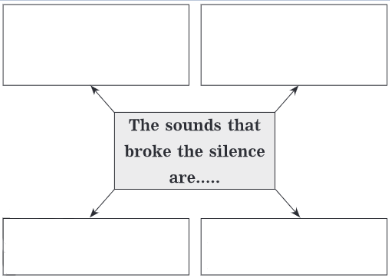
     After a hearty lunch, my parents and my younger sisters lay down for an afternoon nap and I settled down with a storybook. The quiet afternoon presented the perfect backdrop for reading an adventure story. The silence was occasionally broken by the sound of my family snoring, the intermittent chirping of house sparrows, the harsh cawing of a crow the shrill call of a kite flying high above the ground. Minutes ticked by. I became deeply absorbed in the book.

A2. Complex Factual Activities:
Complete the web describing the campus where writer's family lived:
Image
A3. Activities based on Vocabulary:
Match the synonyms:

Column 'A'

Column 'B'

(1) revealed

(a) opportunity

(2) new factor

(b) engrossed in

(3) occupied in

(c) new dimension

(4) chance

(d) unfolded


A4. Activities based on Contextual Grammar: 
(1) The writer's house was in a corner of the ampus.
(Make 'Wh-question' to get underlined part as an answer.) 
(2) I became deeply absorbed in the book.
(Rewrite it in Simple Present Tense)
A5. Personal Response :
(1) Do you like to live in a bungalow? Why? 

A1. Simple Factual Activities:
Write whether the following sentences are True or False:
(1) Writer's journey from India to Norway is a connect between the two centre of global peace.
(2) The Nobel Committee did not invite the writer to deliver a lecture.
(3) Writer represented the sound of silence and cry of innocence.
(4) Writer humbly accepted the award on behalf of all activists.

     My dear children of the world ... Your Majesties, Your Royal Highnesses, Excellencies, distinguished members of the Norwegian Nobel Committee, dear brother Tom Harkin, brothers and sisters, and my dear daughter Malala.
      From this podium of peace and humanity, I am deeply honoured to recite a mantra from the ancient texts of wisdom, Vedas. This mantra carries a prayer, an aspiration and a resolve that has the potential to liberate humanity from all man-made crises.
      Let’s walk together. In the pursuit of global progress, not a single person should be left out or left behind in any corner of the world, from East to West, from South to North. Let’s speak together, let our minds come together! Learning from the experiences of our ancestors, let us together create knowledge for all that benefits all.
      I bow to my late parents, to my motherland India, and to the mother earth.
      With a warm heart I recall how thousands of times, I have been liberated, each time I have freed a child from slavery. In the first smile of freedom on their beautiful faces, I see the Gods smiling.
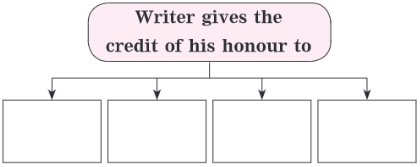
      I give the biggest credit of this honour to my movement’s Kaalu Kumar, Dhoom Das and Adarsh Kishore from India and Iqbal Masih from Pakistan who made the supreme sacrifice for protecting the freedom and dignity of children. I humbly accept this award on behalf of all such martyrs, my fellow activists across the world and my countrymen.
      My journey from the great land of Lord Buddha, Guru Nanak and Mahatma Gandhi; India to Norway is a connect between the two centres of global peace and brotherhood, ancient and modern.
      Friends, the Nobel Committee has generously invited me to present a “lecture.” Respectfully, I am unable to do that. Because, I am representing here - the sound of silence. The cry of innocence. And, the face of invisibility. I represent millions of those children who are left behind and that’s why I have kept an empty chair here as a reminder.

A2. Complex Factual Activities:
Complete the following :
Image
A3. Activities based on Vocabulary:
(1) Use the word 'credit' as a noun and a verb to make a meaningful sentence.
A4. Activities based on Contextual Grammar:
Do as directed:
(1) I humbly accept this award. (Choose the correct question tag.)
(a) do I?  (b) don't I? (c) did I? (d) didn't I?
(2) I am unable to do that.
(Make it negative without changing its meaning)
A5. Personal Response:
(1) What do you know about Kailash Satyarthi? 
A1. Simple Factual Activity:
Say whether the following statements are True or False:
(1) At the age of 17, Dr Stephen Hawking was suffering from an extremely rare disease.
(2) Stephen's teachers liked his handwriting very much.
(3) He got his Ph.D. studying the concept of 'Black Holes'.
(4) At the dismal stage Dr Hawking enjoyed his life the most. 

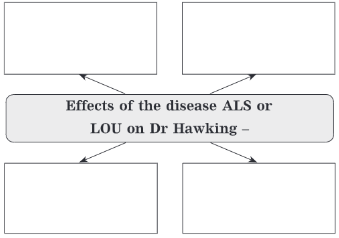
     At the age of 17, Stephen started noticing that he was becoming increasingly clumsy and even fell down a couple of times, for no reason. This perplexed him and he went to see his family doctor, who diagnosed him as suffering from an extremely rare disease - ALS or LOU Gehrig's disease that affects the nervous system and eventually weakens all the muscles of the body. Stephen says that even as a child, his muscle co-ordination was nothing to write home about. He recollects that his handwriting would send his teacher into a fit of frenzy. Nor was he inclined towards sports. Nevertheless, this disease came as a bolt from the blue.
      How much time he had left on this planet was very uncertain. The prognosis was bad and the doctors said they could not do much. Undaunted, Stephen decided to continue his research and even got engaged to a Jane Wilde. Hawking says that,
ironic as it may sound, it is at this dismal stage, began enjoying life the most. This he says was because he started living life for the moment and continued his doctoral research work with renewed vigour.
     In the meanwhile, the disease worked its way into Stephen’s body and left him disabled. He began studying the concept of “Black Holes”, to get his Ph.D. By this time, he was confined to a wheelchair and was rapidly losing control of his hands and
speech. The study of “black holes” sparked his imagination with bright ideas. He made many epochmaking statements that shook established theories.Scientists believe that the universe began with a “Big Bang”. To explain this concept better, Stephen invented what is known as “Lie Algebra”.

A2. Complex Factual Activity:
(1) Complete the following web showing the effects of the disease ALS or LOU on Dr Hawking:
Image
A3. Activities based on Vocabulary:
Match the words in Column 'A' with their meanings in Column 'B':

Column 'A'Column 'B'
 (1) confined (a) determined despite difficulties
 (2) undaunted (b) awkward
 (3) perplexed (c) restricted
 (4) clumsy (d) worried because of difficulty

A4. Activities based on Contextual Grammar:
Change the following sentences as instructed: 
(1) He made many epochmaking statements.
(Rewrite the sentence using Present Continuous Tense.)
(2) This disease came as a bolt from the blue.
(Rewrite the sentence using Past Perfect Tense.)
Ans. This disease had come as a bolt from the blue.
A5. Personal Response:
(1) What, do you think, are the miseries of a person who is confined to wheelchair?