Question
A1. Simple Factual Activity:
State whether the following statements are True or False:
(1) The young seagull was not confident about the ability of his wings.
(2) The young seagull's parents guided and improved his siblings in the art of flying.
(3) The wings of the young seagull were not as short as his own.
(4) The whole family of seagulls commended him for his cowardice.

     The young seagull was alone on his ledge. His two brothers and his sister had already flown away the day before. He had been afraid to fly with them. Somehow when he had taken a little run forward to the brink of the ledge and attempted to flap his
wings he became afraid. The great expanse of sea stretched down beneath, and it was such a long way down - miles down. He felt certain that his wings would never support him; so he bent his head and ran away back to the little hole under the ledge where he slept at night. Even when each of his brothers and his little sister, whose wings were far
shorter than his own, ran to the brink, flapped their wings, and flew away, he failed to muster up courage to take that plunge which appeared to him so desperate. His father and mother had come around calling to him shrilly, upbraiding him, threatening to let him starve on his ledge unless he flew away. But for the life of him he could not move.
      That was twenty-four hours ago. Since then nobody had come near him. The day before, all day long, he had watched his parents flying about with his brothers and sister, perfecting them in the art of flight, teaching them how to skim the waves and how to dive for fish. He had, in fact, seen his older brother catch his first herring and devour it, standing on a rock, while his parents circled around raising a proud cackle. And all the morning the whole family had walked about on the big plateau midway down the opposite cliff taunting him for his cowardice.

A2. Complex Factual Activity:

(1) How did the seagull parents perfect the young seagull's brothers and sister in the art of flight? 
A3. Activities based on Vocabulary:
Pick out from the passage the Homophones for the following:
(1) see 
(2) wood 
(3) there 
(4) scene
A4. Activities based on Contextual Grammar:
Read the following sentences carefully, underline the verbs and then find out the tenses in the sentences:
(1) His two brothers and his sister had already flown away.
(2) But for the life of him he could not move.
A5. Personal Response:
(1) Are you afraid of playing any outdoor game? Explain why? 
Answer

A1. Simple Factual Activity:
(1) True
(2) True
(3) False
(4) False 
A2. Complex Factual Activities:
(1) The parents of the seagull flew about with his brothers and sister, perfecting them in the art of flying. They trained them how to skim the waves and how to dive for fish. When they succeeded in the art, the parents circled about them raising a proud cackle to encourage them.
A3. Activities based on Vocabulary:
(1) see - sea
(2) wood - would 
(3) there - their 
(4) scene - seen
A4. Activities based on Contextual Grammar:
(1) His two brothers and his sister had already flown away.  Past Perfect Tense
(2) But for the life of him he could not move. Simple Past Tense
A5. Personal Response:
(1) Yes, I am afraid of playing Kabbadi. It appears to me that it is a very rough and tough game. I am very much afraid of the injuries caused in it. I cannot endure the thought of injury. I believe that it is a game for only strong and hefty people.

Need a full question paper?

Generate a complete, print-ready paper with questions like this in minutes — across 16+ boards, with answer keys.

Start Generating Free

Similar questions

A1. Simple Factual Activities:
Make a list of the problems that we are facing and creating violence against children -

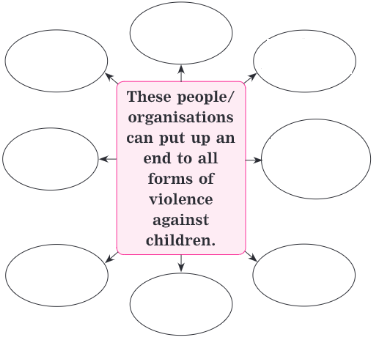
     I call upon all the governments, intergovernmental agencies, businesses, faith leaders, workers, teachers and NGOs, and each one of us, to put an end to all forms of violence against children. Slavery, trafficking, child marriages, child labour, sexual abuse, and illiteracy these things have no place in any civilised society.
     Friends, we can do this. Governments must make child - friendly policies, and invest in education and young people. Businesses must be more responsible, accountable and open to innovative partnerships.Intergovernmental agencies must work together to accelerate action. Global civil society must rise above the business-as-usual and fragmented agendas. Faith leaders and institutions, and all of us must stand with our children.
     We must be bold, we must be ambitious, and we must have the will. We must keep our promises. Over fifty years ago, on the first day of my school, I met a cobbler boy, my age sitting outside the gate of my school. I asked my teachers: “Why is he working outside? Why is he not with us in the school?” My teachers had no answer. One day, I
gathered the courage to ask the boys’ father. He said: “Sir, I have never thought about it. We are born to work.”
     His answer made me angry. It still makes me angry.

A2. Complex Factual Activities:
Image
A3. Activities based on Vocabulary:

Find out the describing words used for the following noun and make your own sentences by using any combination:
(1) _______________ agencies
(2) _______________ partnership
A4. Activities based on Contextual Grammar:
Make the sentences affirmative:
(1) My teacher had no answer.
(2) I have never thought about it.
A5. Personal Response:
(1) Why should we stop 'Child labour'?
A1. Simple Factual Activities:
Fill in the blanks:
(1) Ramlal had ________ sons and ________ daughters.
(2) All the children except Bholi were ________ and ________.

    Her name was Sulekha but since her childhood everyone had been calling her Bholi the simpleton.
    She was the fourth daughter of Numberdar Ramlal. When she was ten months old, she had fallen off the cot on her head and perhaps it had damaged some part of her brain. That was why she remained a backward child and came to be known
as Bholi, the simpleton.
     At birth the child was very fair and pretty. But when she was two years old, she had an attack of small pox. Only the eyes were saved. But the entire body was permanently disfigured by deep black pockmarks. Little Sulekha could not speak till she was five and when at last she learnt to speak, she stammered. The other children often made fun of
her and mimicked her. As a result, she talked very little.
     Ramlal had seven children, three sons and four daughters and the youngest of them was Bholi. It was a prosperous farmer’s household and there was plenty to eat and drink. All the children except Bholi were healthy and strong. The sons had been sent to
the city to study in schools and later in colleges. Of the daughters Radha, the eldest had already been married. The second daughter Mangla’s marriage had also been settled Ramlal would think of third Champa. They were good looking, healthy girls. And
it was not difficult to find bridegrooms for them.
     But Ramlal was worried about Bholi. She had neither good looks nor intelligence.
     Bholi was seven years old when Mangla was married. The same year a primary school for girls was opened in their village. The Tehsildar sahib came to perform its opening ceremony. He said to Ramlal, ‘‘As a revenue official you are the representative of the government in the village and so you must set an example to the villagers. You
must send your daughter to school.’’
      That night when Ramlal consulted his wife. She cried, ‘‘Are you crazy? If girls go to school, who will marry them?’’
      But Ramlal had not the courage to disobey the Tehsildar. At last his wife said, ‘‘I will tell you what to do. Send Bholi to school. As it is there is little chance of her getting married, with her ugly face and lack of sense. Let the teachers at school worry about her.’’

A2. Complex Factual Activities:
Give reasons:
(1) Little Sulekha used to talk very little because - _______________
A3. Activities based on Vocabulary:
Use the following phrases in the following sentences by making certain changes:
(to shout in terror, to pass on, to hand over)
(1) My sister _______________ a letter of apology to her class teacher.
(2) My father had the day off because he didn't want _______________ his flu to everyone in the office."
A4. Activities based on Contextual Grammar:
Do as directed:
(1) The child was very fair and pretty.
(Choose correct alternative to make it exclamatory.)
(a) What a fair and pretty the child was!
(b) How a fair and pretty the child was!
(c) How fair and pretty the child was!
(2) There was plenty to eat and drink.
(Pick out the infinitive.) 
A5. Personal Response:
(1) How do you feel on the first day of your school? 
A1. Simple Factual Activity:
State whether the following statements are True or False:
(1) R. K. Narayan's 'Swami and Friends' is a good read for the kids and teens alike.
(2) Mischievous kids are not as sensitive as other people.

     Significance of the book...
    ‘Swami and Friends’ by R. K. Narayan is not merely an interesting read that could be enjoyed from top to bottom, but the work attributes a lot of literary values even if it is a teen book ‘Swami and Friends’ is a good read for the kids and teens alike. Also the book is widely used in the Asian continent as a study text for the students who study literature as a subject at schools. This does not mean that the book is filled with heavy grammar and technical jargon. Actually the truth is in contrary to this.
     Swami and Friends is written in such simple English it is hard to imagine that it is a work of such a literary genius like R. K. Narayan. The English used in the book is both plain and simple, without any troubling words for the kids. Also the use of simple and short sentences adds to the simplicity of the book.
      It is mentioned in the description that the book is about a mischievous ten year old Indian boy, and some parents may be concerned about the influence this will have on their already mischievous children. But the book is as such, that it encompasses the
mischief of the kids in a view of the kid which is harmless and pure in his perspective. Also amidst all the mischief and naughtiness, we actually find that Swami is a loving and a tender kid who's actually very sensitive. It is also a known fact that mischievous
kids are the most sensitive and loving people of all. And R. K. Narayan does a great job conveying that to all of us.

A2. Complex Factual Activity:
Complete the following web:
Image
A3. Activities based on Vocabulary:
Find the following from the passage:
(i) Noun forms of : conclude, rule
(ii) Verb forms of : improvement, inclusion
A4. Activities based on Contextual Grammar:
Do as directed:
(1) The author is one of the greatest authors of all the time.
(Change the sentence into positive degree.)
(2) R. K. Narayan is responsible for many of the outstanding literary works.
(Frame a Wh-question to get the underlined as answer.)
A5. Personal Response:
(1) What difference do you find between the children of Swami's days and today's children?
A1. Simple Factual Activity:
Write whether the following statements are 'true' or 'false":
(1) Writer's father was a medical professional.
(2) After a hearty lunch the narrator settled down with a story book.

     My father was a medical professional working for a private company in Raniganj in West Bengal. The officers of the company were housed in individual bungalows inside a large campus. Our house was in a corner of the campus. The officer’s club was adjacent to the boundary wall of our garden. The compound was luxurious with green grass, colourful flowers and a host of tall and majestic trees. The seasonal vegetables in the kitchen gardens of the households and the magnificent trees constantly attracted squirrels and many species of birds; a group of langurs had even made their den in an aswatha tree nearby. They had all become a part and parcel of our existence and daily life.
     A small incident on a Saturday afternoon left a profound effect on me and unfolded before my eyes a whole new dimension to the wonders of God’s creation. It was a few days into the Puja vacation. Just like for any other child, the holidays provided an opportunity for me to become engrossed in various magazines and storybooks published specially for children in the festive season.
     After a hearty lunch, my parents and my younger sisters lay down for an afternoon nap and I settled down with a storybook. The quiet afternoon presented the perfect backdrop for reading an adventure story. The silence was occasionally broken by the sound of my family snoring, the intermittent chirping of house sparrows, the harsh cawing of a crow the shrill call of a kite flying high above the ground. Minutes ticked by. I became deeply absorbed in the book.

A2. Complex Factual Activities:
Complete the web describing the campus where writer's family lived:
Image
A3. Activities based on Vocabulary:
Match the synonyms:

Column 'A'

Column 'B'

(1) revealed

(a) opportunity

(2) new factor

(b) engrossed in

(3) occupied in

(c) new dimension

(4) chance

(d) unfolded


A4. Activities based on Contextual Grammar: 
(1) The writer's house was in a corner of the ampus.
(Make 'Wh-question' to get underlined part as an answer.) 
(2) I became deeply absorbed in the book.
(Rewrite it in Simple Present Tense)
A5. Personal Response :
(1) Do you like to live in a bungalow? Why? 

A1. Simple Factual Activities:
Choose the correct alternative and complete the following sentences:
(1) Bholi is compared with _______________.
(a) a dumb cow (b) a kind cow (c) a dead cow
(2) _______________ was not ready to get married.
(a) Bishamber (b) Bholi (c) Bholi's friend

     The bridegroom lifted the garland of yellow marigolds. A woman slipped back the silken veil from the bride’s face. Bishamber took a quick glance. The garland remained poised in his hands. The bride slowly pulled down the veil over her face.
     “Have you seen her ?” said Bishamber to the friend next to him. “She has pockmarks on her face.”
     “So what ? You are not young either.”
     “Maybe. But if I am to marry her, her father must give me five thousand rupees.”
     Ramlal went and placed his turban - his honour - at Bishamber’s feet. “Do not humiliate me so. Take two thousand rupees.”
     “No. Five thousand, or we go back. Keep your daughter.”
     “Be a little considerate, please. If you go back, I can never show my face in the village.”
     “Then out with five thousand.”
     Tears streaming down his face, Ramlal went in, opened the safe and counted out the notes. He placed the bundle at the bridegroom’s feet.
     On Bishamber’s greedy face appeared a triumphant smile. He had gambled and won. “Give me the garland,” he announced.
     Once again the veil was slipped back from the bride face but this time her eyes were not downcast. She was looking up, looking straight at her prospective husband, and in her eyes there was neither anger nor hate, only cold contempt.
      Bishamber raised the garland to place it round the bride’s neck but before he could do so, Bholi’s hand struck out like a streak of lightening and garland was flung into the fire. She got up and threw away the veil.
     “Pitaji” said Bholi in a clear loud voice; and her father, mother, sisters, brothers, relations and neighbours were startled to hear her speak without even the slightest stammer.
     “Pitaji”, take back your money. I am not going to marry this man.”
      Ramlal was thunderstruck. The guests began to whisper, “So shameless! So ugly and so shameless !”
     “Bholi, are you crazy ?” shouted Ramlal. “You want to disgrace your family? Have some regard for out izzat!”
     “For the sake of your izzat,” said Bholi, “I was willing to marry this lame old man. But I will not have such a mean, greedy and contemptible coward as my husband. I won’t, I won’t, I won’t.”
     What a shameless girl! We all thought she was a harmless dumb cow.”

A2. Complex Factual Activities:
(1) What shocked the family members?
A3. Activities based on Vocabulary:
Find out synonyms from the passage for the following words:
(1) humiliate
(2) contempt 
(3) prospective
(4) startled 
A4. Activities based on Contextual Grammar:
Rewrite the following into indirect speech:
(1) "Be a little considerate, please. If you go back, I can never show my face in the village." "Then out with five thousand."
(2) "Pitaji, take back your money. I am not going to marry this man." "Bholi, are you crazy?" shouted Ramlal.
A5. Personal Response:
(1) What did you learn from Bholi's action of not getting married to Bishamber? 
A1. Simple Factual Activity:
Who said to whom?
(1) "The bird has flown!"
(2) "The Pipalnagar Bank is about to collapse."

     ‘What’s that?’ said Kamal Kishore, sitting up suddenly. ‘Which bank?’
     ‘Why the Pipalnagar bank of course. I hear they have stopped paying employees. Don’t tell me you have an account there, Mr. Kishore?’
     ‘No, but my neighbour has!’ he exclaimed; and he called out over the low partition to the keeper of the barber shop next door. ‘Deep Chand, have you heard the latest? The Pipalnagar Bank is about to collapse. You’d better get your money out as soon as you can!’
     Deep Chand who was cutting the hair of an elderly gentleman, was so startled that his hand shook and he nicked his customer’s right ear. The customer yelped with pain and distress: pain, because of the cut and distress because of the awful news he
had just heard. With one side of his neck still unshaven, he sped across the road to the general merchant’s store where there was a telephone. He dialled Seth Govind Ram’s number. The Seth was not at home. Where was he, then? The Seth was holidaying in Kashmir. Oh, was that so? The elderly gentleman did not believe it. He hurried back to the barber’s shop and told Deep Chand: ‘The bird has flown! Seth Govind Ram has left town. Definitely, it means a collapse.’ And then he dashed out of the shop, making a beeline for his office and chequebook.
    The news spread through the bazaar with the rapidity of forest fire. From the general merchant’s it travelled to the shop, circulated amongst the customers, and then spread with them in various directions, to the betel-seller, the tailor, the free vendor, the jeweller, the beggar sitting on the pavement.   

A2. Complex Factual Activity:
Complete the web :
Image
A3. Activities based on Vocabulary:
Match the column with their meanings:

WordsMeanings
 (1) beeline (a) state of being upset
 (2) pavement (b) the direct route
 (3) nicked (c) the road for the people to walk
 (4) distress (d) cut slightly

A4. Activities based on Contextual Grammar:
Do as directed:
(1) Mr Kishore said, "Deep Chand, have you heard the latest?" (Change into indirect speech.)
(2) The bird has flown. (Rewrite the sentence using Past Perfect Tense)
A5. Personal Response:
(1) Do you think that rumour spreads faster than fire? Support your answer in two to three lines.

A1. Simple Factual Activities:
State whether you Agree or Disagree with the following statements: 
Statements
(1) The narrator was fifty-five years old when this incident occurred.
(2) Even today, the narrator cannot forget that look in the mother langur's eyes.

    For a few seconds, the mother langur looked straight into my eyes. Even today, I cannot forget that look in her eyes, showering silent gratitude on me for saving her child. I was overwhelmed by the emotion, the sentiment and the way she said thanks to me. There sat a universal mother holding a stricken child in her lap.
    Then, in a flash, she jumped with her baby clinging to her belly and reached our kitchen roof. She surveyed the area for the vicious male langur and then leapt away in the direction opposite to the place of the violent encounter.
    The brief meeting with the mother and the baby langur convinced me that interspecies communication and mutual trust is indeed a reality and should anyone strike the right chord, the relationship hums into action. The mother langur showed me that food was not the only means of communication between man and animal but that there were other means of establishing a bond through trust, compassion and mutual understanding.
     Fifty-five years have passed since that day. I am now seventy years old. But I still fondly remember that ‘encounter of a special kind’.

A2. Complex Factual Activities:
Complete the web:
Image
 
A3. Activities based on Vocabulary:
Find the words from the passage for the following meanings:
(1) held closely
(2) moved downwards
(3) think very deeply
(4) comfort and peace
A4. Activities based on Contextual Grammar:
Do as directed:
(1) I cannot forget that look in her eyes. (Add a question tag.)
(2) I was overwhelmed by the emotion.
(Write the sentence in Active voice. Begin with The emotion....)
A5. Personal Response:
(1) What opinion do you form about the writer from the story?
A1. Simple Factual Activity:
State whether the following statements are Rumours or Facts:
(1) The manager told the customers to go home and come back next day.
(2) Nathu was disgusted to see the broken glass and  stonescluttering the steps.

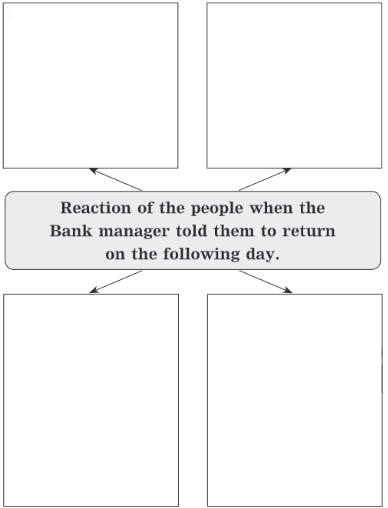
     People were turned back from the counters and told to return the following day. They did not like the sound of that. And so they gathered outside, on the steps of the bank shouting ‘Give us our money or we’ll break in!’ and ‘Fetch the Seth, we know he’s hiding in a safe deposit locker!’ Mischief makers who didn’t have a paisa in the bank, joined the crowd and aggravated their mood. The manager stood at the door and tried to placate them. He declared that the bank had plenty of money but no immediate means of collecting it; he urged them to go home and come back the next day.
    ‘We want it now!’ chanted some of the crowd.‘Now, now, now!’
     And a brick hurtled through the air and crashed through the plate glass window of the Pipalnagar Bank.
    Nathu arrived next morning to sweep the steps of the bank. He saw the refuse and the broken glass and the stones cluttering the steps. Raising his hands in a gesture of horror and disgust he cried: ‘Hooligans! Sons of donkeys! As though it isn’t bad enough to be paid late, it seems my work has also to be increased!’ He smote the steps with his broom scattering the refuse.
    Good morning, Nathu,’ said the washerman’sboy, getting down from his bicycle. ‘Are you ready to take up a new job from the first of next month? You’ll have to I suppose, now that the bank is going out of business.’
    ‘How’s that?’ said Nathu. ‘Haven’t you heard? Well you’d better wait here until half the population of Pipalnagar arrives to claim their money.’ And he waved cheerfully he did not have a bank account and sped away on his cycle.
     Nathu went back to sweeping the steps, muttering to himself. When he had finished his work, he sat down on the highest step, to await the arrival of the manager. He was determined to get his pay. ‘Who would have thought the bank would collapse!’ he said to himself, and looked thoughtfully into the distance. ‘I wonder how it could have happened …

A2. Complex Factual Activity:
Complete the web:
Image
A3. Activities based on Vocabulary:
Write one word for the following:
(1) a person who deliberately causes trouble to people.
(2) a person who washes clothes for other people.
A4. Activities based on Contextual Grammar:
Do as directed :
(1) Nathu raised his hands in a gesture of horror. He cried.
(Join the sentences beginning with the word 'Raising'.)
(2) He was determined to get his pay.
(Change the sentence into exclamatory sentence.)
A5. Personal Response:
(1) How are rumours spread? Are the rumours harmful? Why?/Why not? 
A1. Simple Factual Activity:
Complete the following sentences:
(1) The writer's house was in  _______________.
(2) The officer's club was _______________.

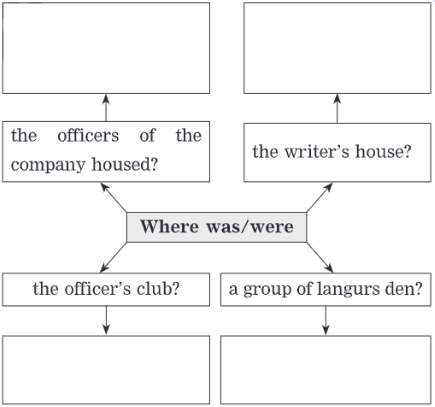
     My father was a medical professional working for a private company in Raniganj in West Bengal. The officers of the company were housed in individual bungalows inside a large campus. Our house was in a corner of the campus. The officer’s club was adjacent to the boundary wall of our garden. The compound was luxurious with green grass, colourful flowers and a host of tall and majestic trees. The seasonal vegetables in the kitchen gardens of the households and the magnificent trees constantly attracted squirrels and many species of birds; a group of langurs had even made their den in an aswatha tree nearby. They had all become a part and parcel of our existence and daily life.
     A small incident on a Saturday afternoon left a profound effect on me and unfolded before my eyes a whole new dimension to the wonders of God’s creation. It was a few days into the Puja vacation. Just like for any other child, the holidays provided an opportunity for me to become engrossed in various magazines and storybooks published specially for children in the festive season.
     After a hearty lunch, my parents and my younger sisters lay down for an afternoon nap and I settled down with a storybook. The quiet afternoon presented the perfect backdrop for reading an adventure story. The silence was occasionally broken by the sound of my family snoring, the intermittent chirping of house sparrows, the harsh cawing of a crow the shrill call of a kite flying high above the ground. Minutes ticked by. I became deeply absorbed in the book.

A2. Complex Factual Activities:
Complete the web describing the campus where writer's family lived:
Image
A3. Activities based on Vocabulary:
Match the synonyms:

Column 'A'

Column 'B'

(1) a part and parcel of

(a) get into a comfortable position

(2) to be engrossed in

(b) penned up a new aspect

(3) settle down with

(c) to be essential or integral part of something

(4) chanceunfolded a new dimension

(d) was completely occupied in


A4. Activities based on Contextual Grammar: 
(1) The compound was luxurious with green grass. (Choose the correct question tag.) 
(a) doesn't it?  (b) does it? (c) wasn't it? (d) was it?
(2) The writer's house was in a corner of the ampus.
(Make 'Wh-question' to get underlined part as an answer.) 
A5. Personal Response :
(1) Describe the surroundings where you live.

A1. Simple Factual Activities:
Choose the correct alternatives and complete the following sentences:
(1) In the cold winter month, the tree was _______________ of all leaves.
(a) full (b) withdrew (c) bare (d) short
(2) We find innunerable _______________ in the infinite sky.
(a) clouds (b) crowds (c) stars (d) moons.

     We saw small bits of grass peeping through the small cracks in a concrete pavement. It left us thinking : however impossible things may look, there is always an opening...
     We saw a tree bare of all leaves in the cold winter months. We thought its chapter was over. But three months passed, spring set in and the tree was back to its green majesty once again, full of leaves, flowers, birds and life. What if we too had the conviction that, however difficult things are right now, it will not remain so for ever. Remember, this too shall pass.
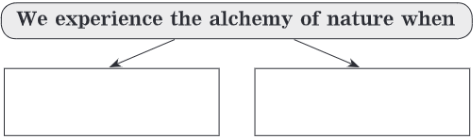
     We saw an army of ants lugging a fly which was at least ten times the ant’s size. The ants organized themselves around the fly, lifted it on frail feelers and carried it to quite a distance. Their teamwork and perseverance were impressive. What if we too are consistent, organized, focused...Spider webs are delicate, yet very strong. A rainbow colours the entire sky. Oysters take in a grain of sand they open up with a pearl. Innumerable stars shine across the infinite sky. Clouds take new shapes with every passing moment. The wind makes trees dance with unhindered passion. Water, without hint of ego, changes its form according to the dictates of the sun and the wind. When we see a caterpillar turn into a butterfly, a flower turn into a fruit, we experience the alchemy of nature... we touch it and become gold ourselves.

A2. Complex Factual Activities:
Complete the following web :
Image
A3. Activities based on Vocabulary:
Find out synonyms from the text for the following words/phrases:
(1) to peer through
(2) easily broken or damaged
(3) mysterious power
(4) drag with great efforts
A4. Activities based on Contextual Grammar:

Do as directed:
(1) We saw an army of ants. (Choose the correct sentence of passive voice.)
(a) An army of ants was seen by us.
(b) An army of ants were seen by us.
(c) An army of ants is seen by us.
(d) An army of ants are seen by us.
(2) We touch it. (Rewrite the sentence in 'Past Perfect Tense.')
A5. Personal Response:
(1) How can learning from nature help human beings?