Question
A1.Simple Simple l Factual Activities:
State whether the statements are True or False: 
(i) It is necessary for science and faith to function true to their roles.
(ii) Kalam's status as a great scientist is in dispute.
(iii) Both fact and faith are required for a better world.
(iv) There is never any conflict between believers in science and believers in religion.
   
   We often witness conflict between two groups of people - one that believes in science and the other that believes in religion.
   Dr Kalam was a great scientist - this is indisputable.But he was also convinced that fact and faith can, together, create a better planet. He once told me, ‘Science and faith must coexist for the human good. Science provides focus-focus helps us solve questions, discover the truth and conceive inventions.Faith provides perspective - perspective helps us see how our creations and discoveries go on to impact a combination vital for the success of societies. Science accelerates progress and faith curbs it within reasonable limitations. If the two function true to their roles, they will work together for the betterment of humanity.’

A2. Complex Factual Activity:

Match the words in Column 'A' with associating words given in Column 'B':

'A''B'
(1) Science and faith(a) Created by fact and faith
(2) Science(b) Success of societies
(3) Better Planet(c) Betterment of humanity
(4) Creations and Discoveries(d) Believers of science and religions
(5) Conflict(e) Solves questions, discovers truth, conceives inventions

A3. Activities based on Vocabulary:
From the passage pick out one word for each of the following:
(i) increase the speed
(ii) point of view
(iii) keeps something within limits
(iv) unable to be challenged or doubted  
A4. Activities based on Contextual Grammar:
Fill in the blanks with suitable prepositions:
(i) Conflict often arises .............. people who believe ........... science and people who believe ........... religion.
A5. Personal Response:
(i) Which, according to you, is more important for our planet to survive - science or religion? Give your reasons in brief.
Answer

A1. Simple Factual Activities:
State whether the statements are True or False: 
(i) True
(ii) False
(iii) True
(iv) False
A2. Complex Factual Activities:

'A''B'
(1) Science and faith(b) Success of societies
(2) Science(e) Solves questions, discovers truth, conceives inventions
(3) Better Planet(a) Created by fact and faith
(4) Creations and Discoveries(c) Betterment of humanity
(5) Conflict(d) Believers of science and religions

A3. Activities based on Vocabulary:
(i) accelerate
(ii) perspective
(iii) curbs
(iv) indisputable
A4. Activities based on Contextual Grammar:
(i) Conflict often arises between people who believe in science and people who believe in religion.
A5. Personal Response:
(i) According to me, both are important - science
as well as religion. Science provides us with facts that tell us about our planet. Religion educates us about the proper attitude towards all things created on earth. We need both for our planet to survive. Both go hand in hand.

Need a full question paper?

Generate a complete, print-ready paper with questions like this in minutes — across 16+ boards, with answer keys.

Start Generating Free

Similar questions

A1.Simple Factual Activities:
Fill in the blanks:

(i) For 30 years, Stephen Hawking held the post of ..................... .
(ii) Stephen Hawking selected his words with a ...................... .
(iii) Stephen Hawking failed to appear at the conference because of a .................. .
(iv) ................ remains a constant anxiety.

   The predicament caught the attention of a California computer programmer, who had developed a speaking program that could be directed by head or eye movement. The invention allowed Hawking to select words on a computer screen that were then passed through a speech synthesizer. At the time of its introduction, Hawking, who still had use of his fingers,selected his words with a handheld clicker. Today, with virtually all control of his body gone, Hawking directs the program through a cheek muscle attached to a
sensor.
   Through the program, and the help of assistants, Stephen Hawking has continued to write at a prolific rate. His work has included numerous scientific papers,of course, but  also information for the non-scientific community.
   Hawking’s health, of course, remains a constant concern - a worry that was heightened in 2009 when he failed to appear at a conference in Arizona because of a chest infection. In April, Hawking, who had already announced he was retiring after 30 years from the post of Lucasian Professor of Mathematics at Cambridge, was rushed to the hospital for being what university officials described as “gravely ill.” It was later announced that he was expected to make a full recovery.

A2. Complex Factual Activity:
Explain the life of Stephen Hawking with reference to the following statement:
(i) Hawking's health, of course, remains a constant concern.
A3. Activity based on Vocabulary:
Choose three synonyms for each of the following:

(i) Write the adjective forms of:
(a) infection  (b) office.
(ii) Write from the last paragraph phrases that give an indication of Stephen Hawking's health situation.
A4. Activities based on Contextual Grammar:
Underline the determiners:

Today, with virtually .............. control of ............ body gone. Hawking directs ............. program through ............. cheek muscle attached to .............. sensor.
A5. Personal Response:
Do you agree or disagree with the following statement? Justify your stand/answer by quoting a line from the passage.
(i)  Though Hawking lost control over his body, he writes at a prolific rate with the help of assistants.
A1.Simple Factual Activities:
Name the following :
(i) Language of the novel
(ii) In his first reading, the reviewer was left :
(iii) After recent reading the reviewer was left:
(iv) It fights for its life desperately :

    Hemingway’s language is simple and pithy. He mostly writes in short and straight-forward sentences and practises an extreme economy in his use of words. This simplicity is deceptive and a reader can read his work again and again and find new layers of meaning every time.
   I first read this novel years ago, when I did not understand it at all and was left unimpressed. In spite of this a vivid image remained with me – an old man holding on to his fishing line with the last of his strength. Recently I read this book again and was extremely moved. The formidable strength of the old man’s character, the quiet devotion of the empathetic Manolin and the relationship between the two are heartwarming. Hemingway’s descriptions of the sea and the creatures of the water are beautiful. The marlin fights for its life desperately and it’s hard to know whether
our sympathies should lie with the old man or with the marlin. But as the novel progresses the old man and the marlin are inseparably linked because both stand
for the same ideal, that is, a noble struggle against destruction.

A2. Complex Factual Activity:
Explain in one or two sentences :
(i) 'Hemingway practises an extreme economy in his use of words". What does this mean?
(ii) What are the ideals that the old man and the marlin both stand for ?
A3. Activity based on Vocabulary:
Write the 'root word' after dropping the prefix or suffix or both :
(i) unimpressed
(ii) relationship
(iii) inseparably
(iv) empathetic
A4. Activities based on Contextual Grammar:
Rewrite as directed, without changing the meaning :
(i) The reader can read his work again and again and find new layers of meaning.
(Begin the sentence with 'On reading....')
(ii) As the novel progresses, the old man and the marlin are inseparably linked.
(Rewrite using 'progress' as a noun.)
A5. Personal Response:
(i) Write four to five sentences about your favourite writer.
A1. Simple Factual Activities:
Write if the following statements are True or False: 
(i) Joan is angry when Robert tells her to get out.
(ii) Joan feels that Squire Jack is kind.
(iii) The steward's name is Bertrand de Poulengey.
(iv) Robert thinks that the girl's idea is crazy.

Robert : (Shocked) To free Orleans!
Joan : (Simply) Yes, squire. Three men will be enough for you to send with me. Polly
and Jack have promised to come with me.
Robert : You mean Monsieur de Poulengey?
Joan : Yes, Squire Jack will come willingly.He is a very kind gentleman, and gives
me money to give to the poor. I think John Godsave will come, and Dick the Archer, and their servants, John of Honecourt and Julian. There will be no trouble for you, squire. I have arranged it all. You have only to give the order.
Robert : (To the steward) Is this true about Monsieur de Poulengey ?
Steward : (Eagerly) Yes, sir, and about Monsieur de Metz too. They both want to go with her.
Robert : (Goes to the window, and shouts into the court-yard.) Send Monseiur de Poulengey to me, will you? (He turns to Joan) Get out and wait in the yard.
Joan : (Smiling brightly at him) Right, squire. (She goes out).
Robert : (To the steward) Go with her. Stay within call and keep your eye on her.
I shall have her up here again. (The steward retreats hastily. Bertrand de Poulengey, a French guard, enters, salutes and stands waiting.)
Robert : She says you, Jack and Dick have offered to go with her. What for ? Do
you take her crazy idea of going to the Dauphin seriously ?  

A2. Complex Factual Activities:
Name the persons needed by Joan to free Orleans.
(i) Explain why Joan wanted to meet Captain Squire.
A3. Activities based on Vocabulary:
(i) Pick out four adverbs of manner from the passage.
A4. Activities based on Contextual Grammar: 
Make the following sentences affirmative without changing the meaning:

(i) Polly and Jack have promised to come with me.(Rewrite using "that".)
(ii) You have only to give the order. (Rewrite using 'nothing'.) 
A5. Personal Response:
(i) 'I have arranged it all'. What does this statement tell you about Joan?
A1.Simple Simple l Factual Activities:
Fill in the blanks:
(i) Hawking claimed that he could think in ................ dimensions.
(ii) ................ is the study of the big. ................... is the study of the small.
(iii) .................. is a single unifying theory that can combine cosmology with quantum mechanics.

   Together these three books, along with Hawking’s own research and papers, articulate the physicist’s personal search for science’s Holy Grail: a single unifying theory that can combine cosmology (the study of the big) with quantum mechanics (the study of the small) to explain how the universe began. It’s this kind of ambitious thinking that has allowed Hawking, who claims he can think in 11 dimensions, to lay out some
big possibilities for humankind. He’s convinced that time travel is possible, and that humans may indeed colonize other planets in the future.
   In September 2010, Hawking spoke against the idea that God could have created the universe in his book The Grand Design. Hawking previously argued that belief in a creator could be compatible with modern scientific theories. His new work, however, concluded that the Big Bang was the inevitable consequence of the laws of physics and nothing more. “Because there is a law such as gravity, the universe can and will create itself from nothing,” Hawking said. “Spontaneous creation is the reason there is something rather than nothing, why the universe exists, why we exist.”  

A2. Complex Factual Activity:

Name of Hawking's bookCentral IdeaConclusion
   

A3. Activity based on Vocabulary:
Write sentences using the given phrases:

(i) lay out
(ii) be the consequence of
A4. Activities based on Contextual Grammar:
Add question tags:
(i) There is something rather than nothing, Isn't there?
(ii) There is something rather than nothing.
A5. Personal Response:
Do you agree or disagree with the following statements? Justify your stand/answer by quoting a line from the passage:
(i) Do you agree or disagree with the following statements? Justify your stand/answer by quoting a line from the passage:

A1. Simple Factual Activities:
Arrange the following incidents in Steve Jobs' life in proper sequence based on this passage:

(i) Jobs underwent surgery.
(ii) Jobs was diagnosed with cancer.
(iii) Jobs was advised to get his affairs in order.
(iv) Jobs was cured of a rare form of cancer.

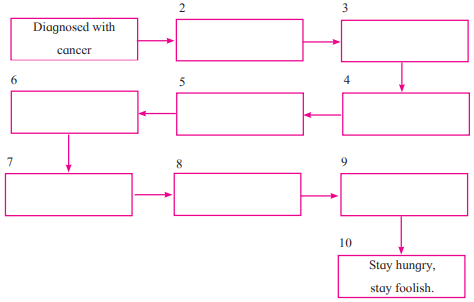
   My third story is about death.
   About a year ago I was diagnosed with cancer. My doctor advised me to go home and get my affairs in order, which is doctor’s code for ‘prepare to die’.I lived with that diagnosis all day. Later that evening I had a biopsy. It turned out to be a very rare form
of pancreatic cancer that is curable with surgery. I had the surgery and I’m fine now.
   This was the closest I’ve been to facing death, and I hope it’s the closest I get for a few more decades.Having lived through it, I can now say this to you : Your time is limited, so don’t waste it living someone else’s life.
   Don’t be trapped by dogma - which is living with the results of other people’s thinking. Don’t let the noise of other’s opinions drown out your own inner voice.
   And most important, have the courage to follow your heart and intuition. They somehow already know what you truly want to become.
   When I was young, there was an amazing publication called The Whole Earth Catalogue. In the final issue, on the back cover they put a photograph of an early
morning country road. Beneath it were the words : Stay Hungry, Stay Foolish. It was their farewell message as they signed off. I have always wished that for myself. And now, as you graduate to begin anew, I wish that for you. Stay Hungry, Stay Foolish. 

A2. Complex Factual Activities:
Read the third story and complete the flow- chart given below:
Image
A3. Activities based on Vocabulary
Match the words in column 'A' with their meanings in column 'B':

'A''B'
 (i) diagnosis (a) a set of beliefs held by an organisation which others   are expected to accept without argument.
 (ii) catalogue (d) act of identifying the nature of a problem or illness.
 (iii) dogma (a) in a new or different way.
 (iv) anew (c) complete list of items especially in a special order   and description.

A4. Activities based on Contextual Grammar:
(i) I am fine now.
(ii) I have been facing death.
A5. Personal Response:
(i) "Your time is limited. So don't waste it living someone else's life."
      What are your views about these statements?

A1.Simple Factual Activities:
Complete the following sentences using word/words from the passage : (Nov. '2O)
(i) Hemingway's novel is based on ________ .
(ii) The novel was published in ________ .
(iii) During the First World War, Hemingway worked for __________ .
(iv) Hemingway had experience of fishing in __________ .

    An old and experienced Cuban fisherman has a run of terrible bad luck and is unable to catch any fish for eighty-four days. His young and devoted apprentice, Manolin, has been forced by his parents to start working with another fisherman. The old man resolves to sail out farther than all the other fishermen and attempt to catch the really big fish. On the eightyfifth day he succeeds in hooking a marlin with his bait but the marlin is too strong for him and starts pulling the boat. ‘The Old Man and the Sea’ is the story of the old man’s struggle with the marlin and his later battle against sharks.
   Social/Historical context:
   Hemingway’s novel is based on real events and it also draws heavily on his own life. He had experience of fishing in the Cuban waters and like the old man he was also a fan of baseball. He worked for the Red Cross during the First World War and was injured by shrapnel when he was in Italy. Hemingway always talks about the need to struggle against defeat or death and how determination and endurance can help one to win in this struggle. The old man is at the end of the novel very near death, but we know that the story of his suffering and loss will live on in the memories of the people of his village. Ultimately, his story becomes one of triumph because the tales of his life will live on even after his death. The novel was published in 1952, when people were trying to recover from the mass destruction wrought by the two world wars, and this tale of endurance and ultimate triumph immediately struck a chord with the readers.

A2. Complex Factual Activity:
Complete : (Nov. '20)
(i) Two things which Hemingway always talks about :
A3. Activity based on Vocabulary:
(i) Add suffix to make adjectives: (Nov. "20)
(a) injury (b) memory
(ii) Write the synonyms from the passage for the following words : (Nov. 20)
(a) victory (b) tolerance
A4. Activities based on Contextual Grammar:
Do as directed : (Nov, '20)
(i) Ultimately his story becomes one of triumph.
(Rewrite the present perfect tense.)
(ii) He was injured during the First World War.
(Frame a Wh-question to get the underlined part as the answer.)
A5. Personal Response:
(i) Would you prefer reading a book or watching an animated film? Justify you answer. (Nov, 20)
A1.Simple Simple l Factual Activities:
Select the correct alternative and completeate the following:
(i) Wants to do this, so that no one is left behind in any corner of the world : ................ .
(walk together/remember his ancestors)
(ii) Wants to do this, to show respect to his late parents: ............... . (bow to them/speak to them)
(iii) Feels if we do this, our minds will come together: ................. . (smile/speak together)
(iv) Feels this, each time he frees a child from slavery : ............... .(honoured/liberated)

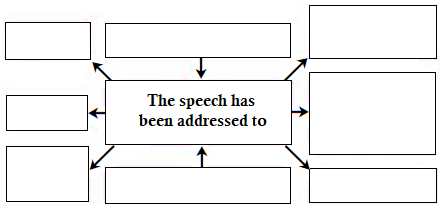
   My dear children of the world ... Your Majesties,Your Royal Highnesses, Excellencies, distinguished members of the Norwegian Nobel Committee, dear brother Tom Harkin, brothers and sisters, and my dear daughter Malala.
   From this podium of peace and humanity, I am deeply honoured to recite a mantra from the ancient texts of wisdom, Vedas. This mantra carries a prayer, an aspiration and a resolve that has the potential to liberate humanity from all man-made crises.
   Let’s walk together. In the pursuit of global progress, not a single person should be left out or left behind in any corner of the world, from East to West, from South to North.
   Let’s speak together, let our minds come together! Learning from the experiences of our ancestors, let us together create knowledge for all that benefits all.
   I bow to my late parents, to my motherland India, and to the mother earth.
   With a warm heart I recall how thousands of times, I have been liberated, each time I have freed a child from slavery. In the first smile of freedom on their beautiful faces, I see the Gods smiling.
   I give the biggest credit of this honour to my movement’s Kaalu Kumar, Dhoom Das and Adarsh Kishore from India and Iqbal Masih from Pakistan who made the supreme sacrifice for protecting the freedom and dignity of children. I humbly accept this award on behalf of all such martyrs, my fellow activists across the world and my countrymen. 

A2. Complex Factual Activity:

Complete the web-chart:
Image
A3. Activities based on Vocabulary:
(i) Choose the correct meaning of : dignity
(a) self-pride  (b) self-support  (c) self-esteem
(ii) Pick out from the passage the noun forms of the following words:
(a) dignified (b) pursue
A4. Activities based on Contextual Grammar:
Rewrite the following sentences using 'not only....but also...':
(i) This mantra carries a prayer, an aspiration and a resolve that has the potential to liberate humanity from all man-made crises.
(ii) I bow to my late parents, to my motherland India and to the mother earth.
A5. Personal Response:
(i) Write about the various problems that children are facing today.
A1. Simple Factual Activity:
Fill in the blanks with the correct options from the brackets:
(i) Hari felt very _________ when he returned to the room that night. (nervous/excited)
(ii) Hari slipped the notes under the edge of the ________ . (bed/mattress)
(iii) Hari's heart sank when he thought that his theft had been _________. (undetected/discovered)
(iv) Anil was __________ when Hari returned to the room. (awake/asleep)

   Anil’s money. In the morning he would probably have given me two or three rupees to go to the cinema, but now I had it all. I couldn’t cook his meals, run to the bazaar or learn to write whole sentences any more.
   I had forgotten about them in the excitement of the theft. Whole sentences, I knew, could one day bring me more than a few hundred rupees. It was a simple matter to steal — and sometimes just as simple to be caught. But to be a really big man, a clever and respected man, was something else. I should go back to Anil, I told myself, if only to learn to read and write.
   I hurried back to the room feeling very nervous, for it is much easier to steal something than to return it undetected. I opened the door quietly, then stood in the
doorway, in clouded moonlight. Anil was still asleep.I crept to the head of the bed, and my hand came up with the notes. I felt his breath on my hand. I remained still for a minute. Then my hand found the edge of the mattress, and slipped under it with the notes.
    I awoke late next morning to find that Anil had already made the tea. He stretched out his hand towards me. There was a fifty-rupee note between his fingers.
My heart sank. I thought I had been discovered.
  “I made some money yesterday,” he explained. “Now you’ll be paid regularly.”
   My spirits rose. But when I took the note, I saw it was still wet from the night’s rain.
  “Today we’ll start writing sentences,” he said.
   He knew. But neither his lips nor his eyes showed anything. I smiled at Anil in my most appealing way. And the smile came by itself, without any effort.

A2. Complex Factual Activities:
(i) What tact had Anil used to change Hari's dishonest ways?
A3. Insert the appropriate word/phrase given below, in the sentence that follows:
(flattery, appealing, by fits and starts, dashed to, undetected, spirits rose)
(i) The crime went ............. for 11 years.
(ii) After the death of my pet dog, my when ............ dad got me a new pup. 
A4. Activities based on Contextual Grammar:
Rewrite using the modal auxiliary 'might'.

(i) He would probably have given me two or three rupees to go to the cinema.
(ii) Whole sentences, I knew, could one day bring me more than a few hundred rupees.
A5. Personal Response:

(i) Why didn't Anil hand Hari over to the police? What effect would it have on Hari?
A1. Simple Factual Activities:
Arrange these incidents in proper sequence:
(i) The bearded man resolved to kill the king.
(ii) The king executed the bearded man's brother.
(iii) The bearded man came out of the ambush.
(iv) The bearded man laid an ambush to kill the king.

    Meanwhile the sun had set and it had become cool. So the king, with the hermit’s help, carried the wounded man into the hut. The man lay there quietly with his eyes closed. By now, the king was so tired after his walk and the work he had done, that he lay down himself and also fell asleep. When he awoke in the morning, it took him some time to remember where he was and who was the strange bearded man lying by his side and gazing intently at him. “Forgive me !” said the bearded man in a weak voice, when he saw that the king was awake and was looking at him.‘‘I do not know you, and I’ve nothing to forgive you for,” said the king. “
   You do not know me, but I know you. I am that enemy of yours who swore to revenge himself on you because you executed his brother and seized his property. I knew you had gone alone to see the hermit, and I resolved to kill you on your way back. But the day passed and you did not return. So I came out of my ambush to find you. Your bodyguards recognised me and wounded me. I escaped from them but would have bled to death had you not dressed my wound. I wished to kill you but you have saved my life. Now if I live, and if you wish it, I’ll serve you all my life.”

A2. Complex Factual Activities:
(i) The king's enemy was repentant. How do you know?
A3. Activities based on Vocabulary:
(i) From the passage, find the collocations for the following:

(a) ............. closed  (b) ............. intently 
(ii) The following compound words from the passage are spelt in jumbled order. Rearrange the letters to make them meaningful:
(a) h e i l n e w a m (b) d a d e b e r 
A4. Activities based on Contextual Grammar:
(i) 'Forgive me,' said the bearded man. (Rewrite in indirect speech.)
(ii) Pick out the finite and non-finite verbs in the sentences:
*Forgive me.
A5. Personal Response:
(i) Whom do you consider your guide when you are in difficulty? Why? (March '20)
A1.Simple Factual Activities:
Complete the following :
(i) Della had the good habit   ____________ .
(ii) Jim stared at Della   __________ .
(iii) Della took pride in the beauty of her hair __________ .
(iv) Della was a bit apprehensive after she had sold her hair because __________ .

   At 7 o’clock the coffee was made and the fryingpan was on the back of the stove hot and ready to cook the chops.
  Jim was never late. Della doubled the fob chain in her hand and sat on the corner of the table near the door that he always entered. Then she heard his step on the stair away down on the first flight, and she turned white for just a moment. She had a habit of saying little silent prayer about the simplest everyday things, and now she whispered: “Please God, make him think I am still pretty.”
  The door opened and Jim stepped in and closed it. He looked thin and very serious. Poor fellow, he was only twenty-two—and to be burdened with a family! He needed a new overcoat and he was without gloves.
  Jim stopped inside the door, as immovable as a setter at the scent of quail. His eyes were fixed upon Della, and there was an expression in them that she could not read, and it terrified her. It was not anger, nor surprise, nor disapproval, nor horror, nor any of the sentiments that she had been prepared for. He simply stared at her fixedly with that peculiar expression on his face.
   Della wriggled off the table and went for him.
   “Jim,” she cried, “don’t look at me that way. I had my hair cut off and sold because I couldn’t have lived through Christmas without giving you a present. It’ll grow out again—you won’t mind, will you? I just had to do it. My hair grows awfully fast. Say `Merry
Christmas!’ Jim, and let’s be happy. You don’t know what a nice—what a beautiful, nice gift I’ve got for you.”
 
A2. Complex Factual Activity:
Complete the web with words to describe Jim.
Image
A3. Activity based on Vocabulary:
Match the adjectives in column 'A' with the nouns in column 'B' :

'A''B'
 (i) new (a) prayer
 (ii) silent (b) overcoat
 (iii) first (c) expression
 (iv) peculiar (d) flight

A4. Activities based on Contextual Grammar:
(i) Frame a Wh-question to get the underlined part as the answer:
At 7 o'clock the the coffee was made.
(ii) Add appropriate question tags :
I just had to do it, ________?
A5. Personal Response:
(i) Give your opinion: 'It is important to give gifts'.