MCQ
Acceleration of a body is given by $\frac{\text{dv}}{\text{dt}}=4-2\text{v}.$ The body started from rest $t = 0.$ Then:
  • The acceleration of the body is initially $+ ve$ but after some time it becomes negative.
  • B
    The body will ultimately acquire a constant velocity after a long time.
  • C
    The body will finally come rest.
  • D
    The acceleration will finally attain a constant non-zero value.
Answer

Correct option: A.
The acceleration of the body is initially $+ ve$ but after some time it becomes negative.
Given that,
Acceleration, $\text{a}=\frac{\text{dv}}{\text{dt}}=4-2\text{t}.$
At $t = 0s, a = 4\ m/ s^2$
At $t = 1s, a =2\ m/ s^2$
At $t = 2s, a = 0$
At $t = 3s, a = 4 − 6 = −2\ m/ s^2$
Hence, the acceleration of the body is initially positive but after some time it becomes negative.

Need a full question paper?

Generate a complete, print-ready paper with questions like this in minutes — across 16+ boards, with answer keys.

Start Generating Free

Similar questions

The temperature of reservoir of Carnot's engine operating with an efficiency of $70\%$ is $1000K.$ The temperature of its sink is ...... $K$
A very broad elevator is going up vertically with a constant acceleration of $2\,m / s ^2$. At the instant when its velocity is $4\,m / s$ a ball is projected from the floor of the lift with a speed of $4\,m / s$ relative to the floor at an elevation of $30^{\circ}$. The time taken by the ball to return the floor is $..............\,s$ $\left(g=10\,m / s ^2\right)$
A man inside an artificial satellite feels weightlessness because the force of attraction due to earth is
A particle of mass $10 \,g$ is undergoing $S.H.M.$ of amplitude $10 \,cm$ and period $0.1 \,s$. The maximum value of force on particle is about ............ $N$
Elasticity is shown by materials because inter$-$atomic or inter$-$molecular forces:
If $150J$ of heat is added to a system and the work done by the system is $110J,$ then change in internal energy will be:
A tuning fork produces $4\text{beats/ sec}$ with another fork of frequency $288\ \text{c.p.s}$. A little wax is placed on the unknown fork and it then produces $2\text{beats/ sec.}$ The unknown frequency is:
The dimensions of $\left(\frac{ B ^{2}}{\mu_{0}}\right)$ will be.

(if $\mu_{0}$ : permeability of free space and $B$ : magnetic field)

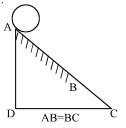
Portion $AB$ of the wedge shown in figure is rough and $BC$ is smooth. $A$ solid cylinder rolls without slipping from $A$ to $B$. The ratio of translational kinetic energy to rotational kinetic energy, when the cylinder reaches point $C$ is :
A soap bubble is blown with the help of a mechanical pump at the mouth of a tube. The pump produces a certain increase per minute in the volume of the bubble, irrespective of its internal pressure. The graph between the pressure inside the soap bubble and time $t$ will be-