Question
According to de Broglie, matter should exhibit dual behaviour, that is both particle and wave like properties. However, a cricket ball of mass 100g does not move like a wave when it is thrown by a bowler at a speed of 100km/ h. Calculate the wavelength of the ball and explain why it does not show wave nature.
Answer

de Broglie equation,
$\lambda=\frac{\text{h}}{\text{mc}},\text{m}=100\text{g}=\frac{100}{1000}=0.1\text{kg},$
Velocity of cricket ball c,
$=100\text{km/ h}$
$=\frac{100\times1000\text{m}}{60\times60\text{s}}=-\frac{1000}{36}\text{ms}^{-1},$
Planck's constant, $\text{h}=6.626\times10^{-34}\text{Js}$
Wavelength,
$\lambda=\frac{6.626\times10^{-34}\text{Js}}{0.1\text{kg}\times\frac{1000}{36}\text{ms}^{-1}}=6.626\times10^{-36}\times36\text{m}$
$\lambda=2.385\times10^{-34}\text{m}$
Since mass of the ball is large, therefore, $'\lambda'$ is very small, the wave nature cannot be observed.

Need a full question paper?

Generate a complete, print-ready paper with questions like this in minutes — across 16+ boards, with answer keys.

Start Generating Free

Similar questions

Out of elements of Group 17, 18, 1 in the sequence placed in modern periodic table.
  1. Which elements have negative electron gain enthalpy.
  2. Which elements have more metallic behaviour?
  3. Which elements have zero electronic behavior (zero valent)?
The following data are obtained when dinitrogen and dioxygen react together to form different compounds:
Fill in the blanks in the following conversions:
  1. 1km = ...................... mm = ...................... pm.
  2. 1mg = ...................... kg = ...................... ng.
  3. 1mL = ...................... L = ...................... $\text{dm}^3$.
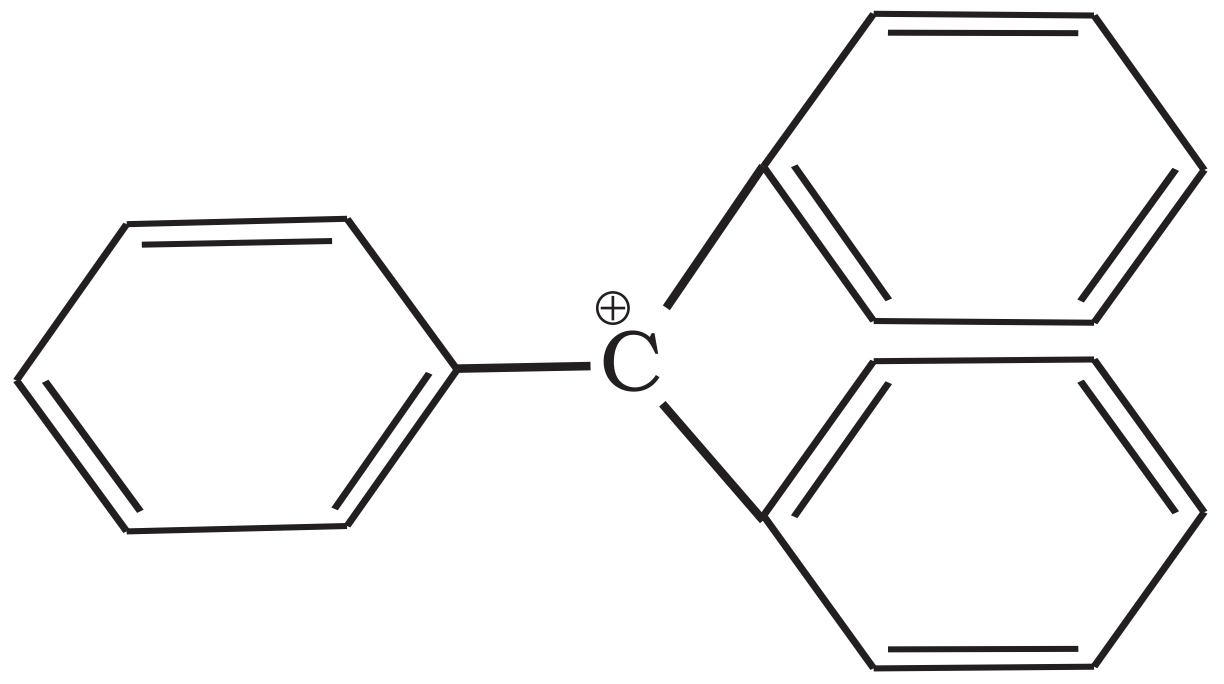
“Stability of carbocations depends upon the electron releasing inductive effect of groups adjacent to positively charged carbon atom involvement of neighbouring groups in hyperconjugation and resonance.”
The structure of triphenylmethyl cation is given below. This is very stable and some of its salts can be stored for months. Explain the cause of high stability of this cation.
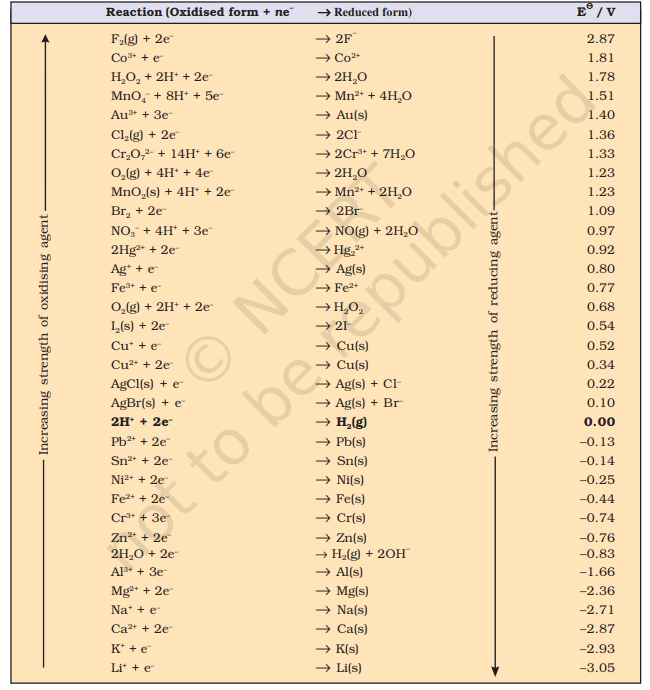
Using the standard electrode potentials given in the Table, predict if the reaction between the following is feasible:

$\mathrm{Br}_2(\mathrm{aq})$ and $\mathrm{Fe}^{2+}(\mathrm{aq})$
Air contains $20\%$ oxygen by volume. Calculate the theoretical volume of air which will be required for burning completely $500\ m$ of acetylene gas.All volumes are measured under the same conditions of temperature and pressure.
Give the name and atomic number of the inert gas atom in which the total number of d-electrons is equal to the difference in numbers of total p and s electrons.
$A 2.0L$ container at $25^\circC$ contain $1.25$ moles of $O_2$ and 3.2 moles of $C.$
  1. What is the initial pressure in the flask?
  2. If the carbon and oxygen react as completely as possible to form $CO$, what will be the final pressure in the container?
  1. How is $BeF_2$ prepared? Write chemical equation.
  2. What happens when $BeCl_2$​​​​​​​ is reduced with $LiAIH_4​​​​​​​$​​​​​​​? Give chemical equation.
  3. Which metals are used to remove air from vacuum tubes?
Why are lithium salts commonly hydrated and those of the other alkali ions usually anhydrous?
  1. What is used of $^{10}_5\text{B}$ in nuclear reactor?
  2. Name the elements with atomic number $113$ and $114$.
  3. Name the element having lowest melting point in group $14$.
  4. Why is $NH_3$ liquid whereas $CH_4$ gas?
  5. Why does carbon form large number of compounds?