MCQ
According to kinetic theory of gases, at absolute zero of temperature:
  • A
    Water freezes
  • Molecular motion stops
  • C
    Liquid hydrogen freezes
  • D
    Liquid helium freezes

Answer

Correct option: B.
Molecular motion stops
This model is described for an ideal gas and assumes that the particles does not interact in any other way.
It is known that the root mean square velocity of a particle is proportional to the absolute temperature Also for zero absolute temperature, the velocity is also zero.

Need a full question paper?

Generate a complete, print-ready paper with questions like this in minutes — across 16+ boards, with answer keys.
Start Generating Free

Similar questions

The radius of gyration of a disc of mass 100 g and radius 5 cm about an axis passing through its centre of gravity and perpendicular to the plane is
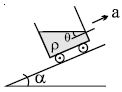
A fluid container is containing a liquid of density $\rho $ is accelerating upward with acceleration a along the inclined place of inclination $\alpha$  as shown. Then the angle of inclination $ \theta $ of free surface is :
If a particle of mass $m$ is moving with constant velocity $v$ parallel to $X-$axis in $x-y$ plane as shown in fig. Its angular momentum with respect to origin at any time $t$ will be
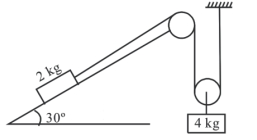
All surfaces shown in figure are assumed to be frictionless and the pulleys and the string are light. The acceleration of the block of mass $2 \mathrm{~kg}$ is :
A large vessel of height $H$, is filled with a liquid of density $\rho$, upto the brim. A small hole of radius $r$ is made at the side vertical face, close to the base. The horizontal force is required to stop the gushing of liquid is ...........
Which graph shows best the velocity-time graph for an object launched vertically into the air when air resistance is given by $| D | = bv?$ The dashed line shows the velocity graph if there were no air resistance.
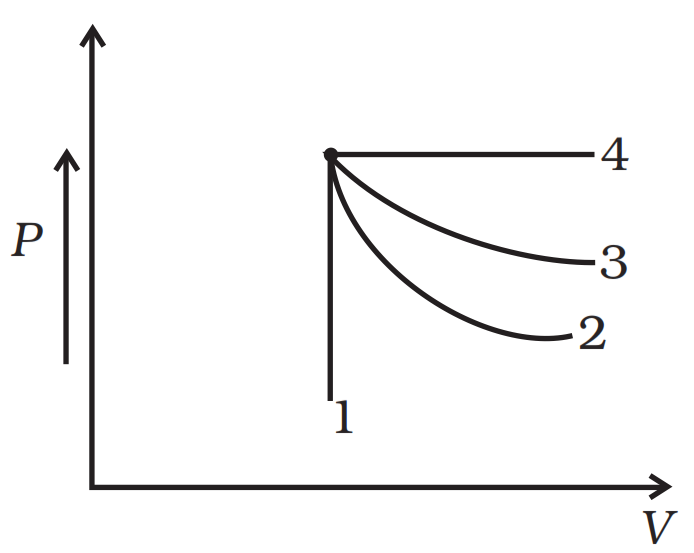
An ideal gas undergoes four different processes from thesame initial state (Fig.). Four processes are adiabatic, isothermal, isobaric and isochoric. Out of 1, 2, 3 and 4 whichone is adiabatic.
An organ pipe $P_1$ closed at one end vibrating in its first overtone. Another pipe $P_2$ open at both ends is vibrating in its third overtone. They are in a resonance with a given tuning fork. The ratio of the length of $P_1$ to that of $P_2$ is
$10$ divisions on the main scale of a Vernier calliper coincide with $11$ divisions on the Vernier scale. If each division on the main scale is of $5$ units, the least count of the instrument is :
When two waves with same frequency and constant phase difference interfere,