MCQ
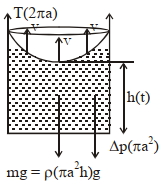
According to Poiseuille's law, the pressure drop per unit length required (overcome viscous forces is $\Delta P =\frac{8 \eta v }{ r ^2}$, where $r$ is the radius of cross section, $v$ is the fluid velocity and $\eta$ is the coefficient of viscosity. A capillary tube of radius a is dipped in a liquid of density $\rho$, surface tension $T$ and coefficient of viscosity $\eta$. The liquid starts rising in it so that its height $h ( t )$ is a function of time t. The resulting rate of change of the momentum of liquid column in the capillary (taking vertically up to be positive direction and the contact angle to be close to $\left.0^{\circ}\right)$ is $-\pi a ^2 \rho gh + F$. Then $F$ is $[ g$ is the acceleration due to gravity):
- A$4 \pi Ta +8 \pi \eta h \frac{ dh }{ dt }$
- B$4 \pi Ta -8 \pi \eta h \frac{ dh }{ dt }$
- ✓$2 \pi Ta -8 \pi \eta h \frac{ dh }{ dt }$
- D$2 \pi Ta +8 \pi \eta h \frac{ dh }{ dt }$