MCQ
According to the following graph, what happens to the distance covered by the body from $0 -10$ minutes?
  • It goes on increasing
  • B
    It goes on decreasing
  • C
    It first increases and then decreases
  • D
    It first decreases and then increases

Answer

Correct option: A.
It goes on increasing
We know that distance traveled by an object is the area under it speed time graph.
Now, in this case, as the area under the speed$-$time graph is increasing from $0 - 10$ minutes.
So, the distance will keep on increasing from $0 - 10$ minutes.

Need a full question paper?

Generate a complete, print-ready paper with questions like this in minutes — across 16+ boards, with answer keys.
Start Generating Free

Similar questions

A liquid will not wet the surface of a solid, if the angle of contact is:
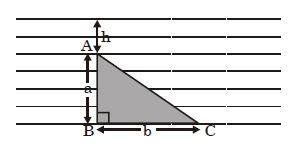
A vertical triangular plate $ABC$ is placed inside water with side $BC$ parallel to water surface as shown. The force on one surface of plate by water is (density of water is $\rho $ and atmospheric pressure $P_0$ ) 
A copper wire of length $1.0\, m$ and a steel wire of length $0.5\, m$ having equal cross-sectional areas are joined end to end. The composite wire is stretched by a certain load which stretches the copper wire by $1\, mm$. If the Young's modulii of copper and steel are respectively $1.0\times10^{11}\, Nm^{-2}$ and $2.0\times10^{11}\, Nm^{- 2}$, the total extension of the composite wire is ........ $mm$
Two trains each of length $100 \,m$ moving parallel towards each other at speed $72 \,km / h$ and $36 \,km / h$ respectively. In how much time will they cross each other is ..........
Dimensional formula of magnetic flux is
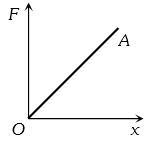
The force required to stretch a spring varies with the distance as shown in the figure. If the experiment is performed with the above spring of half length, the line $OA$ will
The equation of the stationary wave is

$y = 2A\,\,\sin \,\left( {\frac{{2\pi ct}}{\lambda }} \right)\,\cos \,\,\,\left( {\frac{{2\pi x}}{\lambda }} \right)$

Which statement is not true?

If speed of a particle moving in a circle of radius $2\,m$ is given as $v = 2t + 2$, then its centripetal acceleration after $1\, s$ will be   ......... $m/s^2$
There have been suggestions that the value of the gravitational constant $G$ becomes smaller when considered over very large time period $($in billions of years$)$ in the future. If that happens, for our earth,
A monoatomic gas at pressure $P$ and volume $V$ is suddenly compressed to one eighth of its original volume. The final pressure at constant entropy will be $.....P$