Acylindrical vessel open at the top is $20$ $cm$ high and $10$ $cm$ in diameter.Acircular hole whose cross-sectional area $1$ $cm^2$ is cut at the centre of the bottom of the vessel. Water flows from a tube above it into the vessel at the rate $100$ $cm^3s^{^{-1}}$. The height of water in the vessel under steady state is ....... $cm$ (Take $g=1000 $ $ cms^{^{-2}})$
Medium
Download our app for free and get started
In steady state,
Volume flow rate entering the vessel
$=$ volume flow rate leaving the vessel
$\therefore Q=a v=a \sqrt{2 g h}$ or $h=\frac{Q^{2}}{2 g a^{2}}$
$=\frac{\left(10^{2}\right)^{2}}{(2 \times 1000)(1)^{2}}=5 \mathrm{cm}$

Download our appand get started for free
Experience the future of education. Simply download our apps or reach out to us for more information. Let's shape the future of learning together!No signup needed.*
Similar Questions
- 1The two thigh bones (femures), each of cross-sectional area $10 \,cm ^2$ support the upper part of a person of mass $50 \,kg$. The average pressure sustained by the femures is ............. $N / m ^2$View Solution
- 2A hollow spherical shell at outer radius $R$ floats just submerged under the water surface. The inner radius of the shell is $r$. If the specific gravity of the shell material is $\frac{27}{8}$ $w.r.t.$ water, the value of $r$ is$......R$View Solution
- 3Small water droplets of radius $0.01 \mathrm{~mm}$ are formed in the upper atmosphere and falling with a terminal velocity of $10 \mathrm{~cm} / \mathrm{s}$. Due to condensation, if $8 \mathrm{such}$ droplets are coalesced and formed a larger drop, the new terminal velocity will be ........... $\mathrm{cm} / \mathrm{s}$.View Solution
- 4$Assertion :$ For Reynold’s number $Re > 2000$, the flow of fluid is turbulent.View Solution
$Reason :$ Inertial forces are dominant compared to the viscous forces at such high Reynold’s numbers. - 5A liquid of density $\rho $ is coming out of a hose pipe of radius $a$ with horizontal speed $v$ and hits a mesh. $50\%$ of the liquid passes through the mesh unaffected. $25\%$ looses all of its momentum and $25\%$ comes back with the same speed. The resultant pressure on the mesh will beView Solution
- 6View SolutionIf there were no gravity. which of the following will not be there for a fluid?
- 7Two cyllinders of same cross-section and length $L$ but made of two material of densities $d_1$ and $d_2$ are cemented together to form a cylinder of length $2L$. The combination floats in a liquid of density $d$ with $a$ length $L/2$ above the surface of the liquid. If $d_1 > d_2$ then:View Solution
- 8Eight equal drops of water are falling through air with a steady speed of $10\,cm / s$. If the drops coalesce, the new velocity is $.........\,cm/s$View Solution
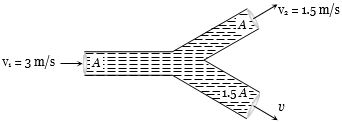
- 9An incompressible liquid flows through a horizontal tube as shown in the following fig. Then the velocity $ v$ of the fluid is .......$m/s$View Solution
- 10A silver ingot weighing $2.1 kg$ is held by a string so as to be completely immersed in a liquid of relative density $0.8$. The relative density of silver is $10.5$ . The tension in the string in $kg-wt$ isView Solution