Question
After one $\alpha $ and two $\beta $ emissions

Answer

(b) $_{Z}{{X}^{A}}{{\xrightarrow{\alpha }}_{Z-2}}{{Y}^{A-4}}{{\xrightarrow{2\beta }}_{Z}}{{X}^{A-4}}$

Need a full question paper?

Generate a complete, print-ready paper with questions like this in minutes — across 16+ boards, with answer keys.
Start Generating Free

Similar questions

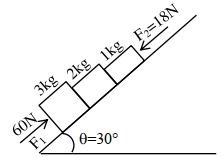
In the diagram shown, the normal reaction force between $2\,kg$ and $1\,kg$ is (Consider the surface, to be smooth)$.........N$ (Given $g =10\,ms ^{-2}$)
A gas mixture consists of molecules of type $1, 2$ and $3$, with molar masses ${m_1} > {m_2} > {m_3}.$ ${V_{rms}}$ and $\overline K $ are the $r.m.s.$ speed and average kinetic energy of the gases. Which of the following is true
The frequency for which a $5\,\mu F$ capacitor has a reactance of $\frac{1}{{1000}}$ ohm is given by
The $x$ and $y$ coordinates of the particle at any time are $x = 5t - 2t^2$ and $y = 10t$ respectively, where $x$ and $y$ are in metres and $t$ in seconds. The acceleration of the particle at $t = 2\, s$ is $......m/\sec^2$
Thermocouple is an arrange ment of two different metal to :-
$1 a.m.u.$  is equivalent to
The intensity of sound wave while passing through an elastic medium falls down by $10\%$ as it covers one metre distance through the medium. If the initial intensity of the sound wave was $100$ decibels, its value after it has passed through $3$ metre thickness of the medium will be .... $decibel$
Two coherent sources of light interfere. The intensity ratio of two sources is $1: 4$. For this interference pattern if the value of $\frac{I_{\max }+I_{\min }}{I_{\max _{\max }}-I_{\min }}$ is equal to $\frac{2 \alpha+1}{\beta+3}$, then $\frac{\alpha}{\beta}$ will be.
A moving coil galvanometer allows a full scale current of $10^{-4}\, A$. A series resistance of $2\, M\,\Omega $ is required to convert the above galvanometer into a voltmeter of range $0 -5\, V$. Therefore the value of shunt resistance required to convert the above galvanometer into a ammeter of range $0-10\, mA$ is....$\Omega $
The ratio of work done by an ideal monoatomic gas to the heat supplied to it in an isobaric process is