Two bulbs consume same power when operated at $200\, V$ and $300\, V$ respectively. When these bulbs are connected in series across a $D.C$. source of $500\, V$, then
Medium
Download our app for free and get started
(c) $P = \frac{{{V^2}}}{R}$ $\therefore R = \frac{{{V^2}}}{P}{\rm{or}}\,R \propto {V^2}$ i.e. $\frac{{{R_1}}}{{{R_2}}} = {\left( {\frac{{200}}{{300}}} \right)^2} = \frac{4}{9}$
When connected in series potential drop and power consumed are in the ratio of their resistances.
When connected in series potential drop and power consumed are in the ratio of their resistances.
So, $\frac{{{P_1}}}{{{P_2}}} = \frac{{{V_1}}}{{{V_2}}} = \frac{{{R_1}}}{{{R_2}}} = \frac{4}{9}$

Download our appand get started for free
Experience the future of education. Simply download our apps or reach out to us for more information. Let's shape the future of learning together!No signup needed.*
Similar Questions
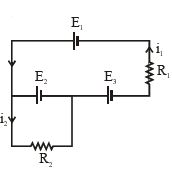
- 1The current $i_1$ and $i_2$ through the resistors $R_1(=10\,\Omega )$ and ${R_2}\left( { = 30\,\Omega } \right)$ in the circuit diagram with $E_1 = 3\,V$, $E_2 = 3\,V$ and $E_3 = 2\,V$ are respectivelyView Solution
- 2A student is provided with a variable voltage source $V$, a test resistor $R_T=10\,\Omega$, two identical galvanometers $G_1$ and $G_2$ and two additional resistors, $R _1=10\,M\,\Omega$ and $R _2=0.001\,\Omega$. For conducting an experiment to verify ohms law, the most suitable circuit is:View Solution
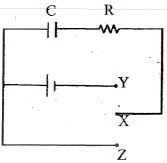
- 3The capacitor $C$ is initially without charge.$X$ is now j oined to $Y$ for a long time, during which $H_1$ heat is produced in the resistance $R$. $X-Y$ connection is removed and $X$ is now joined to $Z$ for a long time, during which heat $H_2$ is produced in $R$.View Solution
- 4View SolutionIf the length of potentiometer wire is increased, then the length of the previously obtained balance point will
- 5View SolutionIn potentiometer a balance point is obtained, when
- 6Two non-ideal identical batteries are connected in parallel. Consider the following statementsView Solution
$(i)$ The equivalent e.m.f. is smaller than either of the two $e.m.f.$ is
$(ii)$ The equivalent internal resistance is smaller than either of the two internal resistances
- 7View SolutionPotential gradient is defined as
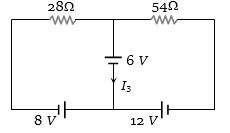
- 8Consider the circuit shown in the figure. The current ${I_3}$ is equal toView Solution
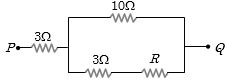
- 9In the circuit shown here, what is the value of the unknown resistor $R$ so that the total resistance of the circuit between points $P$ and $Q$ is also equal to $R$View Solution
- 10In $a$ wire of cross-section radius $r$, free electrons travel with drift velocity $v$ when a current $I$ flows through the wire. What is the current in another wire of half the radius and of the same material when the drift velocity is $2v$?View Solution