Question
Although both $\mathrm{CO}_2$ and $\mathrm{H}_2 \mathrm{O}$ are triatomic molecules, the shape of $\mathrm{H}_2 \mathrm{O}$ molecule is bent while that of $\mathrm{CO}_2$ is linear. Explain this on the basis of dipole moment.
Answer

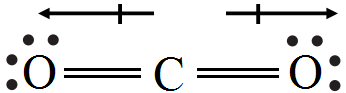
According to experimental results, the dipole moment of carbon dioxide is zero. This is possible only if the molecule is linear so that the dipole moments of $\mathrm{C}-\mathrm{O}$ bonds are equal and opposite to nullify each other.

Resultant μ = 0 D
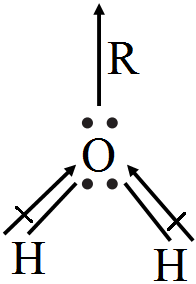
$\mathrm{H}_2 \mathrm{O}$, on the other hand, has a dipole moment value of 1.84 D (though it is a triatomic molecule as $\mathrm{CO}_2$ ). The value of the dipole moment suggests that the structure of $\mathrm{H}_2 \mathrm{O}$ molecule is bent where the dipole moment of $\mathrm{O}-\mathrm{H}$ bonds are unequal.​​​​​​​

Need a full question paper?

Generate a complete, print-ready paper with questions like this in minutes — across 16+ boards, with answer keys.

Start Generating Free

Similar questions

  1. Define standard enthalpy of formation. Explain why the enthalpy changes for the reaction given below are not enthalpies of formation of $CaCO_3$ and HBr:
  1. $\text{CaO(s)}+\text{CO}_2(\text{g})\overrightarrow{\ \ \ \ \ \ \ \ }\ \text{CaCO}_3(\text{s});$ $\Delta_\text{r}\text{H}^\circ=-178.3\text{kJ mol}^{-1}$
  2. $\text{H}_2(\text{g})+\text{Br}_2(\text{g})\overrightarrow{\ \ \ \ \ \ \ }\ 2\text{HBr(g)};$ $\Delta_\text{r}\text{H}^\circ=-72.8\text{kJ mol}^{-1}$
  1. Use the bond enthalpies listed below to determine the enthalpy of reaction:
$\ \ \ \ \ \ \ \ \text{H}\\ \ \ \ \ \ \ \ \ \ |\\\text{H}-\text{C}-\text{H(g)}+2\text{O}=\text{O(g)}\overrightarrow{\ \ \ \ \ }\ \text{O}=\text{C}=\text{O(g)}\\ \ \ \ \ \ \ \ \ \ |\\ \ \ \ \ \ \ \ \ \text{H}\\+2\text{H}-\text{O}-\text{H(g)}$

Bond enthalpy $(\Delta\text{H}^\circ)/\text{kJ mol}^{-1}$ of C=O = 741; C-H = 414; H-O = 464; O=O = 498.
What is the significance of the terms — ‘isolated gaseous atom’ and ‘ground state’
while defining the ionization enthalpy and electron gain enthalpy?
Hint : Requirements for comparison purposes.
Yellow light emitted from a sodium lamp has a wavelength $(\lambda)$ of 580 nm. Calculate the frequency (ν) and wavenumber $(\bar{\text{v}})$ of the yellow light.
Explain the shapes of different atomic orbitals.
Explain with the help of suitable example polar covalent bond.
Derive the formula required to find the energy of the electron in Bohr orbital.
Give reasons:
i. LiCl is more covalent than NaCl .
ii. Lil has lower melting point than LiCl .
iii. CaCl, is ionic than KCI .
iv. CuCl is more covalent than NaCl .
The ionization constant of benzoic acid is $6.46 \times 10^{–5}$ and $K_{sp}$ for silver benzoate is $2.5 \times 10^{–13}$. How many times is silver benzoate more soluble in a buffer of $pH\ 3.19$ compared to its solubility in pure water?
  1. What is the total number of electrons in $\text{NO}^-_3$ and $\text{NH}^+_4?$
  2. Why is melting point of $MgO (2800^\circ C)$ higher than that of BaO (1920°C)?
  3. Why is solubility of MgCl, greater than that of $MgF_2$?
  4. Why are carbon-oxygen bond lengths in $Na_2CO_3$ equal?
  5. Why is $AlF_3$ high melting solid whereas $SiF_4$ is a gas?
What do you meant by electrochemical cells? By giving the example of Daniel cell, explain its construction and working with diagram.