Question
The ionization constant of benzoic acid is $6.46 \times 10^{–5}$ and $K_{sp}$ for silver benzoate is $2.5 \times 10^{–13}$. How many times is silver benzoate more soluble in a buffer of $pH\ 3.19$ compared to its solubility in pure water?

Answer

Since pH = 3.19,
$[\text{H}_3\text{O}^+]=6.46\times10^{-4}\text{M}$
$\text{C}_6\text{H}_5\text{COOH}+\text{H}_2\text{O}\leftrightarrow\text{C}_6\text{H}_5\text{COO}^-+\text{H}_3\text{O}$
$\text{K}_\text{a}\frac{[\text{C}_6\text{H}_5\text{COO}^-][\text{H}_3\text{O}^+]}{[\text{C}_6\text{H}_5\text{COOH}]}$
$\frac{[\text{C}_6\text{H}_5\text{COOH}]}{[\text{C}_6\text{H}_5\text{COO}^-]}=\frac{[\text{H}_3\text{O]}}{\text{K}_\text{a}}=\frac{6.46\times10^{-4}}{6.46\times10^{-5}}=10$
Let the solubility of $C_6H_5COO$Ag be xmol/L.
Then,
$[\text{Ag}^+]=\text{x}$
$[\text{C}_6\text{H}_5\text{COOH}]+[\text{C}_6\text{H}_5\text{COO}^-]=\text{x}$
$10[\text{C}_6\text{H}_5\text{COO}^-]+[\text{C}_6\text{H}_5\text{COO}^-]=\text{x}$
$[\text{C}_6\text{H}_5\text{COO}^-]=\frac{\text{x}}{11}$
$\text{K}_\text{sp}[\text{Ag}^+][\text{C}_6\text{H}_5\text{COO}^-]$
$2.5\times10^{-13}=\text{x}\Big(\frac{\text{x}}{11}\Big)$
$\text{x}1.66\times10^{-6}\text{mol/L}$
Thus, the solubility of silver benzoate in a pH 3.19 solution is $1.66 \times 10^{–6}mol/L$.
Now, let the solubility of $C_6H_5COO$ Ag be x'mol/L.
Then,
$[\text{Ag}^+]=\text{x}'\text{M and}[\text{CH}_3\text{COO}^-]=\text{x}'\text{M}.$
$\text{K}_\text{sp}=[\text{Ag}^+][\text{CH}_3\text{COO}^-]$
$\text{K}_\text{sp}=\text{(x}')^2$
$\text{x}'=\sqrt{\text{K}_\text{sp}}=\sqrt{2.5\times10^{-13}}=5\times10^{-7}\text{mol/L}$
$\therefore\ \frac{\text{x}}{\text{x}'}=\frac{1.66\times10^{-6}}{5\times10^{-7}}=3.32$
Hence, $C_6H_5COO$Ag is approximately 3.317 times more soluble in a low pH solution.

Need a full question paper?

Generate a complete, print-ready paper with questions like this in minutes — across 16+ boards, with answer keys.
Start Generating Free

Similar questions

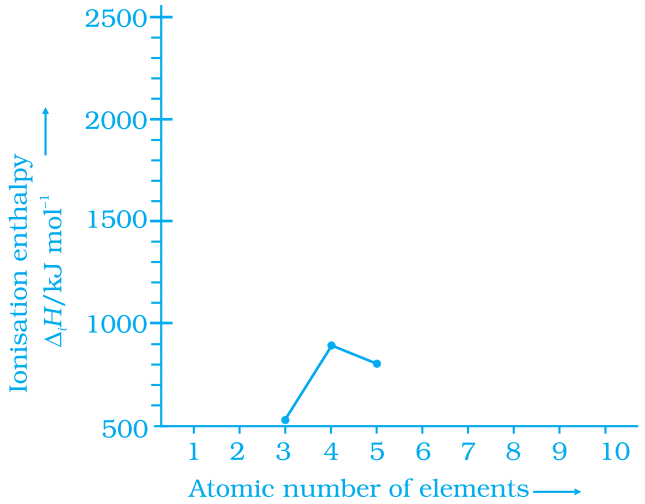
Ionisation enthalpies of elements of second period are given below:
Ionisation enthalpy/ kcal $mol^{-1}, 520, 899, 801, 1086, 1402, 1314, 1681, 2080$.
Match the correct enthalpy with the elements and complete the graph given in also write symbols of elements with their atomic number.
If the photon of the wavelength $150pm$ strikes an atom and one of tis inner bound electrons is ejected out with a velocity of $1.5 \times 107ms ^{–1}$, calculate the energy with which it is bound to the nucleus.
Describe graphically the measurement of change in internal energy $(\Delta U )$ by bomb calorimeter.
  1. A certain salt 'X' gives the following results:
  1. Its aqueous solution is alkaline to litmus.
  2. It swells up to a glassy material ‘Y' on strong heating.
  3. When conc. HCl is added to a hot solution of 'X' white crystals of an acid 'Z' separates out.
Write equations for all the above reactions and identify 'X', 'Y' and 'Z'.
  1. Select the members of group $14$ that:
  1. Forms the most acidic dioxide.
  2. Is commonly found in $+2$ oxidation state
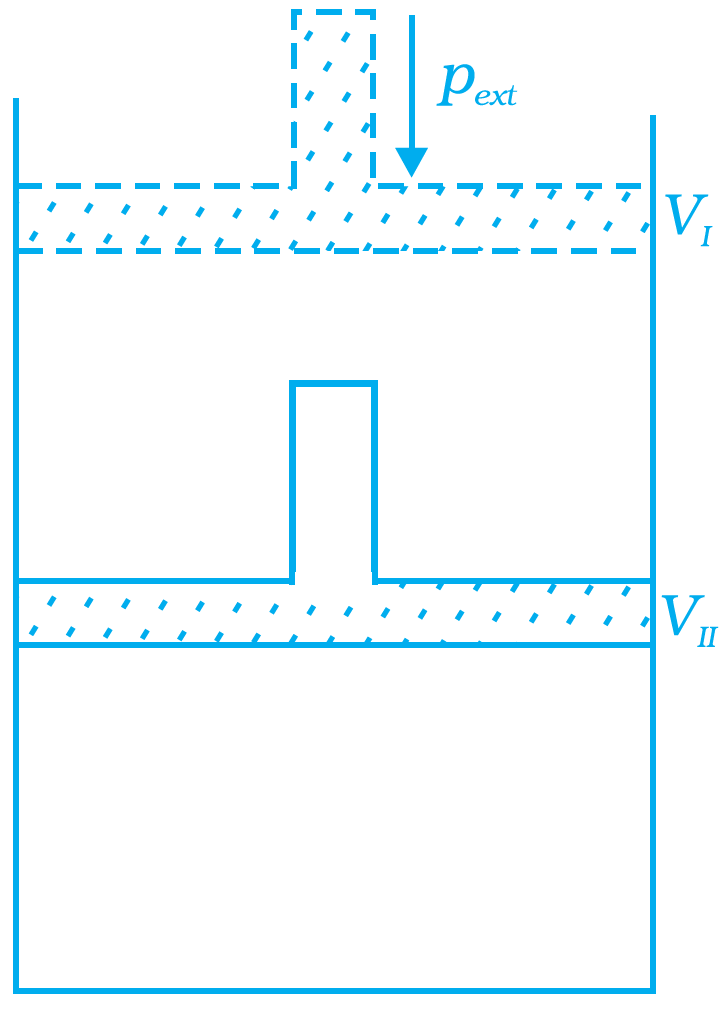
What will be the work done on an ideal gas enclosed in a cylinder, when it is compressed by a constant external pressure, $p_{ext}$​​​​​​​ in a single step as shown in Fig. Explain graphically.
It has been found that the pH of a 0.01M solution of an organic acid is 4.15. Calculate the concentration of the anion, the ionization constant of the acid and its $pK_a$​​​​​​​.
  1. A gas occupies a volume of 4 L at $8 \times 10^5Nm^{-2}$. Calculate the additional pressure required to decrease the volume of the gas to $2.5L$. keeping the temperature constant.
  2. Which of the following gas will hale smaller value of van der Waals' constant a?
  1. Ne
  2. $NH_3$
  1. The size of a weather balloon changes as it rises. What change is expected in its size and why?
Describe the hybridisation in case of $PCl_5$ . Why are the axial bonds longer as compared to equatorial bonds?
The $Mn^{3+}$ ion is unstable in solution and undergoes disproportionation to give $Mn^{2+}, MnO_2,$ and $H^+$ ion. Write a balanced ionic equation for the reaction.
What is the minimum volume of water required to dissolve 1g of calcium sulphate at 298K? (For calcium sulphate, $K_{sp}$ is $9.1 \times 10^{–6}$​​​​​​​).