MCQ
Among the following, the intensive property is (properties are)

$(A)$ molar conductivity $(B)$ electromotive force

$(C)$ resistance $(D)$ heat capacity

  • A
    $(B, D)$
  • B
    $(A, D)$
  • $(A, B)$
  • D
    $(A, C)$

Answer

Correct option: C.
$(A, B)$
c
Resistance and heat capacity are mass dependent properties, hence extensive.

Need a full question paper?

Generate a complete, print-ready paper with questions like this in minutes — across 16+ boards, with answer keys.

Start Generating Free

Similar questions

The $pH $ of ${10^{ - 8}}$ molar aqueous solution of $HCl$ is
Hydrocarbon containing following bond is most reactive
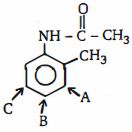
Identify the position where electrophilic aromatic substitution $(EAS)$ is most  favourable.
A triene is treated with ozone followed by zinc in acetic acid to give the following  three products. What is the structure of the triene ?
Which of the following electronic configuration represent representative elements
Which of the following carbides produces propyne on reaction with water?
At $-20^{\circ} \mathrm{C}$ and $1 \mathrm{~atm}$ pressure, a cylinder is filled with equal number of $\mathrm{H}_2 . \mathrm{I}_2$ and $\mathrm{HI}$ molecules for the reaction

$\mathrm{H}_2(\mathrm{~g})+\mathrm{I}_2(\mathrm{~g}) \rightleftharpoons 2 \mathrm{HI}(\mathrm{g})$, the $\mathrm{K}_{\mathrm{p}}$ for the process is $\mathrm{x} \times 10^{-1} \cdot \mathrm{x}=$ $\qquad$

[Given : $\mathrm{R}=0.082 \mathrm{~L} \mathrm{~atm} \mathrm{~K}^{-1} \mathrm{~mol}^{-1}$ ]

The transformation occurring in Duma's method is given below :

$\mathrm{C}_{2} \mathrm{H}_{7} \mathrm{~N}+\left(2 \mathrm{x}+\frac{\mathrm{y}}{2}\right) \mathrm{CuO} \rightarrow \mathrm{x\,CO}_{2}+\frac{y}{2} \mathrm{H}_{2} \mathrm{O}+\frac{\mathrm{z}}{2} \mathrm{~N}_{2}+\left(2\, \mathrm{x}+\frac{\mathrm{y}}{2}\right) \mathrm{Cu}$

The value of $y$ is ...... .(Integer answer)

Wave number of a spectral line for a given transition is $y\,cm^{-1}$ for $He^+$, then its value for $Li^{2+}$ for the same transition is
The order of dipole moments of the following molecules is