Among the forces in nature, friction can be classified into
Easy
Download our app for free and get started
Friction is the molecule-molecule interaction in contact. Hence, it can be classified as electromagnetic force.

Download our appand get started for free
Experience the future of education. Simply download our apps or reach out to us for more information. Let's shape the future of learning together!No signup needed.*
Similar Questions
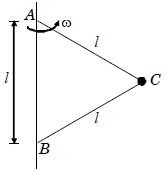
- 1As shown in the figure, two strings of length $l$ each are attached with a vertical axis $AB$ of length $l$. Strings are $AC$ and $BC$. At point $C$ a point mass m is attached. Mass rotates about axis with angular velocity. Tensions in $AB$ and $BC$ are $T_1$ and $T_2$ respectively. Choose the $CORRECT$ alternative :-View Solution
- 2A road is $10\, m$ wide. Its radius of curvature is $50\, m$. The outer edge is above the lower edge by a distance of $1.5\, m$. This road is most suited for the velocity .......... $m/\sec$View Solution
- 3View SolutionMeena applies the front brakes, while riding on her bicycle along a flat road. The force that slows her bicycle is provided by the
- 4A body of mass $2 \,kg$ is kept by pressing to a vertical wall by a force of $100\, N$. The coefficient of friction between wall and body is $0.3.$ Then the frictional force is equal to ........ $N$View Solution
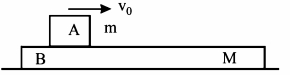
- 5The masses of blocks A and B are $m$ and $M$ respectively. Between $A$ and $B$, there is a constant frictional force $F$ and $B$ can slide on a smooth horizontal surface. A is set in motion with velocity while $B$ is at rest. What is the distance moved by A relative to $B$ before they move with the same velocity?View Solution
- 6A body of mass $m$ is tied to one end of a spring and whirled round in a horizontal plane with a constant angular velocity. The elongation in the spring is one centimetre. If the angular velocity is doubled, the elongation in the spring is $5\, cm$ . The original length of the spring is ............ $cm$View Solution
- 7View SolutionWhen a body is moving on a surface, the force of friction is called
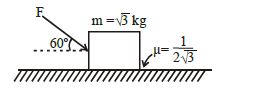
- 8What is the maximum value of the force $F$ such that the block shown in the arrangement does not move ....... $N$View Solution
- 9A circular road of radius $1000 \,m$ has banking angle ${45^o}$. The maximum safe speed of a car having mass $2000 \,kg$ will be, if the coefficient of friction between tyre and road is $0.5$ ....... $m/s$View Solution
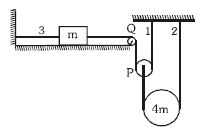
- 10Shown in the diagram is a system of two bodies, a block of mass $m$ and a disc of mass $4\ m$ , held in equilibrium. If the string $3$ is burnt, find the acceleration of the disc. Neglect the masses of the pulleys $P$ and $Q$ . The co-efficient of friction between the block and horizontal surface is $0.5$ and friction between disc and string is zero ........ $m/s^2$View Solution