Meena applies the front brakes, while riding on her bicycle along a flat road. The force that slows her bicycle is provided by the
KVPY 2020, Medium
Download our app for free and get started
$(b)$
The frictional force is used to slow down the bicycle, which is an external force and hence provided by the road

Download our appand get started for free
Experience the future of education. Simply download our apps or reach out to us for more information. Let's shape the future of learning together!No signup needed.*
Similar Questions
- 1View SolutionWhen two surfaces are coated with a lubricant, then they
- 2A block of mass $m$ is on an inclined plane of angle $\theta$. The coefficient of friction between the block and the plane is $\mu$ and $\tan \theta>\mu$. The block is held stationary by applying a force $\mathrm{P}$ parallel to the plane. The direction of force pointing up the plane is taken to be positive. As $\mathrm{P}$ is varied from $\mathrm{P}_1=$ $m g(\sin \theta-\mu \cos \theta)$ to $P_2=m g(\sin \theta+\mu \cos \theta)$, the frictional force $f$ versus $P$ graph will look likeView Solution
- 3A car of mass $1000\,kg$ negotiates a banked curve of radius $90\,m$ on a frictionless road. If banking angle is $45^o$ , the maximum speed of car is ............ $m/s$ $[g = 10\,m/s^2]$View Solution
- 4A brick of mass $2\, kg$ begins to slide down on a plane inclined at an angle of $45^° $ with the horizontal. The force of friction will beView Solution
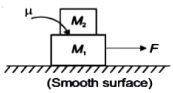
- 5The maximum value of $F$ which can be applied on the system shown in figure so that both blocks move together with same acceleration is ..........View Solution
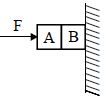
- 6Given in the figure are two blocks $A$ and $B$ of weight $20\, N$ and $100\, N$, respectively. These are being pressed against a wall by a force $F$ such that the system does not slide as shown. If the coefficient of friction between the blocks is $0.1$ and between block $B$ and the wall is $0.15$, the frictional force applied by the wall on block $B$ is ........ $N$View Solution
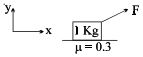
- 7A $\vec F\,\, = \,\,\hat i\, + \,4\hat j\,$ acts on block shown. The force of friction acting on the block is :View Solution
- 8Consider a car moving along a straight horizontal road with a speed of $72\, km/h$. If the coefficient of kinetic friction between the tyres and the road is $0.5,$ the shortest distance in which the car can be stopped is ........ $m$ .$[g = 10\,m{s^{ - 2}}]$View Solution
- 9Starting from rest a body slides down a $45^o$ inclined plane in twice the time it takes to slide down the same distance in the absence of friction. The co-efficient of friction between the body and the inclined plane is:View Solution
- 10View SolutionWhen a body is moving on a surface, the force of friction is called