MCQ
Among which the magnetic susceptibility does not depend on the temperature
  • A
    Ferrite substances
  • B
    Ferromagnetic substances
  • Diamagnetic substances
  • D
    Paramagnetic substances

Answer

Correct option: C.
Diamagnetic substances
c
(c)

Need a full question paper?

Generate a complete, print-ready paper with questions like this in minutes — across 16+ boards, with answer keys.
Start Generating Free

Similar questions

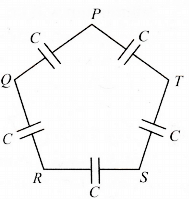
Five capacitors, each of capacitance value $C$ are connected as shown in the figure. The ratio of capacitance between $P$ and $R$, and the capacitance between $P$ and $Q$, is
A block of mass M is hanging over a smooth and light pulley through a light string. T he other end of the string is pulled by a constant force F. The kinetic energy of the block increases by 20J in 1s.
Curie temperature is the temperature above which:
${K_\alpha }$characteristic $X- $ ray refers to the transition
The binding energy per nucleon in a nucleus shows:
In Young's interference experiment, the central bright fringe can be identified due to the fact that it:
A metallic surface with work function of 2 eV, on heating to a temperature of 800 K gives an emission current of 1 mA. If another metallic surface having the same surface area, same emission constant but work function 4 eV is heated to a temperature of 1600 K, then the emission current will be
Assertion : Newton’s rings are formed in the reflected system. When the space between the lens and the glass plate is filled with a liquid of refractive index greater than that of glass, the central spot of the pattern is dark.
Reason : The reflection is Newton’s ring cases will be from a denser to a rarer medium and the two interfering rays are reflected under similar conditions.
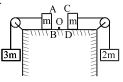
Two blocks each of mass $m$ lie on $a$ smooth table. They are attached to two other masses as shown in the figure. The pulleys and strings are light. An object $O$ is kept at rest on the table. The sides $AB$ & $CD$ of the two blocks are made reflecting. The acceleration of two images formed in those two reflecting surfaces $w.r.t.$ each other is:
A long solenoid is fabricated to closely winding wire of radius $0.5\,mm$ over a cylindrical frame so that the successive turns nearly touch each other, the magnetic field at the centre of solenoid if it carries a current of $5\,A$