An ammeter of $100$ $\Omega$ resistance gives full deflection for the current of $10^{-5} \,amp$. Now the shunt resistance required to convert it into ammeter of $1\, amp$. range, will be
Medium
Download our app for free and get started
(c) $\frac{i}{{{i_g}}} = 1 + \frac{G}{S} \Rightarrow \frac{1}{{{{10}^{ - 5}}}} = 1 + \frac{{100}}{S}$$ \Rightarrow \,\,S \approx \frac{{100}}{{{{10}^5}}} = {10^{ - 3}}\,\Omega $.

Download our appand get started for free
Experience the future of education. Simply download our apps or reach out to us for more information. Let's shape the future of learning together!No signup needed.*
Similar Questions
- 1A charged particle going around in a circle can be considered to be a current loop. A particle of mass $m$ carrying charge $q$ is moving in a plane with speed $v$ under the influence of magnetic field $\overrightarrow{ B }$. The magnetic moment of this moving particleView Solution
- 2In case Hall effect for a strip having charge $Q$ and area of cross-section $A$, the Lorentz force isView Solution
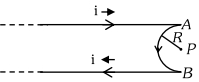
- 3A very long conducting wire is bent in a semicircular shape from $A$ to $B$ as shown in figure. The magnetic field at point $P$ for steady current configuration is given by:View Solution
- 4A circuit to verify $Ohm's$ law uses ammeter and voltmeter in series or parallel connected correctly to the resistor. In the circuitView Solution
- 5Suppose an isolated north pole is kept at the centre of a circular loop carrying a electric current $i$. The magnetic field due to the north pole at a point on the periphery of the wire is $B$. The radius of the loop is $a$. The force on the wire isView Solution
- 6A galvanometer has a resistance of $25\, ohm$ and a maximum of $0.01\, A$ current can be passed through it. In order to change it into an ammeter of range $10\, A$, the shunt resistance required isView Solution
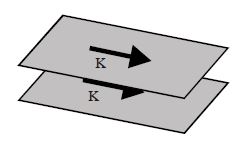
- 7View SolutionWhat are the directions of the magnetic field between and outside a pair of two parallel large sheets carrying currents in the same directions, as illustrated in Figure (from the side shown)?
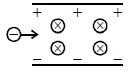
- 8An electron enters the space between the plates of a charged capacitor as shown. The charge density on the plate is $\sigma $. Electric intensity in the space between the plates is $E$. A uniform magnetic field $B$ also exists in that space perpendicular to the direction of $E$. The electron moves perpendicular to both $\vec E$ and $\vec B$ without any change in direction. The time taken by the electron to travel a distance $\ell $ is the space isView Solution
- 9View SolutionA charged particle is released from rest in a region of uniform electric and magnetic fields which are parallel to each other. The particle will move on a
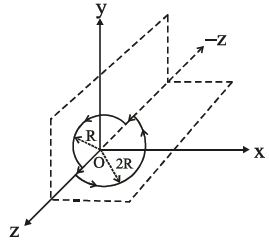
- 10In given diagram, two current carrying circular loop of radius $R$ and $2R$ are arranged in $YZ-$ plane and $XZ-$ plane respectively. Common centre of both are at origin $O$. Then what will be angle of resultant magnetic field from $X-$ axis.View Solution