Two immiscible liquids $A$ and $B$ are kept in an U-tube. If the density of liquid $A$ is smaller than the density of liquid $B$, then the equilibrium situation is
KVPY 2009, Diffcult
Download our app for free and get started
(c)
As density of $B$ is more than that of $A$, a small volume of $B$ weighs equals to a large volume of $A$.
Hence, if we draw a horizontal line from bottom of column of $A$, then a lesser
length column of $B$ must appear above this line in other limb of U-tube. It is as shown below.
This is shown in option $(c)$.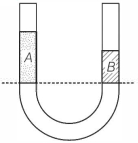

Download our appand get started for free
Experience the future of education. Simply download our apps or reach out to us for more information. Let's shape the future of learning together!No signup needed.*
Similar Questions
- 1An object falling through a fluid is observed to have acceleration given by $a = g -bv$ where $g =$ gravitational acceleration and $b$ is constant. After a long time of release, it is observed to fall with constant speed. The value of constant speed isView Solution
- 2A cylindrical vessel of cross-section $A$ contains water to a height $h$ . There is a hole in the bottom of radius $'a'$ . The time in which it will be emptied isView Solution
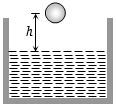
- 3A ball of radius $r $ and density $\rho$ falls freely under gravity through a distance $h$ before entering water. Velocity of ball does not change even on entering water. If viscosity of water is $\eta$, the value of $h$ is given byView Solution
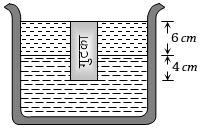
- 4A cubical block of wood $10 \,cm$ on a side floats at the interface between oil and water with its lower surface horizontal and $4\, cm$ below the interface. The density of oil is $0.6gc{m^{ - 3}}$. The mass of block is ...... $gm$View Solution
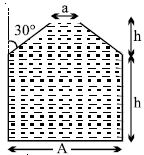
- 5The vessel shown in the figure has two sections. The lower part is a rectangular vessel with area of cross-section $A$ and height $h$. The upper part is a conical vessel of height $h$ with base area $‘A’$ and top area $‘a’$ and the walls of the vessel are inclined at an angle $30^o$ with the vertical.A liquid of density $\rho$ fills both the sections upto a height $2h$. Neglecting atmospheric pressure.View Solution
- 6A small metal sphere of radius $a$ is falling with a velocity $v$ through a vertical column of a viscous liquid. If the coefficient of viscosity of the liquid is $\eta $ , then the sphere encounters an opposing force ofView Solution
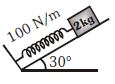
- 7A cubical block is floating in a liquid with one fourth of its volume immersed in the liquid. If whole of the system accelerates upward with acceleration $g / 4$, the fraction of volume immersed in the liquid will be ..........View Solution
- 8A wide vessel with a small hole at the bottom is filled with two liquids. The density and heightof one liquid are $\rho_1$ and $h_1$ and that of the otherare $\rho_2$ and $h_2 \ (\rho_1 >\rho_2)$. The velocity of liquid coming out of the hole is :View Solution
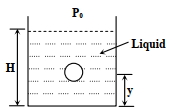
- 9A small spherical monoatomic ideal gas bubble $\left(\gamma=\frac{5}{3}\right)$ is trapped inside a liquid of density $\rho_{\ell}$ (see figure). Assume that the bubble does not exchange any heat with the liquid. The bubble contains n moles of gas. The temperature of the gas when the bubble is at the bottom is $\mathrm{T}_0$, the height of the liquid is $\mathrm{H}$ and the atmospheric pressure is $\mathrm{P}_0$ (Neglect surface tension).View Solution
Figure: $Image$
$1.$ As the bubble moves upwards, besides the buoyancy force the following forces are acting on it
$(A)$ Only the force of gravity
$(B)$ The force due to gravity and the force due to the pressure of the liquid
$(C)$ The force due to gravity, the force due to the pressure of the liquid and the force due to viscosity of the liquid
$(D)$ The force due to gravity and the force due to viscosity of the liquid
$2.$ When the gas bubble is at a height $\mathrm{y}$ from the bottom, its temperature is
$(A)$ $\mathrm{T}_0\left(\frac{\mathrm{P}_0+\rho_0 \mathrm{gH}}{\mathrm{P}_0+\rho_t \mathrm{gy}}\right)^{2 / 5}$
$(B)$ $T_0\left(\frac{P_0+\rho_t g(H-y)}{P_0+\rho_t g H}\right)^{2 / 5}$
$(C)$ $\mathrm{T}_0\left(\frac{\mathrm{P}_0+\rho_t \mathrm{gH}}{\mathrm{P}_0+\rho_t \mathrm{gy}}\right)^{3 / 5}$
$(D)$ $T_0\left(\frac{P_0+\rho_t g(H-y)}{P_0+\rho_t g H}\right)^{3 / 5}$
$3.$ The buoyancy force acting on the gas bubble is (Assume $R$ is the universal gas constant)
$(A)$ $\rho_t \mathrm{nRgT}_0 \frac{\left(\mathrm{P}_0+\rho_t \mathrm{gH}\right)^{2 / 5}}{\left(\mathrm{P}_0+\rho_t \mathrm{gy}\right)^{7 / 5}}$
$(B)$ $\frac{\rho_{\ell} \mathrm{nRgT}_0}{\left(\mathrm{P}_0+\rho_{\ell} \mathrm{gH}\right)^{2 / 5}\left[\mathrm{P}_0+\rho_{\ell} \mathrm{g}(\mathrm{H}-\mathrm{y})\right]^{3 / 5}}$
$(C)$ $\rho_t \mathrm{nRgT} \frac{\left(\mathrm{P}_0+\rho_t g \mathrm{H}\right)^{3 / 5}}{\left(\mathrm{P}_0+\rho_t g \mathrm{~g}\right)^{8 / 5}}$
$(D)$ $\frac{\rho_{\ell} \mathrm{nRgT}_0}{\left(\mathrm{P}_0+\rho_{\ell} \mathrm{gH}\right)^{3 / 5}\left[\mathrm{P}_0+\rho_t \mathrm{~g}(\mathrm{H}-\mathrm{y})\right]^{2 / 5}}$
Give the answer question $1,2,$ and $3.$
- 10The density of the atmosphere is $1.29\, kg/m^3$, then how high would the atmosphere extend ? $(g = 9.81\, m/sec^2)$ ........ $km$View Solution