An astronomical telescope is to be designed to have a magnifying power of 50 in normal adjustment. If the length of the tube is 102cm, find the powers of the objective and the eyepiece.
Download our app for free and get started
For the astronomical telescope in normal adjustment.Magnifying power = m = 50, length of the tube = L = 102cm
Let $f_0$ and fe be the focal length of objective and eye piece respectively.
$\text{m}=\frac{\text{f}_0}{\text{f}_\text{e}}=50\Rightarrow\text{f}_0=50\text{f}_\text{e}\dots(1)$
and, $\text{L}=\text{f}_0+\text{f}_\text{e}=102\text{cm}\dots(2)$
Putting the value of f0 from equation (1) in (2), we get,
$f_0 + f_e= 102 \Rightarrow 51f_e = 102 \Rightarrow f_e= 2cm = 0.02m$
So, $f_0 = 100cm = 1m$
$\therefore$ Power of the objective lens$=\frac{1}{\text{f}_0}=1\text{D}$
And Power of the eye piece lens$=\frac{1}{\text{f}_\text{e}}=\frac{1}{0.02}=50\text{D}$
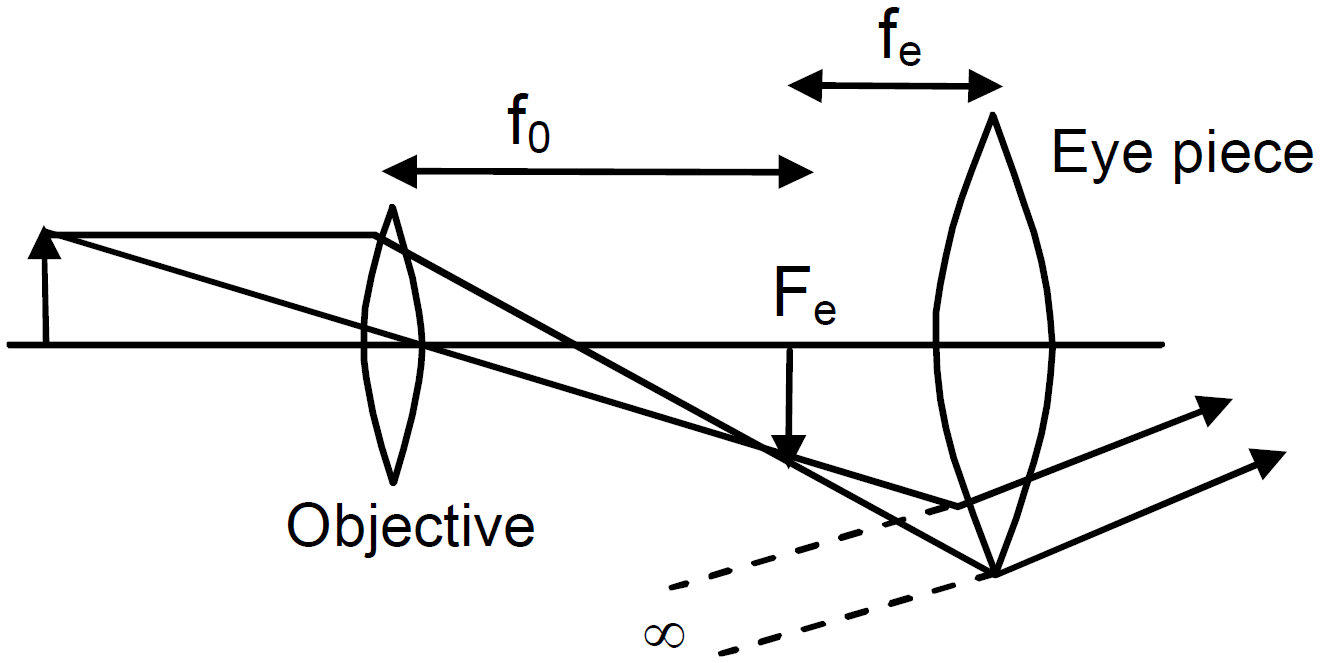
Let $f_0$ and fe be the focal length of objective and eye piece respectively.
$\text{m}=\frac{\text{f}_0}{\text{f}_\text{e}}=50\Rightarrow\text{f}_0=50\text{f}_\text{e}\dots(1)$
and, $\text{L}=\text{f}_0+\text{f}_\text{e}=102\text{cm}\dots(2)$
Putting the value of f0 from equation (1) in (2), we get,
$f_0 + f_e= 102 \Rightarrow 51f_e = 102 \Rightarrow f_e= 2cm = 0.02m$
So, $f_0 = 100cm = 1m$
$\therefore$ Power of the objective lens$=\frac{1}{\text{f}_0}=1\text{D}$
And Power of the eye piece lens$=\frac{1}{\text{f}_\text{e}}=\frac{1}{0.02}=50\text{D}$

Download our appand get started for free
Experience the future of education. Simply download our apps or reach out to us for more information. Let's shape the future of learning together!No signup needed.*
Similar Questions
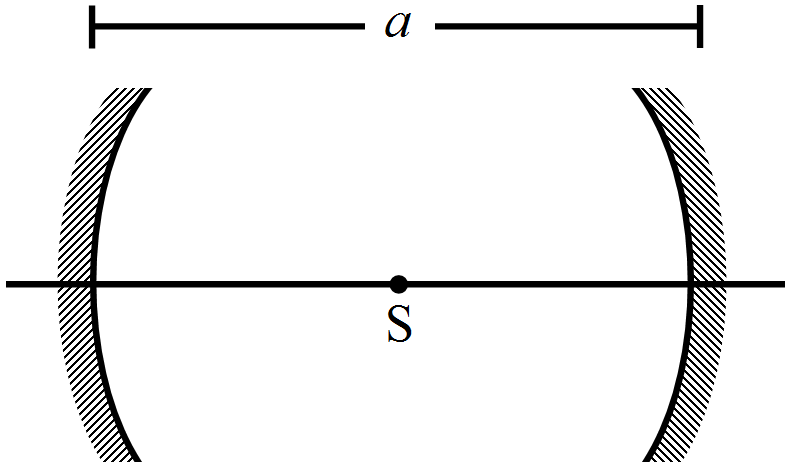
- 1View SolutionA point source S is placed midway between two converging mirrors having equal focal length f. Find the values of d for which only one image is formed.
- 2View Solution
- Draw a labelled ray diagram to show the formation of image in an astronomical telescope for a distant object.
- Write three distinct advantages of a reflecting type telescope over a refracting type telescope.
- A convex lens of focal length 10 cm is placed coaxially 5 cm away from a concave lens of focal length 10 cm. If an object is placed 30 cm in front of the convex lens, find the position of the final image formed by the combined system.
- 3View SolutionAn optical instrument used for angular magnification has a 25D objective and a 20D eyepiece. The tube length is 25cm when the eye is least strained.
- Whether it is a microscope or a telescope?
- What is the angular magnification produced?
- 4A hemispherical portion of the surface of a solid glass sphere $(\mu=1.5)$ of radius r is silvered to make the inner side reflecting. An object is placed on the axis of the hemisphere at a distance 3r from the centre of the sphere. The light from the object is refracted at the unsilvered part, then reflected from the silvered part and again refracted at the unsilvered part. Locate the final image formed.View Solution
- 5For a glass prism $(\mu=\sqrt{3})$ the angle of minimum deviation is equal to the angle of the prism. Find the angle of the prism.View Solution
- 6View Solution
- Draw the ray diagram of an astronomical telescope when the final image is formed at infinity. Write the expression for the resolving power of the telescope.
- An astronomical telescope has an objective lens of focal length 20m and eyepiece of focal length 1cm.
- Find the angular magnification of the telescope.
- If this telescope is used to view the Moon, find the diameter of the image formed by the objective lens. Given the diameter of the Moon is $3.5 \times 10^6m$ and radius of lunar orbit is $3.8 \times 10^8m.$
- 7View SolutionA diverging lens of focal length 20cm and a converging lens of focal length 30cm are placed 15cm apart with their principal axes coinciding. Where should an object be placed on the principal axis so that its image is formed at infinity?
- 8View Solution
- Draw a ray diagram to show image formation when the concave mirror produces a real, inverted and magnified image of the object.
- Obtain the mirror formula and write the expression for the linear magnification.
- Explain two advantages of a reflecting telescope over a refracting telescope.
- 9View SolutionFigure shows a plane mirror M placed at a distance of 10cm from a concave lens L. A point object is placed at a distance of 60cm from the lens. The image formed due to refraction by the lens and reflection by the mirror is 30cm behind the mirror. What is the focal length of this lens?
- 10A thin lens made of a material of refractive index $\mu_2$ has a medium of refractive index $\mu_1$ on one side and a medium of refractive index $\mu_3$ on the other side. The lens is biconvex and the two radii of curvature have equal magnitude R. A beam of light travelling parallel to the principal axis is incident on the lens. Where will the image be formed if the beam is incident from:View Solution
- The medium $\mu_1$
- From the medium $\mu_3?$