- Draw a ray diagram to show image formation when the concave mirror produces a real, inverted and magnified image of the object.
- Obtain the mirror formula and write the expression for the linear magnification.
- Explain two advantages of a reflecting telescope over a refracting telescope.
CBSE DELHI - OUTSIDE DELHI - FOREIGN SET 2 2018
Download our app for free and get started
- Object between F and C. The image is Beyond C.
- No chromatic aberration.
- Spherical aberration reduces significantly.
- Low set up cost, lighter, forms brighter image.
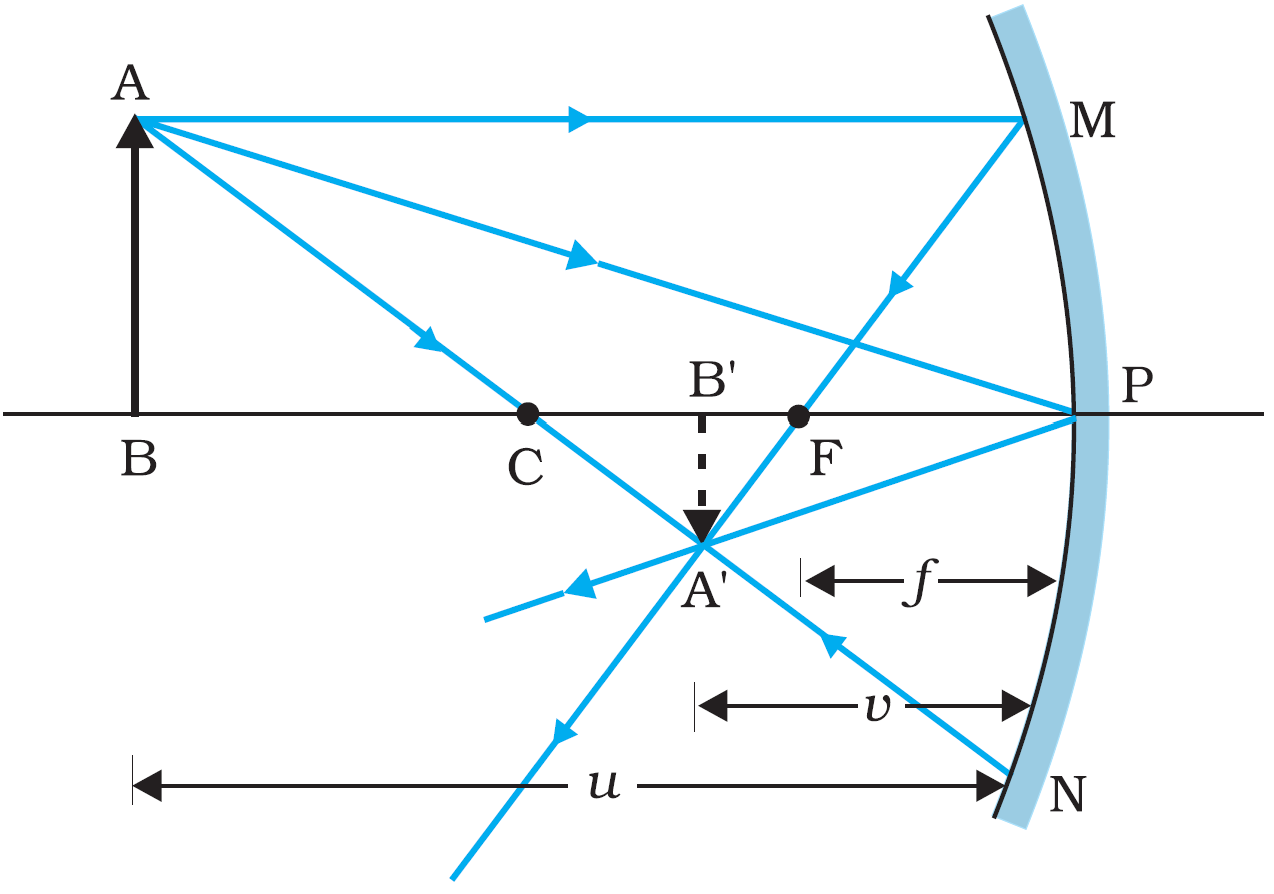
From the concavemirror.
Using cartesian sign convention, we find
Now, $\triangle\text{A}'\text{B}'\text{C}\sim\triangle\text{ABC}$Object distance,BP = -uImage distance,B'P = -vFocal length,FP = -fRadius of curvature,CP = -R = -2f
$\therefore\ \frac{\text{A}'\text{B}'}{\text{AB}}=\frac{\text{CB}'}{\text{BC}}=\frac{\text{CP}-\text{B}'\text{P}}{\text{BP}-\text{CP}}=\frac{-\text{R}+\text{v}}{-\text{u}+\text{R}}\ ....(1)$
As $\angle\text{A}'\text{PB}'=\angle\text{APB},$ therefore,
$\triangle\text{A}'\text{B}'\text{P}\sim\triangle\text{ABP}.$
Consequently,
$\frac{\text{A}'\text{B}'}{\text{AB}}=\frac{\text{B}'\text{P}}{\text{BP}}=\frac{-\text{v}}{-\text{u}}=\frac{\text{v}}{\text{u}}\ ....(2)$
From equations (1) and (2), we get
$\frac{-\text{R}+\text{v}}{-\text{u}+\text{R}}=\frac{\text{v}}{\text{u}}$
or, $-\text{uR}+\text{uv}=\text{-uv}+\text{vR}$
or, $\text{vR}+\text{uR}=2\text{uv}$
Dividing both sides by uvR, we get
$\frac{1}{\text{u}}+\frac{1}{\text{v}}=\frac{2}{\text{R}}$
But, R = 2f
$\frac{1}{\text{u}}+\frac{1}{\text{v}}=\frac{1}{\text{f}}$
This proves themirror formula for a concavemirror, when it forms a real image.
Linear magnification is given by:
$\text{m}=\frac{\text{h}_2}{\text{h}_1}=\frac{-\text{v}}{\text{u}}$
here $h_2, h_1$ are heights of image and object respectively v, u are distances of image and object from the pole of mirror respectively.- Nature Real, Inverted and Larger than object.
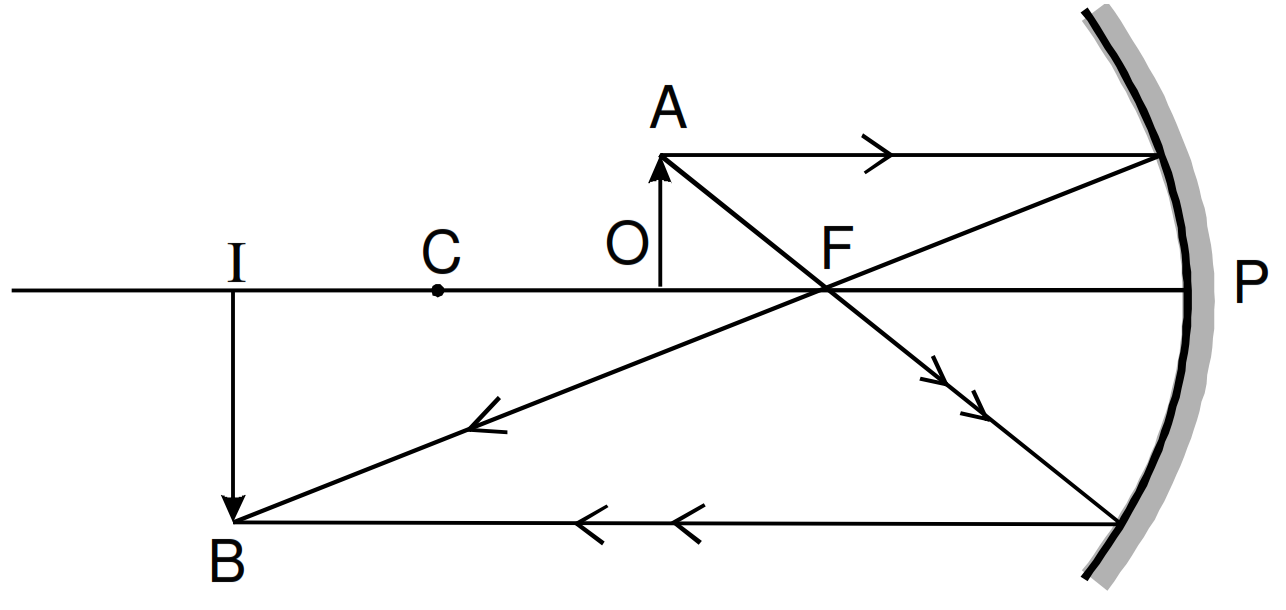
- Consider an object AB placed on the principal axis beyond the centre of curvature C of a concave mirror of small aperture, as shown in Fig. Aray AM from the object travels parallel to the principal axis and after reflection from the mirror it passes through focus F. Another ray AP is incident on the pole P of the mirror and is reflected along PA' in accordance with the laws of reflection so that $\angle\text{APB}=\angle\text{BPA}'.$ The two reflected rays meet at point A'. Thus A' is the real image of A. The image of any point on AB will lie on a corresponding point of A'B. Hence A'B is the real image of AB formed by reflection.

Download our appand get started for free
Experience the future of education. Simply download our apps or reach out to us for more information. Let's shape the future of learning together!No signup needed.*
Similar Questions
- 1View SolutionAt what angle should a ray of light be incident on the face of a prism of refracting angle 60° so that it just suffers total internal reflection at the other face? The refractive index of the material of the prism is 1.524.
- 2A point object 'O' is kept in a medium of refractive index $n_1$ in front of a convex spherical surface of radius of curvature R which separates the second medium of refractive index $n_2$ from the first one, as shown in the figure.View Solution
- Draw the ray diagram showing the image formation and deduce the relationship between the object distance and the image distance in terms of $n_1, n_2$ and R.
- When the image formed above acts as a virtual object for concave spherical, surface separating the medium $n_2$ from $n_1 (n_2> n_1)$, draw this ray diagram and write the similar (similar to (a) relation. Hence obtain the expression for the lens maker's formula.
- 3A ball is kept at a height h above the surface of a heavy transparent sphere made of a material of refractive index $\mu.$ The radius of the sphere is R. At t = 0, the ball is dropped to fall normally on the sphere. Find the speed of the image formed as a function of time for $\text{t}<\sqrt{\frac{2\text{h}}{\text{g}}}.$ Consider only the image by a single refraction.View Solution
- 4View Solution
- Draw a labelled ray diagram to show the formation of image in an astronomical telescope for a distant object.
- Write three distinct advantages of a reflecting type telescope over a refracting type telescope.
- A convex lens of focal length 10 cm is placed coaxially 5 cm away from a concave lens of focal length 10 cm. If an object is placed 30 cm in front of the convex lens, find the position of the final image formed by the combined system.
- 5View SolutionA man with normal near point (25 cm) reads a book with small print using a magnifying glass: a thin convex lens of focal length 5 cm.
- What is the closest and the farthest distance at which he should keep the lens from the page so that he can read the book when viewing through the magnifying glass?
- What is the maximum and the minimum angular magnification (magnifying power) possible using the above simple microscope?
- 6View SolutionA person with a normal near point (25 cm) using a compound microscope with objective of focal length 8.0 mm and an eyepiece of focal length 2.5 cm can bring an object placed at 9.0 mm from the objective in sharp focus. What is the separation between the two lenses? Calculate the magnifying power of the microscope.
- 7A thin prism of angle $6.0^\circ,\omega=0.07$ and $\mu_\text{y}=1.50$ is combined with another thin prism having $\omega=0.08$ and $\mu_\text{y}=1.60.$ The combination produces no deviation in the mean ray.View Solution
- Find the angle of the second prism.
- Find the net angular dispersion produced by the combination when a beam of white light passes through it.
- If the prisms are similarly directed, what will be the deviation in the mean ray
- Find the angular dispersion in the situation described in (c).
- 8View SolutionA professor reads a greeting card received on his 50th birthday with +2.5D glasses keeping the card 25cm away. Ten years later, he reads his farewell letter with the same glasses but he has to keep the letter 50cm away. What power of lens should he now use?
- 9View Solution
- Draw the ray diagram of an astronomical telescope when the final image is formed at infinity. Write the expression for the resolving power of the telescope.
- An astronomical telescope has an objective lens of focal length 20m and eyepiece of focal length 1cm.
- Find the angular magnification of the telescope.
- If this telescope is used to view the Moon, find the diameter of the image formed by the objective lens. Given the diameter of the Moon is $3.5 \times 10^6m$ and radius of lunar orbit is $3.8 \times 10^8m.$
- 10View SolutionA 5mm high pin is placed at a distance of 15cm from a convex lens of focal length 10cm. A second lens of focal length 5cm is placed 40cm from the first lens and 55cm from the pin. Find
- The position of the final image.
- Its nature.
- Its size.