A parallel plate condenser with oil between the plates (dielectric constant of oil $K = 2$) has a capacitance $C$. If the oil is removed, then capacitance of the capacitor becomes
AIPMT 1999, Easy
Download our app for free and get started
(d) ${C_{air}} = \frac{{{C_{medium}}}}{K} = \frac{C}{2}$

Download our appand get started for free
Experience the future of education. Simply download our apps or reach out to us for more information. Let's shape the future of learning together!No signup needed.*
Similar Questions
- 1A circuit has a section $AB$ as shown in the figure. If the potential difference between points $A$ and $B$ is $V\, volt$, then potential difference across $C_1$ isView Solution

- 2Twenty seven drops of same size are charged at $220\, \mathrm{~V}$ each. They combine to form a bigger drop. Calculate the potential of the bigger drop. (In $\mathrm{~V}$)View Solution
- 3The distance between the circular plates of a parallel plate condenser $40\,mm$ in diameter, in order to have same capacity as a sphere of radius $1\;metre$ is....$mm$View Solution
- 4The electric potential at a point $(x, y, z)$ is given by $V=-x^2y-xz^3 +4 $. The electric field at that point isView Solution
- 5When a positive $q$ charge is taken from lower potential to a higher potential point, then its potential energy willView Solution
- 6View SolutionWhen two identical capacitors are charged individually to different potentials and connected parallel to each other, after disconnecting them from the source :
- 7The potential difference between the points $P$ and $Q$ in the adjoining circuit will be :-View Solution
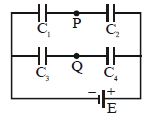
- 8A particle of mass $m$ and charge $q$ is placed at rest in a uniform electric field $E$ and then released. The kinetic energy attained by the particle after moving a distance $y$ isView Solution
- 9The potential at a point, due to a positive charge of $100\,\mu C$ at a distance of $9\,m$, isView Solution
- 10A fully charged capacitor has a capacitance $‘C’$. It is discharged through a small coil of resistance wire embedded in a thermally insulated block of specific heat capacity $‘s’$ and mass $‘m’$. If the temperature of the block is raised by ‘$\Delta T$’, the potential difference $‘V’$ across the capacitance isView Solution