- Larger wavelength.
- Larger frequency.
- Larger velocity.
- Larger time period.
Explanation:
The velocity varies with temperature as $\text{v}\propto\sqrt{\text{T}}.$ Therefore, it increases. Since the frequency remains constant, the wavelength will increase as $\lambda\propto\text{v}.$
Generate a complete, print-ready paper with questions like this in minutes — across 16+ boards, with answer keys.
Electric room radiator which operates at 225 volts has resistance of 50 ohms. Power of the radiator is approximately
|
(a) 100 W |
(b) 450 W |
(c) 750 W |
(d) 1000 W |
Select the right option in the following
|
(a) Christian Huygens a contemporary of Newton established the wave theory of light by assuming that light waves were transverse |
|
(b) Maxwell provided the compelling theoretical evidence that light is transverse wave |
|
(c) Thomas Young experimentally proved the wave behaviour of light and Huygens assumption |
|
(d) All the statements give above, correctly answers the question “what is light” |
Which of the following are not electromagnetic waves
|
(a) Cosmic rays |
(b) Gamma rays |
(c) b-rays |
(d) X-rays |
Two normal uniform magnetic field contain a magnetic needle making an angle 60° with F. Then the ratio of is
| (a) 1 : 2 | (b) 2 : 1 |
(c) |
(d) 1 : |
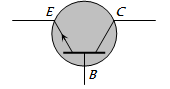
The symbol given in figure represents

|
(a) NPN transistor |
(b) PNP transistor |
|
(c) Forward biased PN junction diode |
(d) Reverse biased NP junction diode |
Assertion : In a common emitter transistor amplifier the input current is much less than the output current.
Reason : The common emitter transistor amplifier has very high input impedance.
|
(a) If both assertion and reason are true and the reason is the correct explanation of the assertion. |
|
(b) If both assertion and reason are true but reason is not the correct explanation of the assertion. |
|
(c) If assertion is true but reason is false. |
|
(d) If the assertion and reason both are false. |
As our eyes can not retrace the bent path of light, a stick, dipped in water, appears: