An electron (charge $= 1.6 × 10^{-19}$ coulomb) is moving in a circle of radius $5.1 × 10^{-11}\,m$ at a frequency of $6.8 × 10^{15} $ revolutions/sec. The equivalent current is approximately
Easy


Download our appand get started for free
Experience the future of education. Simply download our apps or reach out to us for more information. Let's shape the future of learning together!No signup needed.*
Similar Questions
- 1A cell of emf $6\, V$ and resistance $0.5\, ohm$ is short circuited. The current in the cell is ............... $amp$View Solution
- 2What amount of heat will be generated in a coil of resistance $R$ due to a charge $q$ passing through it if the current in the coil decreases to zero uniformly during a time interval $\Delta t$View Solution
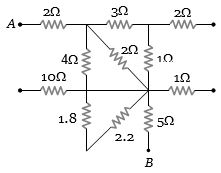
- 3What is the equivalent resistance between the points $A$ and $B$ of the network .................. $\Omega$View Solution
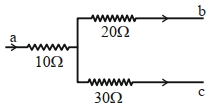
- 4Figure shows a part of an electric circuit. The potentials at points $a , b$ and $c$ are $30\,V , 12\,V$ and $2\,V$ respectively. The current through the $20 \Omega$ resistor will be $........\,A$View Solution
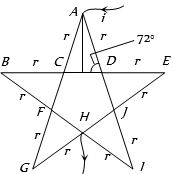
- 5In the following star circuit diagram (figure), the equivalent resistance between the points $A$ and $H$ will be ..............$r$View Solution
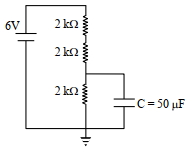
- 6A capacitor of $50 \,\mu {F}$ is connected in a circuit as shown in figure. The charge on the upper plate of the capacitor is $......\,\mu {C} .$View Solution
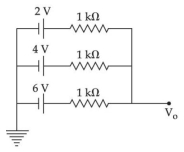
- 7In the given figure, the value of $V_{0}$ will be $.....V$.View Solution
- 8A bulb has specification of one kilowatt and $250\, volts$, the resistance of bulb is .................. $\Omega$View Solution
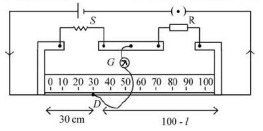
- 9In meter bridge experiment for measuring unknown resistance ' $S$ ', the null point is obtained at a distance $30 cm$ from the left side as shown at point $D$. If $R$ is $5.6 k \Omega$, then the value of unknown resistance ' $S$ ' will be $\Omega .$View Solution
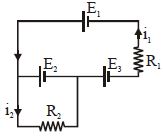
- 10The current $i_1$ and $i_2$ through the resistor $R_1 (= 10\,\Omega )$ and $R_2 (=30 \,\Omega )$ in the circuit diagram with $E_1 = 3\,V, E_2 = 3\,V$ and $E_3 = 2\,V$ are respectively:View Solution