Question
An electron emitted by a heated cathode and accelerated through a potential difference of $2.0 kV,$ enters a region with uniform magnetic field of $0.15 T$. Determine the trajectory of the electron if the field,
  1. is transverse to its initial velocity,
  2. makes an angle of $30^\circ$ with the initial velocity.
​​

Answer

Magnetic field strength $, B = 0.15 T$ Charge on the electron $, e = 1.6 \times 10^{-19} C$
Mass of the electron $, m = 9.1 \times 10^{-31} \ kg$
Potential difference $, V = 2.0 kV = 2 \times 10^3 V$
Thus, kinetic energy of the electron $= eV$
$\Rightarrow\text{eV}=\frac{1}{2}\text{mv}^{2}$
$\text{v}=\sqrt\frac{2\text{ev}}{\text{m}}.........(1)$
Where,
$v = $ velocity of the electron
  1. Magnetic force on the electron provides the required centripetal force of the electron.
  2. Hence, the electron traces a circular path of radius $r$.
Magnetic force on the electron is given by the relation,
$\text{B ev}$
$\text{Centripetal force}=\frac{\text{mv}^{2}}{\text{r}}$
$\therefore\text{Bev}=\frac{\text{mv}^{2}}{\text{r}}$
$\text{r}=\frac{\text{mv}}{\text{Be}}.........(2)$
From equations $(1)$ and $(2), $ we get
$\text{r}=\frac{\text{m}}{\text{Be}}\Big[\frac{2\text{ev}}{\text{m}}\Big]^{\frac{1}{2}}$
$=\frac{9.1\times10^{-31}}{0.15\times1.6\times10^{-19}}\times\Big(\frac{2\times1.6\times10^{-19}\times2\times10^{3}}{9.1\times10^{-31}}\Big)^{\frac{1}{2}}$
$=100.55\times10^{-5}$
$=1.01\times10^{-3}\text{ m}$
$=1\text{ mm}$
Hence, the electron has a circular trajectory of radius $1.0 \ mm$ normal to the magnetic field.
  1. When the field makes an angle $\theta$ of $30^\circ$ with initial velocity, the initial velocity will be,
$\text{v}_{1}=\text{v}\sin\theta$
From equation $(2),$ we can write the expression for new radius as: $\text{r}_{1}=\frac{\text{mv}_{1}}{\text{Be}}$
$=\frac{\text{mv}\sin\theta}{\text{Be}}$
$=\frac{9.1\times10^{-31}}{0.15\times1.6\times10^{-19}}\times\Big(\frac{2\times1.6\times10^{-19}\times2\times10^{3}}{9\times10^{-31}}\Big)^{\frac{1}{2}}\times\sin30^{\circ}$
$=0.5\times10^{-31}\text{ m}$
$=0.5\text{ mm}$
Hence, the electron has a helical trajectory of radius $0.5 \ mm$ along the magnetic field direction.

Need a full question paper?

Generate a complete, print-ready paper with questions like this in minutes — across 16+ boards, with answer keys.

Start Generating Free

Similar questions

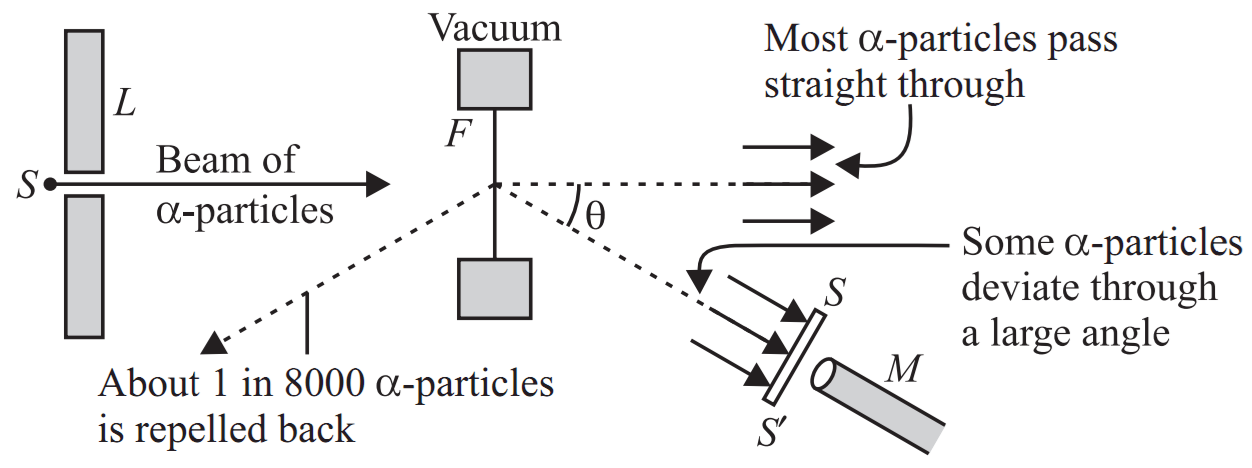
In $1911,$ Rutherford, along with his assistants, $H$.
Geiger and $E$. Marsden, performed the alpha particle scattering experiment. $H$.
Geiger and $E$. Marsden took radioactive source $(^{214}_{83}\text{Bi})$ for $\alpha- $ particles.
A collimated beam of $\alpha-$ particles of energy $5.5 MeV$ was allowed to fall on $2.1 \times 10^{-7} m$ thick gold foil. The $\alpha-$ particles were observed through a rotatable detector consisting of a Zinc sulphide screen and microscope. It was found that $CL-$ particles got scattered. These scattered $\alpha-$ particles produced scintillations on the zinc sulphide screen. Observations of this experiment are as follows?
Most of the $\alpha-$ particles passed through the foil without deflection.
Only about $0.14\%$ of the incident $\alpha-$ particles scattered by more than $1^\circ$
Only about one $\alpha-$ particle in every $8000 \ \alpha-$ particles deflected by more than $90^\circ$
These observations led to many arguments and conclusions which laid down the structure of the nuclear model of an atom.
  1. Rutherford's atomic model can be visualised as.
  1. Gold foil used in Geiger $-$ Marsden experiment is about $10^{-8}m$ thick. This ensures.
  1. Gold foil's gravitational pull is small or possible.
  2. Gold foil is deflected when $\alpha-$ particle stream is not incident centrally over it.
  3. Gold foil provides no resistance to passage of $\alpha-$ particles.
  4. Most $\alpha-$ particle will not suffer more than $1^\circ$ scattering during passage through gold foil.
  1. In Geiger $-$ Marsden scattering experiment, the trajectory traced by an $\alpha-$ particle depends on.
  1. Number of collision.
  2. Number of scattered $\alpha- $ particles.
  3. Impact parameter.
  4. None of these.
  1. In the Geiger $-$ Marsden scattering experiment, in case of head $-$ on collision, the impact parameter should be.
  1. Maximum
  2. Minimum
  3. Infinite
  4. zero
  1. The fact only a small fraction of the number of incident particles rebound back in Rutherford scattering indicates that.
  1. Number of $\alpha-$ particles undergoing head $-$ on $-$ collision is small.
  2. Mass of the atom is concentrated in a small volume.
  3. Mass of the atom is concentrated in a large volume.
  4. Both $(a)$ and $(b).$
Hydrogen spectrum consists of discrete bright lines in a dark background, and it is specifically known as hydrogen emission spectrum. There is one more type of hydrogen spectrum that exists where we get dark lines on the bright background, it is known as absorption spectrum. Balmer found an empirical formula by the observation of a small part of this spectrum, and it is represented by $\frac{1}{\lambda}=\text{R}\bigg(\frac{1}{2^2}-\frac{1}{\text{n}^2}\bigg)$ where $n = 3, 4, 5$ For Lyman series, the emission is from first state to $n^{th}$ state, for Paschen series, it is from third state to $n^{th}$ state, for Brackett series, it is from fourth state to $n^{th}$ state and for $P$ fund series, it is from fifth state to $n^{th}$ state.
  1. Number of spectral lines in hydrogen atom is:
  1. $8$
  2. $6$
  3. $15$
  4. $\infty$
  1. Which series of hydrogen spectrum corresponds to ultraviolet region?
  1. Balmer series.
  2. Brackett series.
  3. Paschen series.
  4. Lyman series.
  1. Which of the following lines of the $H-$ atom spectrum belongs to the Balmer series?
  1. $1025A$
  2. $1218A$
  3. $4861A$
  4. $18751A$
  1. Rydberg constant is.
  1. A universal constant.
  2. A universal constants.
  3. Different for different elements.
  4. None of these.
  1. Hydrogen atom is excited from ground state to another state with principal quantum number equal to $4$. Then the number of spectral lines in the emission spectra will be.
  1. $3$
  2. $5$
  3. $6$
  4. $2$
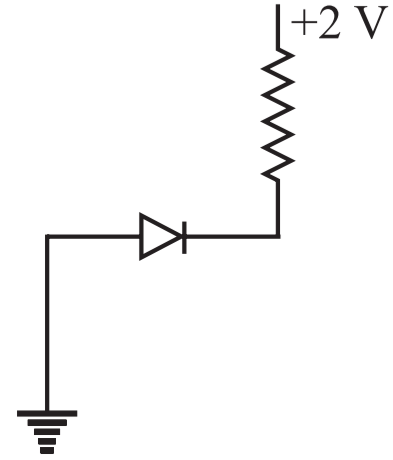
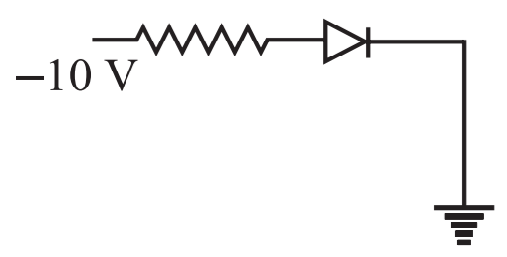
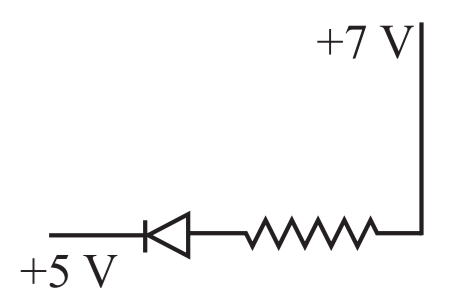
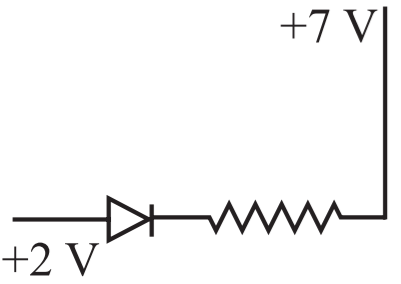
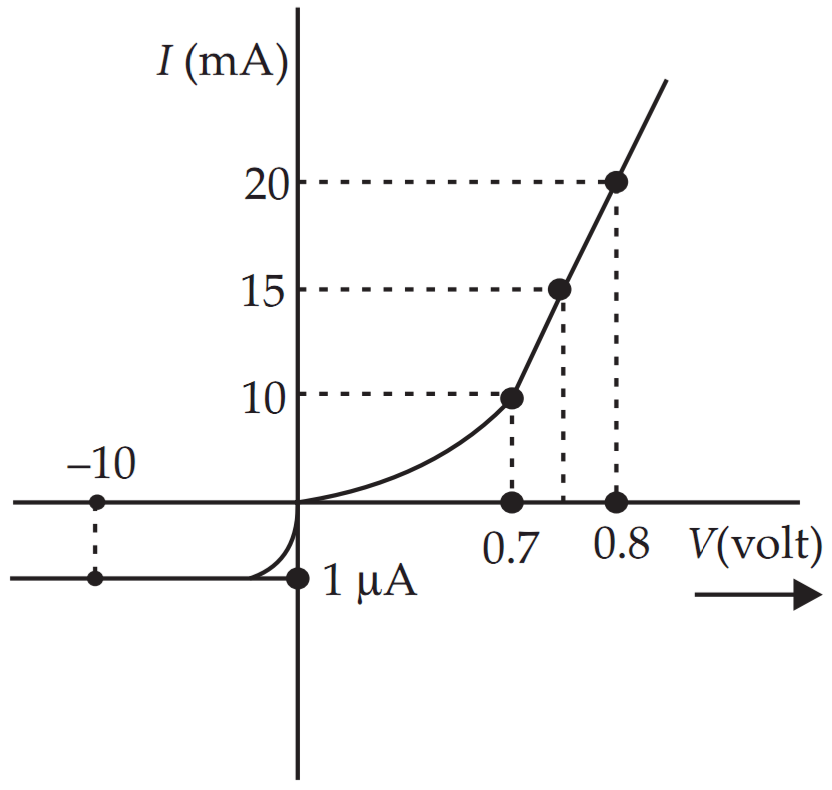
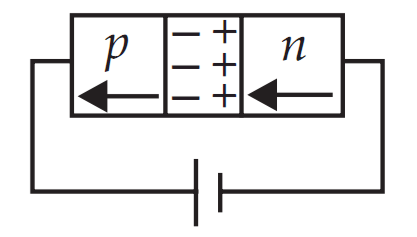
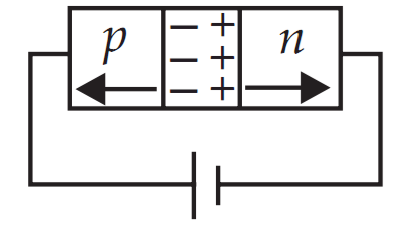
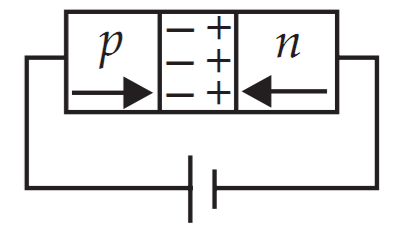
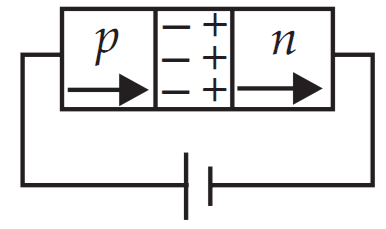
When the diode is forward biased, it is found that beyond forward voltage $V = V_k,$ called knee voltage, the conductivity is very high. At this value of battery biasing for $p-n$ junction, the potential barrier is overcome and the current increases rapidly with increase in forward voltage.
When the diode is reverse biased, the reverse bias voltage produces a very small current about a few microamperes which almost remains constant with bias. This small current is reverse saturation current.
  1. In which of the following figures, the $p-n$ diode is forward biased.
  1.  
  1.  
  1.  
  1.  
  1. Based on the $V-I$ characteristics of the diode, we can classify diode as:
  1. $Bi-$ directional device.
  2. Ohmic device.
  3. Non $-$ ohmic device.
  4. Passive element.
  1. The $V-I$ characteristic of a diode is shown in the figure. The ratio of forward to reverse bi as resistance is:
  1. $100$
  2. $10^6$
  3. $10$
  4. $10^{-6}$
  1. In the case of forward biasing of a $p-n$ junction diode, which one of the following figures correctly depicts the direction of conventional current $($indicated by an arrow mark$)$?
  1.  
  1.  
  1.  
  1.  
  1. If an ideal junction diode is connected as shown, then the value of the current I is:
  1. $0.013A$
  2. $0.02A$
  3. $0.01A$
  4. $0.1A$
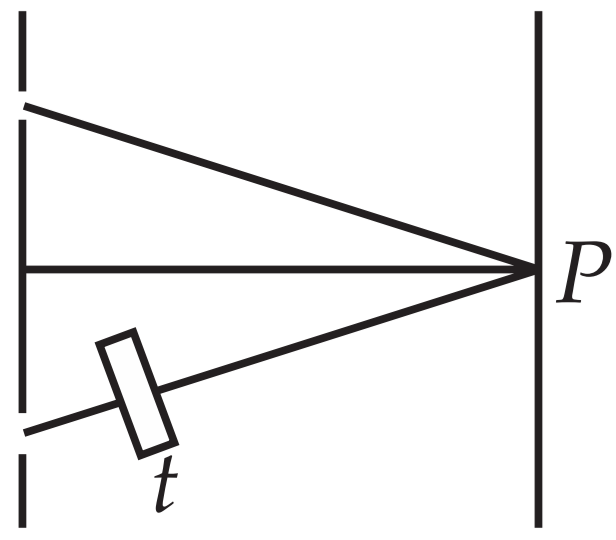
If double slit apparatus is immersed in a liquid of refractive index, $\mu$ the wavelength of light reduces to $\lambda$ and fringe width also reduces to $\beta=\frac{\beta}{\mu}$.
The given figure shows a double $-$ slit experiment in which coherent monochromatic light of wavelength $\lambda$ from a distant source is incident upon the two slits, each of width $\text{w}(\text{w}>>\lambda)$ and the interference pattern is viewed on a distant screen. A thin piece of glass of thickness $ t$ and refractive index $n$ is placed between one of the slit and the screen, perpendicular to the light path.
  1. ln Young's double slit interference pattern, the fringe width.
  1. Can be changed only by changing the wavelength of incident light.
  2. Can be changed only by changing the separation between the two slits.
  3. Can be changed either bychangingthe wavelength or by changing the separation between two sources.
  4. Is a universal constant and hence cannot be changed.
  1. If the width w ofone of the slits is increased to $2w,$ the become the amplitude due to slit.
  1. $1.5\text{a}$
  2. $\frac{\text{a}}{2}$
  3. $2\text{a}$
  4. No change.
  1. ln $\text{YDSE},$ let $A$ and $B$ be two slits. Films of thicknesses $t_A$ and $t_B$ and refractive indices $m_A$ and $m_B$ are placed in front of $A$ and $B,$ respectively. If $\mu_\text{A}\text{t}_\text{A}=\mu_\text{B}\text{t}_\text{B}$ then the central maxima will:
  1. Not shift.
  2. Shift towards $A$.
  3. Shift towards $B.$
  4. Shift towards $A$ if $t_B = t_A$ and shift towards $B$ if $t_B < t_A$​​​​​​​
  1. ln Young's double slit experiment, a third slit is made in between the double slits. Then:
  1. Fringes of unequal width are formed.
  2. Contrast between bright and dark fringes is reduced.
  3. Intensity of fringes totally disappears.
  4. Only bright tight is observed on the screen.
  1. ln Young's double slit experiment, if one of the slits is covered with a microscope cover slip, then:
  1. Fringe pattern disappears.
  2. The screen just gets illuminated.
  3. In the fringe pattern, the brightness of the bright fringes will decreases and the dark fringes will become more dark.
  4. Bright fringes will be more bright and dark fringes will become more dark.
A bar magnet takes $\frac{\pi}{10}$ second to complete one oscillation in an oscillation magnetometer. The moment of inertia of the magnet about the axis of rotation is $1.2 \times 10^{-4} \ kg-m^2$ and the earth's horizontal magnetic field is $30\mu \text{T}.$ Find the magnetic moment of the magnet.
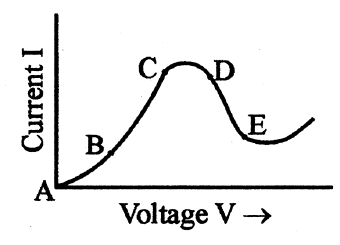
Graph showing the variation of current versus voltage for a material GaAs is shown in the figure. Identify the region of.
  1. Negative resistance.
  2. Where Ohm's law is obeyed.
Establish the expression for equivalent resistance of series combination and parallel combination of resistance separately.
The radio and TV programmes, telecast at the studio, reach our antenna by wave motion. Is it a mechanical wave or nonmechanical?
The magnetic field due to the earth has a horizontal component of $26\mu\text{T}$ at a place where the dip is 60°. Find the vertical component and the magnitude of the field.
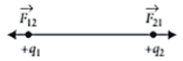
Coulomb's law states that the electrostatic force of attraction or repulsion acting between two stationary point charges is given by
Image
where $F$ denotes the force between two charges $q _1$ and $q _2$ separated by a distance r in free space, $\varepsilon_0$ is a constant known as the permittivity of free space.
Free space is a vacuum and may be taken to be air practically.
If free space is replaced by a medium, then $\varepsilon_0$ is replaced by $\left(\varepsilon_0 k\right)$ or $\left(\varepsilon_0 \varepsilon_r\right)$ where $k$ is known as dielectric constant or relative permittivity.
$(i)$ In coulomb's law, $F =k \frac{q_1 q_2}{r^2}$, then on which of the following factors does the proportionality constant k depends?
$(a)$ Nature of the medium between the two charges
$(b)$ Distance between the two charges
$(c)$ Electrostatic force acting between the two charges
$(d)$ Magnitude of the two charges

$(ii)$ Dimensional formula for the permittivity constant $\varepsilon_0$ of free space is
$(a) \left[ M ^{-1} L^3 T^2 A^2\right]$
$(b) \left[ ML ^{-3} T^4 A^2\right]$
$(c) \left[ M ^{-1} L^{-3} T^4 A^2\right]$
$(d) \left[ ML ^{-3} T^4 A^{-2}\right]$

$(iii)$ The force of repulsion between two charges of $1 C$ each, kept $1m$ apart in vaccum is
$(a) \frac{1}{9 \times 10^9} N$
$(b) \frac{1}{9 \times 10^{12}} N$
$(c) 9 \times 10^7 N$
$(d) 9 \times 10^9 N$

$(iv)$ Two identical charges repel each other with a force equal to $10$ mgwt when they are $0.6 m$ apart in air. ( $g =$ $10 m s ^{-2} )$. The value of each charge is
$(a) 2 mC$
$(b) 2 \times 10^{-7} mC$
$(c) 2 \mu C$
$(d) 2 nC$
OR
Coulomb's law for the force between electric charges most closely resembles with
$(a)$ law of conservation of energy
$(b)$ Newton's $2^{nd}$ law of motion
$(c)$ law of conservation of charge .
$(d)$ Newton's law of gravitation