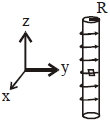
An electron gun is placed inside a long solenoid of radius $\mathrm{R}$ on its axis. The solenoid has $\mathrm{n}$ turns/length and carries a current $I$. The electron gun shoots an electron along the radius of the solenoid with speed $v$. If the electron does not hit the surface of the solenoid, maximum possible value of ${v}$ is (all symbols have their standard meaning)
JEE MAIN 2020, Medium
Download our app for free and get started
Maximum possible radius of electron $=\frac{\mathrm{R}}{2}$
$\therefore \frac{\mathrm{R}}{2}=\frac{\mathrm{mv}}{\mathrm{qB}}=\frac{\mathrm{mv}_{\max }}{\mathrm{e}\left(\mu_{0} \mathrm{ni}\right)}$
$\mathrm{v}_{\max }=\frac{\mathrm{R}}{2} \frac{\mathrm{e} \mu_{0} \mathrm{ni}}{\mathrm{m}}$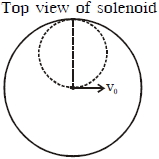

Download our appand get started for free
Experience the future of education. Simply download our apps or reach out to us for more information. Let's shape the future of learning together!No signup needed.*
Similar Questions
- 1The magnetic moment of a circular orbit of radius $‘r’$ carrying a charge $‘q’$ and rotating with velocity $v$ is given byView Solution
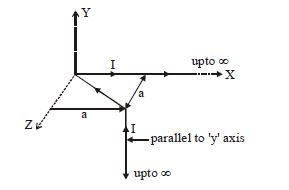
- 2View SolutionThe magnetic field at the origin due to the current flowing in the wire is
- 3A square coil of side $10\; cm$ consists of $20$ turns and carries a current of $12\; A$. The coil is suspended vertically and the normal to the plane of the coil makes an angle of $30^o$ with the direction of a uniform horizontal magnetic field of magnitude $0.80 \;T$. What is the magnitude of torque (in $N\;m$) experienced by the coil?View Solution
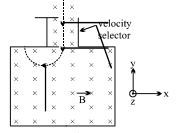
- 4Two charged particle $A$ and $B$ each of charge $+e$ and masses $12$ $amu$ and $13$ $amu$ respectively follow a circular trajectory in chamber $X$ after the velocity selector as shown in the figure. Both particles enter the velocity selector with speed $1.5 \times 10^6 \,ms^{-1}.$ A uniform magnetic field of strength $1.0$ $T$ is maintained within the chamber $X$ and in the velocity selector.View Solution
- 5A galvanometer has a coil of resistance $100\, ohm$ and gives a full scale deflection for $30\, mA$ current. If it is to work as a voltmeter of $30\, volt$ range, the resistance required to be added will be.....$Ω$View Solution
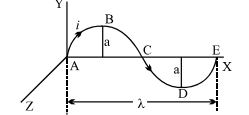
- 6A conductor $ABCDE$, shaped as shown, carries a current i. It is placed in the $xy$ plane with the ends $A$ and $E$ on the $x$-axis. $A$ uniform magnetic field of magnitude $B$ exists in the region. The force acting on it will beView Solution
- 7A power line lies along the east-west direction and carries a current of $10\, ampere$. The force per metre due to the earth's magnetic field of ${10^{ - 4}}\,tesla$ isView Solution
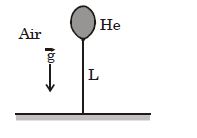
- 8A light balloon filled with helium of density $\rho_{He}$ is tied to a light string of length $L.$ The string is tied to the ground forming an "inverted" simple pendulum (figure). If the balloon is displaced slightly from equilibrium as in figure and released, the period of the motion is. Take the density of air to be $\rho_{air}$. Assume the air applies a buoyant force on the balloon but does not otherwise affect its motion.)View Solution
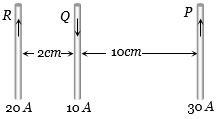
- 9Three long, straight and parallel wires carrying currents are arranged as shown in figure. The force experienced by $10\, cm$ length of wire $Q$ isView Solution
- 10A small square loop of wire of side $l$ is placed inside a large square loop of wire of side $L(L >> l)$. The loops are coplaner and their centres coincide. The mutual inductance of the system is propotional toView Solution