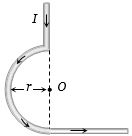
In the figure, what is the magnetic field at the point $O$
Medium
Download our app for free and get started
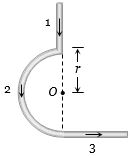
(c) Magnetic field due to different parts are
$B_1 = 0$
${B_2} = \frac{{{\mu _0}}}{{4\pi }}.\frac{{\pi i}}{r}\odot$
${B_3} = \frac{{{\mu _0}}}{{4\pi }}.\frac{i}{r}\odot$
$\therefore \;{B_{net}} = {B_2} + {B_3} = \frac{{{\mu _0}i}}{{4r}} + \frac{{{\mu _0}i}}{{4\pi r}}$
$B_1 = 0$
${B_2} = \frac{{{\mu _0}}}{{4\pi }}.\frac{{\pi i}}{r}\odot$
${B_3} = \frac{{{\mu _0}}}{{4\pi }}.\frac{i}{r}\odot$
$\therefore \;{B_{net}} = {B_2} + {B_3} = \frac{{{\mu _0}i}}{{4r}} + \frac{{{\mu _0}i}}{{4\pi r}}$

Download our appand get started for free
Experience the future of education. Simply download our apps or reach out to us for more information. Let's shape the future of learning together!No signup needed.*
Similar Questions
- 1A particle of specific charge $(q/m)$ is projected from the origin of coordinates with initial velocity $[ui - vj]$. Uniform electric magnetic fields exist in the region along the $+y$ direction, of magnitude $E$ and $B.$ The particle will definitely return to the origin once ifView Solution
- 2A square loop of side $2a$ and carrying current I is kept in $xz$ plane with its centre at origin. A long wire carrying the same current I is placed parallel to $z-$axis and passing through point $(0, b , 0),( b >> a ) .$ The magnitude of torque on the loop about $z-$ax is will beView Solution
- 3View SolutionAssertion : The magnetic field produced by a current carrying solenoid is independent of its length and cross-sectional area.
Reason : The magnetic field inside the solenoid is uniform.
- 4View SolutionThe magnetic induction at any point due to a long straight wire carrying a current is
- 5A square loop of side $l$ is kept in a uniform magnetic field $B$ such that its plane makes an angle $\alpha$ with $\vec{B}$. The loop carries a current $i$. The torque experienced by the loop in this position isView Solution
- 6An ammeter of $100$ $\Omega$ resistance gives full deflection for the current of $10^{-5} \,amp$. Now the shunt resistance required to convert it into ammeter of $1\, amp$. range, will beView Solution
- 7A long solenoid of radius $2\, cm$ has $100\, turns/cm$ and carries a current of $5\,A$. A coil of radius $1\, cm$ having $100\, turns$ and a total resistance of $20\,\Omega $ is placed inside the solenoid coaxially. The coil is connected to a galvanometer. If the current in the solenoid is reversed in direction, find the charge flown through the galvanometerView Solution
- 8A moving coil galvanometer has $50$ turns and each turn has an area $2 \times 10^{-4} m ^2$. The magnetic field produced by the magnet inside the galvanometer is $0.02 T$. The torsional constant of the suspension wire is $10^{-4} N m rad ^{-1}$. When a current flows through the galvanometer, a full scale deflection occurs if the coil rotates by $0.2$ rad. The resistance of the coil of the galvanometer is $50 \Omega$. This galvanometer is to be converted into an ammeter capable of measuring current in the range $0-1.0 A$. For this purpose, a shunt resistance is to be added in parallel to the galvanometer. The value of this shunt resistance, in ohms, is. . . . . .View Solution
- 9A galvanometer coil has a resistance $90\, \Omega$ and full scale deflection current $10\, mA$ . A $910\,\Omega$ resistance is connected in series with the galvanometer to make a voltmeter. If the least count of the voltmeter is $0.1\,V$, the number of divisions on its scale isView Solution
- 10A non conducting ring (of mass $m,$ radius $r,$ having charge $Q$) is placed on a rough horizontal surface (in a region with transverse magnetic field). The field is increasing with time at the rate $R$ and coefficient of friction between the surface and the ring is $\mu .$ For ring to remain in equilibrium $\mu$ should be greater thanView Solution