An electron (mass = $9.1 \times {10^{ - 31}}$ $kg$; charge = $1.6 \times {10^{ - 19}}$ $C$) experiences no deflection if subjected to an electric field of $3.2 \times {10^5}$ $V/m$, and a magnetic fields of $2.0 \times {10^{ - 3}} \,Wb/m^2$. Both the fields are normal to the path of electron and to each other. If the electric field is removed, then the electron will revolve in an orbit of radius.......$m$
Medium


Download our appand get started for free
Experience the future of education. Simply download our apps or reach out to us for more information. Let's shape the future of learning together!No signup needed.*
Similar Questions
- 1A galvanometer has resistance of $7\,\Omega $ and gives a full scale deflection for a current of $1.0\, A$. How will you convert it into a voltmeter of range $10\, V$View Solution
- 2A steel wire has a magnetic moment $M.$ What will be its magnetic moment if it is bent into a semi-circular arc ?View Solution
- 3A circular coil ‘$A$’ has a radius $R$ and the current flowing through it is $I$. Another circular coil ‘$B$’ has a radius $2R$ and if $2I$ is the current flowing through it, then the magnetic fields at the centre of the circular coil are in the ratio of (i.e.${B_A}$ to ${B_B}$)View Solution
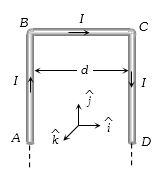
- 4$AB$ and $CD$ are long straight conductor, distance $d$ apart, carrying a current $I$. The magnetic field at the midpoint of $BC$ isView Solution
- 5View SolutionElectrons moving with different speeds enter a uniform magnetic field in a direction perpendicular to the field., time periods of rotation will be :
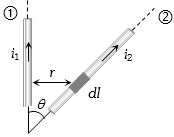
- 6Wires $1$ and $2$ carrying currents ${i_1}$ and ${i_2}$respectively are inclined at an angle $\theta $ to each other. What is the force on a small element $dl$ of wire $2$ at a distance of $r$ from wire $1$ (as shown in figure) due to the magnetic field of wire $1$View Solution
- 7An electron enters a region where magnetic $(B)$ and electric $(E)$ fields are mutually perpendicular to one another, thenView Solution
- 8View SolutionAn electron is travelling horizontally towards east. A magnetic field in vertically downward direction exerts a force on the electron along
- 9A uniform magnetic field $\vec B\,\, = \,\,{B_0}\,\hat j$ exists in a space. A particle of mass $m$ and charge $q$ is projected towards negative $x$-axis with speed $v$ from the a point $(d, 0, 0)$. The maximum value $v$ for which the particle does not hit $y-z$ plane isView Solution
- 10A long straight wire of radius a carries a steady current $i$. The current is uniformly distributed across its cross section. The ratio of the magnetic field at $ a/2$ and $2a$ isView Solution