An electron moves in a circular orbit with a uniform speed $v$. It produces a magnetic field $B$ at the centre of the circle. The radius of the circle is proportional to
AIPMT 2005, Medium
Download our app for free and get started
(c) Electric current corresponds to the revolution of electron is $i = \frac{{ev}}{{2\pi r}}$
Magnetic field due to circular current at the centre $B = \frac{{{\mu _0}}}{{4\pi }}.\frac{{2\pi \,i}}{r} = \frac{{{\mu _0}}}{{4\pi }}.\frac{{ev}}{{{r^2}}}$==> $r = \sqrt {\frac{{{\mu _0}}}{{4\pi }}.\frac{{ev}}{B}} $==> $r \propto \sqrt {\frac{v}{B}} $.
Magnetic field due to circular current at the centre $B = \frac{{{\mu _0}}}{{4\pi }}.\frac{{2\pi \,i}}{r} = \frac{{{\mu _0}}}{{4\pi }}.\frac{{ev}}{{{r^2}}}$==> $r = \sqrt {\frac{{{\mu _0}}}{{4\pi }}.\frac{{ev}}{B}} $==> $r \propto \sqrt {\frac{v}{B}} $.

Download our appand get started for free
Experience the future of education. Simply download our apps or reach out to us for more information. Let's shape the future of learning together!No signup needed.*
Similar Questions
- 1A proton is accelerating in a cyclotron where the applied magnetic field is $2 \,T$. If the potential gap is effectively $100 \,kV$ then how much revolutions the proton has to make between the "dees" to acquire a kinetic energy of $20 \,MeV$ ?View Solution
- 2A current $i$ is flowing in a straight conductor of length $L.$ The magnetic induction at a point on its axis at a distance $\frac {L}{4}$ from its centre will beView Solution
- 3A moving coil galvanometer, having a resistance $G$, produces full scale deflection when a current $I_g$ flows through it. This galvanometer can be converted into $(i)$ an ammeter of range $0$ to $I_0 (I_0 > I_g)$ by connecting a shunt resistance $R_A$ to it and $(ii)$ into a voltmeter of range $0$ to $V(V = GI_0)$ by connecting a series resistance $R_V$ to it. Then,View Solution
- 4An ammeter whose resistance is $180\,\Omega $ gives full scale deflection when current is $2\, mA$. The shunt required to convert it into an ammeter reading $20\, mA$ (in $ohms$) isView Solution
- 5Two insulated circular loop $A$ and $B$ radius ' $a$ ' carrying a current of ' $\mathrm{I}$ ' in the anti clockwise direction as shown in figure. The magnitude of the magnetic induction at the centre will be :View Solution
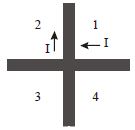
- 6View SolutionIdentical currents flow in two perpendicular wires, as shown in the figure. The wires are very close but do not touch. The magnetic field can be zero:
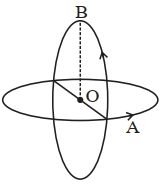
- 7A circular loop is kept in that vertical plane which contains the north-south direction. It carries a current that is towards south at the topmost point. Let $A$ be a point on axis of the circle to the east of it and $B$ a point on this axis to the west of it. The magnetic field due to the loop :-View Solution
- 8A particle of charge $q$ and mass $m$ moves in a circular orbit of radius $r$ with angular speed $\omega $. The ratio of the magnitude of its magnetic moment to that of its angular momentum depends onView Solution
- 9A current $I$ flows in an infinitely long wire with cross section in the form of a semi-circular ring of radius $R$. The magnitude of the magnetic induction along its axis is:View Solution
- 10The magnitude of the magnetic field at the centre of an equilateral triangular loop of side $1\,m$ which is carrying a current of $10\,A$ is:......$\mu T$ [Take $\mu _0 = 4\pi \times 10^{-7}\,NA^{-2}$]View Solution