An electron, moving in a uniform magnetic field of induction of intensity $\vec B,$ has its radius directly proportional to
Easy


Download our appand get started for free
Experience the future of education. Simply download our apps or reach out to us for more information. Let's shape the future of learning together!No signup needed.*
Similar Questions
- 1A galvanometer having coil resistance $10 \ \Omega$ shows a full scale deflection for a current of $3 \mathrm{~mA}$. For it to measure a current of $8 \mathrm{~A}$, the value of the shunt should be:View Solution
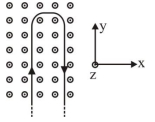
- 2A rigid wire consists of a semicircular portion of radius $R$ and two straight sections. The wire is partially immerged in a perpendicular magnetic field $B=B_0\ {j}$ as shown in figure. The magnetic force on the wire if it has a current $i$ is :View Solution
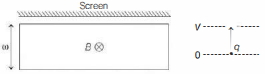
- 3A rectangular region of dimensions ( $\omega \times l(\omega) \ll l$ ) has a constant magnetic field into the plane of the paper as shown in the figure below. On one side, the region is bounded by a screen. On the other side, positive ions of mass $m$ and charge $q$ are accelerated from rest and towards the screen by a parallel plate capacitor at constant potential difference $V < 0$ and come out through a small hole in the upper plate. Which one of the following statements is correct regarding the charge on the ions that hit the screen?View Solution
- 4A particle of mass $m$ carrying charge $q$ is accelerated by a potential difference $V$. It enters perpendicularly in a region of uniform magnetic field $B$ and executes circular arc of radius $R$, then $\frac{q}{m}$ equalsView Solution
- 5$20$ $ampere$ current is flowing in a long straight wire. The intensity of magnetic field at a distance $20\, cm$ from the wire will beView Solution
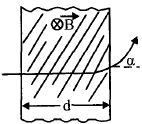
- 6A proton (mass $m$ ) accelerated by a potential difference $V$ flies through a uniform transverse magnetic field $B.$ The field occupies a region of space by width $'d'$. If $\alpha $ be the angle of deviation of proton from initial direction of motion (see figure), the value of $sin\,\alpha $ will beView Solution
- 7A thin circular wire carrying a current $I$ has a magnetic moment $M$. The shape of the wire is changed to a square and it carries the same current. It will have a magnetic momentView Solution
- 8A moving coil galvanometer allows a full scale current of $10^{-4}\, A$. A series resistance of $2\, M\,\Omega $ is required to convert the above galvanometer into a voltmeter of range $0 -5\, V$. Therefore the value of shunt resistance required to convert the above galvanometer into a ammeter of range $0-10\, mA$ is....$\Omega $View Solution
- 9A deuteron and a proton moving with equal kinetic energy enter into to a uniform magnetic field at right angle to the field. If $r_{d}$ and $r_{p}$ are the radii of their circular paths respectively, then the ratio $\frac{r_{d}}{r_{p}}$ will be $\sqrt{ x }: 1$ where $x$ is ..........View Solution
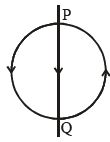
- 10A circular coil of wire carries a current. $PQ$ is a part of a very long wire carrying a current and passing close to the circular coil. If the directions of currents are those shown in figure, what is the direction of force acting on $PQ$ ?View Solution