An ideal gas has molecules with $5\,$ degrees of freedom. The ratio of specific heats at constant pressure $(C_p)$ and at constant volume $(C_v)$ is
JEE MAIN 2017, Easy


Download our appand get started for free
Experience the future of education. Simply download our apps or reach out to us for more information. Let's shape the future of learning together!No signup needed.*
Similar Questions
- 1What is the mass of $2$ litres of nitrogen at $22.4$ atmospheric pressure and $273\,K$View Solution
- 2The value closest to the thermal velocity of a Helium atom at room temperature $(300\,K)$in $ms^{-1}$ is $[k_B\, = 1 .4\times10^{-23}\,J/K;\, m_{He}\, = 7\times10^{-27}\,kg]$View Solution
- 3A vessel is partitioned in two equal halves by a fixed diathermic separator. Two different ideal gases are filled in left $(L)$ and right $(R)$ halves. The rms speed of the molecules in $L$ part is equal to the mean speed of molecules in the $R$ part. Then the ratio of the mass of a molecule in $L$ part to that of a molecule in $R$ part isView Solution
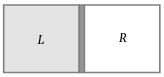
- 4$STATEMENT- 1$ The total translational kinetic energy of all the molecules of a given mass of an ideal gas is $1.5$ times the product of its pressure and its volume. becauseView Solution
$STATEMENT-2$ The molecules of a gas collide with each other and the velocities of the molecules change due to the collision.
- 5The temperature of an ideal gas at atmospheric pressure is $300\,K$ and volume $1\,m^3$. If temperature and volume become double, then pressure will beView Solution
- 6The pressure $P,$ volume $V$ and temperature $T$ of a gas in the jar $A$ and the other gas in the jar $B$ at pressure $2P,$ volume $V/4$ and temperature $2T,$ then the ratio of the number of molecules in the jar $A$ and $B$ will beView Solution
- 7The root mean square speed of molecules of nitrogen gas at $27^{\circ} C$ is approximately$.......m/s$(Given mass of a nitrogen molecule $=4.6 \times 10^{-26}\,kg$ and take Boltzmann constant $k _{ B }=1.4 \times 10^{-23}\,JK ^{-1}$ )View Solution
- 8View SolutionIf hydrogen gas is heated to a very high temperature, then the fraction of energy possessed by gas molecules correspond to rotational motion ...........
- 9Molar specific heat at constant volume is ${C_v}$ for a monoatomic gas isView Solution
- 10Energy of $10$ non rigid diatomic molecules at temperature $\mathrm{T}$ is :View Solution