MCQ
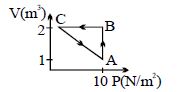
An ideal gas is taken through the cycle $A \to B \to C \to A$ , as shown in the figure. If the net heat supplied to the gas in the cycle is $5\ J$, the work done by the gas in the process $C \to A$ is  .... $J$
  • $-5$
  • B
    $-10$
  • C
    $-15$
  • D
    $-20$

Answer

Correct option: A.
$-5$
a
$\mathrm{dR}=\mathrm{dU}+\mathrm{d} \mathrm{W}$

$5=0+10(2-1)+0+\mathrm{W}_{\mathrm{CA}}$

$\mathrm{W}_{\mathrm{CA}}=5-10$

$=-5$ Joule

Need a full question paper?

Generate a complete, print-ready paper with questions like this in minutes — across 16+ boards, with answer keys.
Start Generating Free

Similar questions

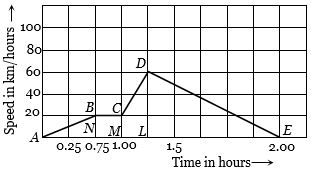
A train moves from one station to another in $2$ hours time. Its speed-time graph during this motion is shown in the figure. The maximum acceleration during the journey is.............$km\, h^{-2}$
The change in potential energy, when a body of mass m is raised to a height $nR$ from earth's surface is $(R =$ radius of earth$):$
A body of mass $1\,kg$ is thrown upwards with a velocity $20\, m/s.$ It momentarily comes to rest after attaining a height of $18\, m.$ How much energy is lost due to air friction ? ........... $\mathrm{J}$ $ (g = 10 \,m/s^2)$
There are two identical vessels filled with equal amounts of ice. The vessels are of different metals., If the ice melts in the two vessels in $20$ and $35$ minutes respectively, the ratio of the coefficients of thermal conductivity of the two metals is
$Assertion :$ Falling raindrops acquire a terminal velocity.
$Reason :$ A constant force in the direction of motion and a velocity dependent force opposite to the direction of motion, always result in the acquisition of terminal velocity.
$1\, m^3$ water is brought inside the lake upto $200$ metres depth from the surface of the lake. What will be change in the volume when the bulk modulus of elastically of water is $22000$ atmosphere? (density of water is $1\times10^3\, kg/m^3$ atmosphere pressure $= 10^5\, N/m^2$ and $g = 10\, m/s^2$)
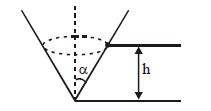
A particle is describing circular motion in a horizontal plane in contact with the smooth inside surface of a fixed right circular cone with its axis vertical and vertex down. The height of the plane of motion above the vertex is $h$ and the semivertical angle of the cone is $\alpha $ . The period of revolution of the particle
Starting at temperature $300\; \mathrm{K},$ one mole of an ideal diatomic gas $(\gamma=1.4)$ is first compressed adiabatically from volume $\mathrm{V}_{1}$ to $\mathrm{V}_{2}=\frac{\mathrm{V}_{1}}{16} .$ It is then allowed to expand isobarically to volume $2 \mathrm{V}_{2} \cdot$ If all the processes are the quasi-static then the final temperature of the gas (in $\left. \mathrm{K}\right)$ is (to the nearest integer)
The length, breath and thickness of a metal sheet are $4.234 \;m , 1.005\; m$, and $2.01\; cm$ respectively then the volume of the sheet is
A projectile is fired from level ground at an angle $\theta $ above the horizontal. The elevation angle $\phi $ of the highest point as seen from the launch point is related to $\theta $ by the relation