An inductor L of inductance XL is connected in series with a bulb B and an ac source. How would brightness of the bulb change when (i) number of turns in the inductor is reduced, (ii) an iron rod is inserted in the inductor and (iii) a capacitor of reactance $X_C = X_L$ is inserted in series in the circuit. Justify your answer in each case.
CBSE DELHI - SET 2 2015
Download our app for free and get started
- Increases
As number of turns decreases, L decreases, hence current through bulb increases. /voltage across bulb increases.
- Decreases
- Increases

Download our appand get started for free
Experience the future of education. Simply download our apps or reach out to us for more information. Let's shape the future of learning together!No signup needed.*
Similar Questions
- 1View SolutionIn the given circuit, the potential difference across the inductor L and resistor R are 200V and 150V respectively and the rms. value of current is 5A. Calculate (i) the impedance of the circuit and (ii) the phase angle between the voltage and the current.
- 2In the given circuit, the value of resistance effect of the coil L is exactly equal to the resistance R. Bulbs $B_1$ and $B_2$ are exactly identical. Answer the following questions based on above information:View Solution
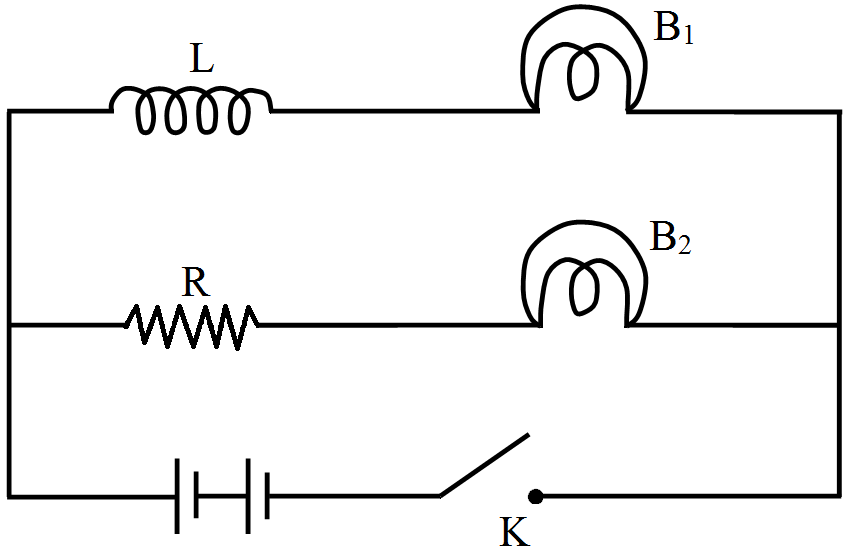
- Which one of the two bulbs lights up earlier, when key K is closed and why?
- What will be the comparative brightness of the two bulbs after sometime if the key K is kept closed and why?
- 3A voltage $V = V_o$ sin $\omega\text{t}$ is applied to a series LCR circuit. Derive the expression for the average power dissipated over a cycle. Under what condition is (i) no power dissipated even though the current flows through the circuit, (ii) maximum power dissipated in the circuit?View Solution
- 4An inductor 200mH, a capacitor $100\mu\text{F}$ and a resistor $10\Omega$ are connected in series to an a.c. source of 100V, having variable frequency.View Solution
- At what frequency of the applied voltage will the power factor of the circuit be 1?
- What will be the current amplitude at this frequency?
- Calculate the Q-factor of the circuit.
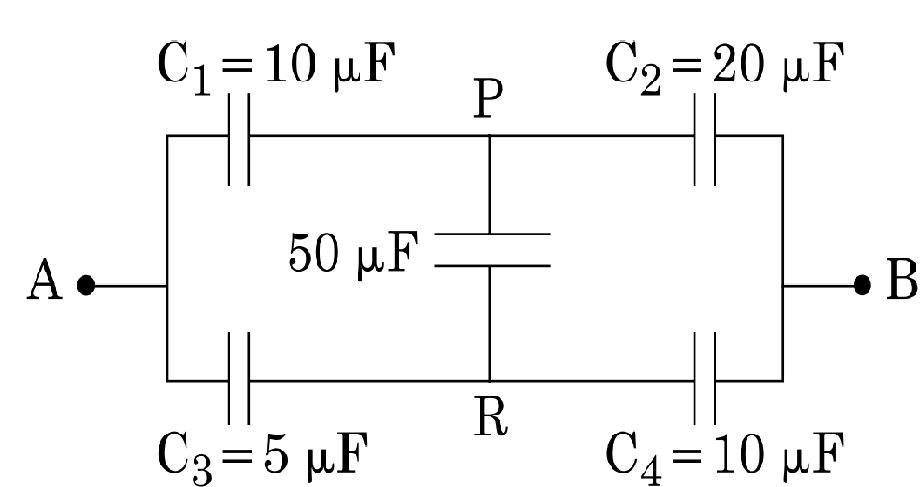
- 5View SolutionCalculate the equivalent capacitance between points A and B in the circuit below. If a battery of 10 V is connected across A and B, calculate the charge drawn from the battery by the circuit.
- 6View SolutionA series LCR circuit is connected to an ac source. Using the phasor diagram, derive the expression for the impedance of the circuit. Plot a graph to show the variation of current with frequency of the source, explaining the nature of its variation.
- 7View Solution
- Explain briefly the process of emission of light by a Light Emitting Diode (LED).
- Which semiconductors are preferred to make LEDs and why?
- Give two advantages of using LEDs over conventional incandescent lamps.
- 8View Solution
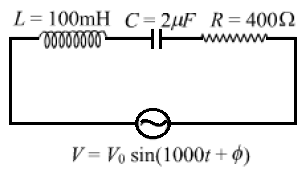
- Find the value of the phase difference between the current and the voltage in the series LCR circuit shown below. Which one leads in phase: current or voltage?
- Without making any other change, find the value of the additional capacitor $C_1,$ to be connected in parallel with the capacitor C, in order to make the power factor of the circuit unity.
- 9View SolutionWhen a capacitor is connected in series LR circuit, the alternating current flowing in the circuit increases. Explain why.
- 10View SolutionHow are electromagnetic waves produced? What is the source of energy of these waves? Write mathematical expressions for electric and magnetic fields of an electromagnetic wave propagating along the z-axis. Write any two important properties of electromagnetic waves.