MCQ
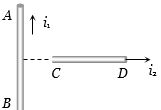
An infinitely long, straight conductor $AB$ is fixed and a current is passed through it. Another movable straight wire $CD$ of finite length and carrying current is held perpendicular to it and released. Neglect weight of the wire
  • A
    The rod $CD$ will move upwards parallel to itself
  • B
    The rod $CD$ will move downward parallel to itself
  • The rod $CD$ will move upward and turn clockwise at the same time
  • D
    The rod $CD$ will move upward and turn anti -clockwise at the same time
Answer

Correct option: C.
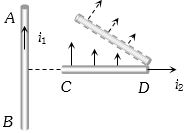
The rod $CD$ will move upward and turn clockwise at the same time
c
(c) Since the force on the rod $CD$ is non-uniform it will experience force and torque. From the left hand side it can be seen that the force will be upward and torque is clockwise.
 

Need a full question paper?

Generate a complete, print-ready paper with questions like this in minutes — across 16+ boards, with answer keys.

Start Generating Free

Similar questions

The de-Broglie wavelength of a neutron in thermal equilibrium with heavy water at a temperature $T$ (kelvin) and mass $m,$ is 
Assertion : The induced emf in a conducting loop of wire will be non zero when it rotates in a uniform magnetic field.
Reason : The emf is induced due to change in magnetic flux.
The $ i-V$  characteristic of a $P-N$  junction diode is shown below. The approximate dynamic resistance of the $P-N$  junction when a forward bias of $1\;volt $ is applied.......$\Omega$
Armature current in dc motor will be maximum when
The radioactive decay of uranium into thorium is expressed by the equation $_{92}^{238}U \to _{90}^{234}Th + X,$ where $'X'$ is
The $AC$ voltage across a resistance can be measured using:
As compared to ${ }^{12} \mathrm{C}$ atom, ${ }^{14} \mathrm{C}$ atom has:
A uniform sphere is placed on a smooth horizontal surface and a horizontal force F is applied on it at a distance h above the surface. The acceleration of the centre:
In a Young's double slit experiment, the width of the one of the slit is three times the other slit. The amplitude of the light coming from a slit is proportional to the slit-width. Find the ratio of the maximum to the minimum intensity in the interference pattern.
When one of the slits of Young’s experiment is covered with a transparent sheet of thickness $4.8\ mm,$ the central fringe shifts to a position originally occupied by the $30^{th}$ bright fringe. What should be the thickness of the sheet if the central fringe has to shift to the position occupied by $20^{th}$ bright fringe