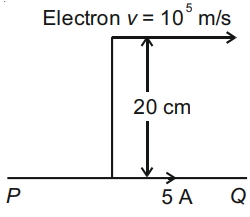
An infinitely long straight conductor carries a current of $5 \,\mathrm{~A}$ as shown. An electron is moving with a speed of $10^{5} \, \mathrm{~m} / \mathrm{s}$ parallel to the conductor. The perpendicular distance between the electron and the conductor is $20 \, \mathrm{~cm}$ at an instant. Calculate the magnitude of the force experienced by the electron at that instant in $\times 10^{-20} \,N$
NEET 2021, Medium


Download our appand get started for free
Experience the future of education. Simply download our apps or reach out to us for more information. Let's shape the future of learning together!No signup needed.*
Similar Questions
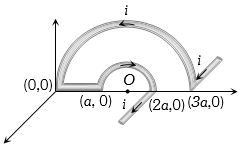
- 1In the given figure net magnetic field at $O$ will beView Solution
- 2The oscillator frequency of a cyclotron is $10 \,MHz$. What should be the operating magnetic field for accelerating proton is ......... $T$View Solution
- 3Two very long, straight, parallel wires carry steady currents $I$ and $-I$ respectively. The distance etween the wires is $d$. At a certain instant of time, a point charge $q$ is at a point equidistant from the two wires, in the plane of the wires. Its instantaneous velocity $v$ is perpendicular to the plane of wires. The magnitude of the force due to the magnetic field acting on the charge at this instant isView Solution
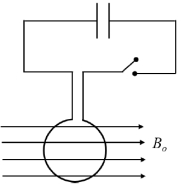
- 4A circular coil of radius $R$ and $N$ turns has negligible resistance. As shown in the schematic figure, its two ends are connected to two wires and it is hanging by those wires with its plane being vertical. The wires are connected to a capacitor with charge $Q$ through a switch. The coil is in a horizontal uniform magnetic field $B_0$ parallel to the plane of the coil. When the switch is closed, the capacitor gets discharged through the coil in a very short time. By the time the capacitor is discharged fully, magnitude of the angular momentum gained by the coil will be (assume that the discharge time is so short that the coil has hardly rotated during this time)-View Solution
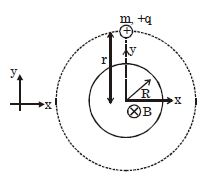
- 5Circular region of radius $R$ has uniform magnetic field $B = {B_0} + {B_0}t\left( { - \hat k} \right).\,At\,\,t\, = 0\,$ acceleration of charged particleView Solution
- 6Two charged particles traverse identical helical paths in a completely opposite sense in a uniform magnetic field $B = B_0 \hat k$ .View Solution
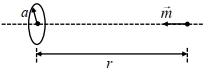
- 7A special metal $S$ conducts electricity without any resistance. A closed wire loop, made of $S$, does not allow any change in flux through itself by inducing a suitable current to generate a compensating flux. The induced current in the loop cannot decay due to its zero resistance. This current gives rise to a magnetic moment which in turn repels the source of magnetic field or flux. Consider such a loop, of radius $a$, with its center at the origin. A magnetic dipole of moment $m$ is brought along the axis of this loop from infinity to a point at distance $r \gg a)$ from the center of the loop with its north pole always facing the loop, as shown in the figure below.View Solution
The magnitude of magnetic field of a dipole $m$, at a point on its axis at distance $r$, is $\frac{\mu_0}{2 \pi} \frac{m}{r^3}$, where $\mu_0$ is the permeability of free space. The magnitude of the force between two magnetic dipoles with moments, $m_1$ and $m_2$, separated by a distance $r$ on the common axis, with their north poles facing each other, is $\frac{k m_1 m_2}{r^4}$, where $k$ is a constant of appropriate dimensions. The direction of this force is along the line joining the two dipoles.
($1$) When the dipole $m$ is placed at a distance $r$ from the center of the loop (as shown in the figure), the current induced in the loop will be proportional to
$(A)$ $\frac{m}{r^3}$ $(B)$ $\frac{m^2}{r^2}$ $(C)$ $\frac{m}{r^2}$ $(D)$ $\frac{m^2}{r}$
($2$) The work done in bringing the dipole from infinity to a distance $r$ from the center of the loop by the given process is proportional to
$(A)$ $\frac{m}{r^5}$ $(B)$ $\frac{m^2}{r^5}$ $(C)$ $\frac{m^2}{r^6}$ $(D)$ $\frac{m^2}{r^7}$
Give the answer or qution ($1$) and ($2$)
- 8View SolutionIf an ammeter is connected in parallel to a circuit, it is likely to be damaged due to excess
- 9A voltmeter has a resistance of $G\, ohms$ and range $V\, volts$. The value of resistance used in series to convert it into a voltmeter of range $nV$ $volts$ isView Solution
- 10A circuit to verify $Ohm's$ law uses ammeter and voltmeter in series or parallel connected correctly to the resistor. In the circuitView Solution