An isolated rail car originally moving with speed $v_0$ on a straight, frictionles, level track contains a large amount of sand. $A$ release valve on the bottom of the car malfunctions, and sand begins to pour out straight down relative to the rail car. What happens to the speed of the rail car as the sand pours out?
Medium
Download our app for free and get started

Download our appand get started for free
Experience the future of education. Simply download our apps or reach out to us for more information. Let's shape the future of learning together!No signup needed.*
Similar Questions
- 1View SolutionWhich of the following is self adjusting in nature?
- 2Two masses $M$ and $m$ are attached to a vertical axis by weightless threads of combined length $l$. They are set in rotational motion in a horizontal plane about this axis with constant angular velocity $\omega $. If the tensions in the threads are the same during motion, the distance of $M$ from the axis isView Solution
- 3Two bodies of equal masses revolve in circular orbits of radii ${R_1}$ and ${R_2}$ with the same period. Their centripetal forces are in the ratioView Solution
- 4A marble block of mass $2\, kg$ lying on ice when given a velocity of $6 \,m/s$ is stopped by friction in $10\,s$. Then the coefficient of friction isView Solution
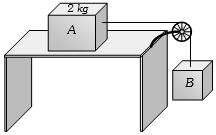
- 5The coefficient of static friction, ${\mu _s},$ between block $A$ of mass $2\, kg$ and the table as shown in the figure is $0.2$. ........ $kg$ would be the maximum mass value of block $B$ so that the two blocks do not move. The string and the pulley are assumed to be smooth and massless. $(g = 10\,m/{s^2})$View Solution
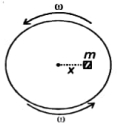
- 6A block of mass $m$ is kept on horizontal turn table at $x$ distance from the centre. If coefficient of friction between block and surface of turn table is $\mu$, then maximum angular speed of the table so that block does not slipView Solution
- 7A box is lying on an inclined plane what is the coefficient of static friction if the box starts sliding when an angle of inclination is $60^o $View Solution
- 8A body is moving along a rough horizontal surface with an initial velocity $6\,\,m/s.$ If the body comes to rest after travelling $9\, m$, then the coefficient of sliding friction will beView Solution
- 9View SolutionA stone tied to a string is rotated in a circle. If the string is cut, the stone flies away from the circle because
- 10A heavy uniform chain lies on a horizontal table-top. If the coefficient of friction between the chain and table surface is $0.25$, then the maximum fraction of length of the chain, that can hang over one edge of the table is ...... $\%$View Solution