Question
An observer is moving with half the speed of light towards a stationary microwave source emitting waves at frequency $10\ GHz$. What is the frequency of the microwave measured by the observer?.......$GHz$ ( speed of light $= 3 \times  10^8 $ $ms^{-1}$)

Answer

Use relativistic doppler's effect as velocity of observer is not small as compared to light

$f=f_{0} \sqrt{\frac{c+v}{c+v}}$ ; $V=$ relative speed of approach

$f_{0}=10\, \mathrm{GHz}$

$\therefore f=10 \sqrt{\frac{c+\frac{c}{2}}{c-\frac{c}{2}}}=10 \sqrt{3}=17.3\, \mathrm{GHz}$

Need a full question paper?

Generate a complete, print-ready paper with questions like this in minutes — across 16+ boards, with answer keys.

Start Generating Free

Similar questions

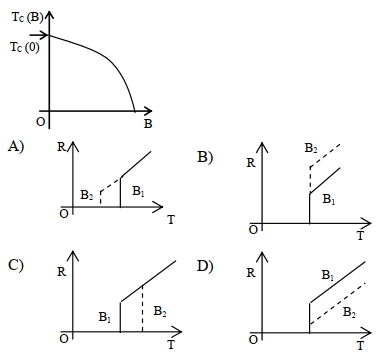
Electrical resistance of certain materials, known as superconductors, changes abruptly from a nonzero value to zero as their temperature is lowered below a critical temperature $T_c(0)$. An interesting property of superconductors is that their critical temperature becomes smaller than $T_c(0)$ if they are placed in a magnetic field, i.e., the critical temperature $T_c(B)$ is a function of the magnetic field strength $B$. The dependence of $T_c(B)$ on $B$ is shown in the figure. $Image$

$1.$ In the graphs below, the resistance $\mathrm{R}$ of a superconductor is shown as a function of its temperature $\mathrm{T}$ for two different magnetic fields $\mathrm{B}_1$ (solid line) and $\mathrm{B}_2$ (dashed line). If $\mathrm{B}_2$ is larger than $\mathrm{B}_1$ which of the following graphs shows the correct variation of $\mathrm{R}$ with $\mathrm{T}$ in these fields?

MCQ $Image$

$2.$ A superconductor has $T_C(0)=100 \mathrm{~K}$. When a magnetic field of 7.5 Tesla is applied, its $\mathrm{T}_{\mathrm{c}}$ decreases to $75 \mathrm{~K}$. For this material one can definitely say that when

$(A)$ $\mathrm{B}=5$ Tesla, $\mathrm{T}_{\mathrm{c}}(\mathrm{B})=80 \mathrm{~K}$

$(B)$ $\mathrm{B}=5$ Tesla, $75 \mathrm{~K}<\mathrm{T}_{\mathrm{c}}(\mathrm{B})<100 \mathrm{~K}$

$(C)$ $\mathrm{B}=10 \mathrm{Tesla}, 75 \mathrm{~K}<\mathrm{T}_{\mathrm{c}}<100 \mathrm{~K}$

$(D)$ $\mathrm{B}=10$ Tesla, $\mathrm{T}_{\mathrm{c}}=70 \mathrm{~K}$

Give the answer question $1, 2$
The magnetic field $d\overrightarrow B $ due to a small current element $d\overrightarrow {l\,} $ at a distance $\overrightarrow {r\,} $ and element carrying current $i$ is
In an $L-R$ circuit connected to a battery the rate at which energy is stored in the inductor is plotted against time during the growth of the current in the circuit. Which of the following best represents the resulting curve
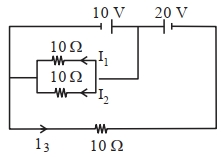
In the given circuit the value of $\left|\frac{I_1+I_3}{I_2}\right|$ is
A transistor-oscillator using a resonant circuit with an inductor $L$ (of negligible resistance) and a capacitor $C$ in series produce oscillations of frequency $f$. If $L$ is doubled and $C$ is changed to $4C$. the frequency will be
A man can see upto $100 \,cm$ of the distant object. The power of the lens required to see far objects will be
A travelling wave represented by $y = A \sin (\omega t - kx )$ is susperimposed on another wave represented by $y = A$ $\sin (\omega t + kx )$. The resultant is
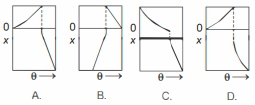
A ray of light originates from inside a glass slab and is incident on its inner surface at an angle $\theta$ as shown below. In this experiment, the location $x$ of the spot where the ray hits the screen is recorded. Which of the following correctly shows the plot of variation of $x$ with the angle $\theta$ ?
Conditions of diffraction is
Two bodies with kinetic energies in the ratio of $4 : 1$ are moving with equal linear momentum. The ratio of their masses is