Question
An optical component and an object $S$ placed along its optic axis are given in Column $I$. The distance between the object and the component can be varied. The properties of images are given in Column $II$. Match all the properties of images from Column $II$ with the appropriate components given in Column $I$. Indicate your answer by darkening the appropriate bubbles of the $4 \times 4$ matrix given in the $ORS$.
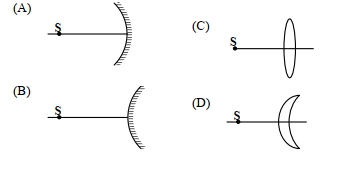
Column $I$ Column $II$
$Image$ $(p)$ Real image
$Image$ $(q)$ Virtual image
$Image$ $(r)$ Magnified image
$Image$ $(s)$ Image at infinity

Answer

Get the step-by-step solution for this question inside the Vidyadip app.

Get the answer in the app

Need a full question paper?

Generate a complete, print-ready paper with questions like this in minutes — across 16+ boards, with answer keys.

Start Generating Free

Similar questions

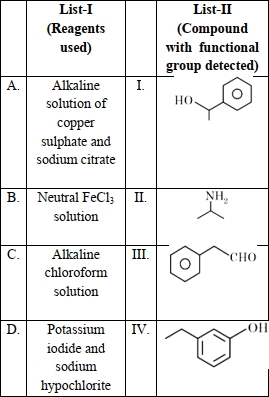
Match List$-I$ with List$-II$ :

Choose the correct answer from the options given below:

Two identical capacitors are connected in parallel across a potenial difference $V$. After they are fully charged, the positive plate of first capacitor is connected to negative plate of second and negative plate of first is connected to positive plate of other. The loss of energy will be
An elevator cable can have a maximum stress of $7 \times 10^7\,N/m^2$ for appropriate safety factors. Its maximum upward acceleration is $1.5\,m/s^2$ . If the cable has to support the total weight of $2000\,kg$ of a loaded elevator, the minimum area of crosssection of the cable should be ....... $cm^2$  $(g = 10\,m/s^2)$
A beaker contains a fluid of density $\rho \, kg / m^3$, specific heat $S\, J / kg\,^oC$ and viscosity $\eta $. The beaker is filled upto height $h$. To estimate the rate of heat transfer per unit area $(Q / A)$ by convection when beaker is put on a hot plate, a student proposes that it should depend on $\eta \,,\,\left( {\frac{{S\Delta \theta }}{h}} \right)$ and $\left( {\frac{1}{{\rho g}}} \right)$ when $\Delta \theta $ (in $^oC$) is the difference in the temperature between the bottom and top of the fluid. In that situation the correct option for $(Q / A)$ is
A particle starts moving from rest in a straight line with constant acceleration. After time $t_0$, acceleration changes its sign (just opposite to the initial direction), remaining the same in magnitude. Determine the time from the beginning of motion in which the particle returns to the initial position.
A body starts from rest. What is the ratio of the distance travelled by the body during the $4^{th}$ and $3^{rd}$ second
The earth's magnetic field lines resemble that of a dipole at the centre of the earth. If the magnetic moment of this dipole is close to $8 \times 10^{22}\, Am^2$, the value of earth 's magnetic field near the equator is close to....$Gauss$ (radius of the earth $= 6.4 \times 10^6\, m$)
A Young's doublc$-$slit experiment is performed using monochromatic light of wavelength $\lambda$. The intensity of light at a point on the screen, where the path difference is $\lambda,$ is $K$ units. The intensity of light at a point where the path difference is A $\frac{\lambda}{6}$ is given by $\frac{n K}{12},$ where $n$ is an integer. The value of $n$ is$......$
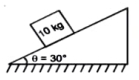
A block of mass $10 \,kg$ is kept on a fixed rough $(\mu=0.8)$ inclined plane of angle of inclination $30^{\circ}$. The frictional force acting on the block is ........... $N$
The resistance of the filament of an electric bulb changes with temperature. If an electric bulb rated $220\, volt$ and $100\, watt$ is connected $(220 \times 0.8)$ $volt$ sources, then the actual power would be