Question
An unsymmetrical double convex thin lens forms the image of a point object on its axis. Will the position of the image change if the lens is reversed?
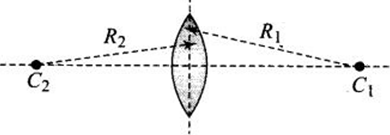
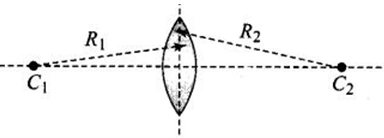
Answer

Key concept: Thin lens formula: $\frac{1}{\text{v}}-\frac{1}{\text{u}}=\frac{1}{\text{f}}$ For a given object position if focal length of the lens deos not change, the image posrition remains unchanged.
 
By lens maker's formula, $\frac{1}{\text{f}}=(\mu-1)\Big(\frac{1}{\text{R}_1}+\frac{1}{\text{R}_2}\Big)$ For this position $R_1$ is positive and $R_2$​​​​​​​ is negative. Hence focal lenght at this position $\frac{1}{\text{f}_1}=(\mu-1)\Big(\frac{1}{(+\text{R}_1)}-\frac{1}{(-\text{R}_2)}\Big)=(\mu-1)\Big(\frac{1}{\text{R}_1}+\frac{1}{\text{R}_2}\Big)$
Now the lens is reversed,
At this position, $R_2$ is positive and $R_1$ is negative. Hence focal length at this position is $\frac{1}{\text{f}_2}=(\mu-1)\Big(\frac{1}{(+\text{R}_2)}-\frac{1}{(-\text{R}_1)}\Big)=(\mu-1)\Big(\frac{1}{\text{R}_1}+\frac{1}{\text{R}_2}\Big)$ We can observe the focal length of the lens does not change in both positions, hence the image position remains unchanged.

Need a full question paper?

Generate a complete, print-ready paper with questions like this in minutes — across 16+ boards, with answer keys.
Start Generating Free

Similar questions

Two coherent point sources $S_1$ and $S_2$ vibrating in phase emit light of wavelength $\lambda$. The separation between the sources is $2\lambda$. Consider a line passing through $S_2$ and perpendicular to the line $S_1S_2$. What is the smallest distance from $S_2$ where a minimum of intensity occurs?
A rectangular loop of sides $20\ cm$ and $10\ cm$ carries a current of $5.0A$. A uniform magnetic field of magnitude $0.20T$ exists parallel to the longer side of the loop.
  1. What is the force acting on the loop?
  2. What is the torque acting on the loop?
Clear the difference between interference and diffraction.
Define capacitance of a capacitor. Derive expression for stored energy between plates of parallel plate capacitor. Show that energy-density between plates of parallel capacitor can be expressed as $\frac{1}{2}\in_{0}E^{2}$ , when E = Electric Field between plates.
Calculate the frequency of beats produced in air when two sources of sound are activated, one emitting a wavelength of 32cm and the other of 32.2cm. The speed of sound in air is 350m/s.
(a) Prove that the peak value ( $I_m$ ) of an alternating current is $\sqrt{2}$ times its root mean square ( rms ) value.(b) If alternating current $I=4 sin \omega t$ of and voltage $V =200 \sin (\omega t+\pi / 3)$, calculate the dissipated average power in the circuit.
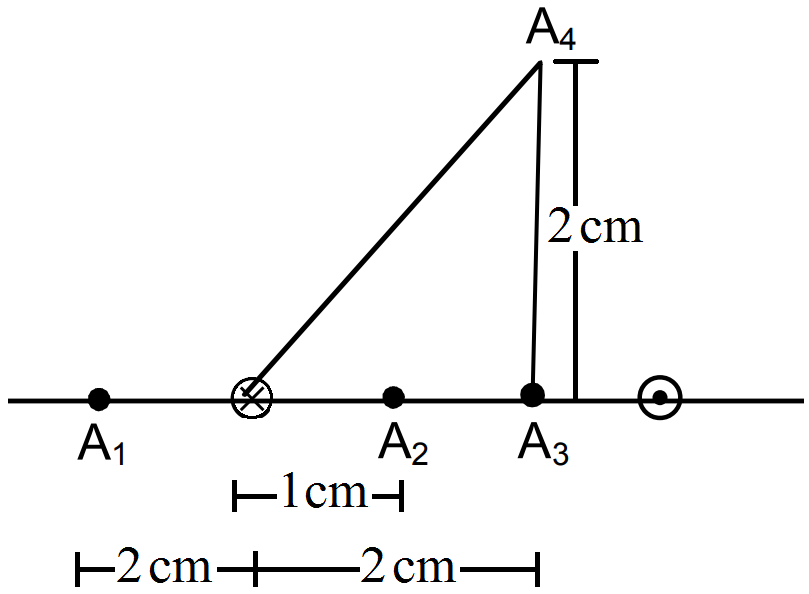
Figure shows two parallel wires separated by a distance of $4.0\ cm$ and carrying equal currents of $10A$ along opposite directions. Find the magnitude of the magnetic field $B$ at the points $A_1, A_2, A_3$ and $A_4.$​​​​​​​
A cubical metal block of edge 12cm floats in mercury with one fifth of the height inside the mercury. Water is poured till the surface of the block is just immersed in it. Find the height of the water column to be poured. Specific gravity of mercury = 13.6.
Potassium$-40$ can decay in three modes. It can decay by $\beta^-$-emission, $\beta^+$-emission of electron capture.
  1. Write the equations showing the end products.
  2. Find the $Q-$values in each of the three cases. Atomic masses of $\text{ }^{40}_{18}\text{Ar},\text{ }^{40}_{19}\text{K}$ and $\text{ }^{40}_{20}\text{Ca}$ are $39.9624u,39.9640u$ and $39.9626u$ respectively.
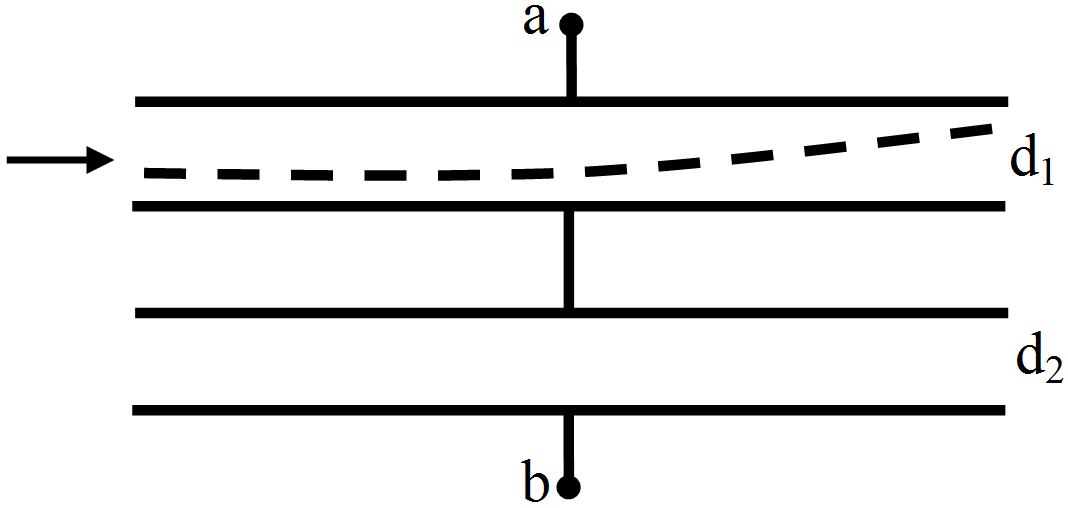
Both the capacitors shown in figure are made of square plates of edge a. The separations between the plates of the capacitors are $d_1$ and $d_2$ as shown in the figure. A potential difference $V$ is applied between the points $a$ and $b,$ An electron is projected between the plates of the upper capacitor along the central line. With what minimum speed should the electron be projected so that it does not collide with any plate? Consider only the electric forces.