Question
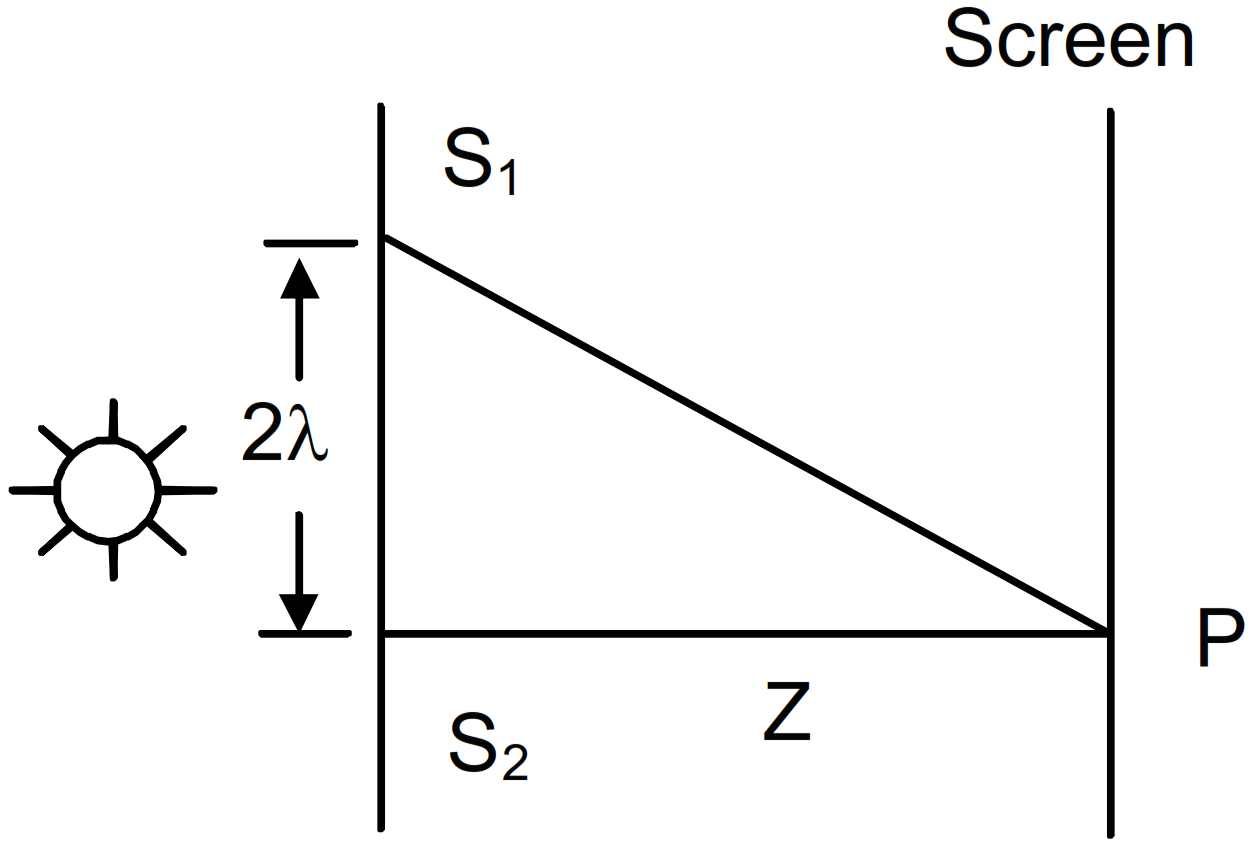
Two coherent point sources $S_1$ and $S_2$ vibrating in phase emit light of wavelength $\lambda$. The separation between the sources is $2\lambda$. Consider a line passing through $S_2$ and perpendicular to the line $S_1S_2$. What is the smallest distance from $S_2$ where a minimum of intensity occurs?
Answer

For minimum intensity

$\therefore\text{S}_1\text{P}-\text{S}_2\text{P}=\text{x}=(2\text{n}+1)\frac{\lambda}{2}$
From the figure, we get,
$\Rightarrow\sqrt{\text{X}^2+(2\lambda)^2}-\text{Z}=(2\text{n}+1)\frac{\lambda}{2}$
$\Rightarrow\text{Z}^2+4\lambda^2=\text{Z}^2+(2\text{n}+1)^2\frac{\lambda^2}{4}+\text{Z}(2\text{n}+1)\lambda$
$\Rightarrow\text{Z}=\frac{4\lambda^2-(2\text{n}+1)^2\Big(\lambda^2{4}\Big)}{(2\text{n}+1)\lambda}=\frac{16\lambda^2-(2\text{n}+1)^2\lambda^2}{4(2\text{n}+1)\lambda}\ ...(1)$
Putting, $\text{n}=0$
$\Rightarrow\text{Z}=\frac{15\lambda}{4}$
$\text{n}=-1$
$\Rightarrow\text{Z}=\frac{-15\lambda}{4}$
$\text{n}=1$
$\Rightarrow\text{Z}=\frac{7\lambda}{12}$
$\text{n}=2$
$\Rightarrow\text{Z}=\frac{-9\lambda}{20}$
$\therefore\text{Z}=\frac{7\lambda}{12}$ is the smallest distance for which there will be minimum intensity.

Need a full question paper?

Generate a complete, print-ready paper with questions like this in minutes — across 16+ boards, with answer keys.

Start Generating Free

Similar questions

The magnetic field B and the magnetic intensity H in material are found to be 1.6T and 1000A/m reepectively. Calculate the relative permeability $\mu_\text{r}$ and the susceptibility x of the material.
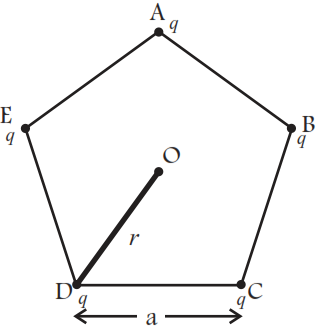
Five charges, q each are placed at the corners of a regular pentagon of side 'a' (Fig.).
  1.  
  1. What will be the electric field at O, the centre of the pentagon?
  2. What will be the electric field at O if the charge from one of the corners (say A) is removed?
  3. What will be the electric field at O if the charge q at A is replaced by -q?
  1. How would your answer to (a) be affected if pentagon is replaced by n-sided regular polygon with charge q at each of its corners?
Two charges -q each are separated by distance 2d. A third charge +q is kept at mid point O. Find potential energy of +q as a function of small distance x from O due to -q charges. Sketch P.E. v/s x and convince yourself that the charge at O is in an unstable equilibrium.
When a metal plate is exposed to a monochromatic beam of light of wavelength 400nm, a negative potential of 1.1V is needed to stop the photocurrent. Find the threshold wavelength for the metal.
Do magnetic forces obey Newton's third law. Verify for two current elements $\text{dI}_1=\text{dI}\hat{\text{i}}$ located at the origin and $\text{dI}_2=\text{dI}\hat{\text{j}}$ located at $(0, R, 0)$. Both carry current $I.$
A parallel $-$ plate capacitor of plate area $40\ cm^2$ and separation between the plates $0.10\ mm,$ is connected to a battery of emf $2.0V$ through a $16\Omega$ resistor. Find the electric field in the capacitor $10\ ns$ after the connections are made.
Explain the variation of conductivity with temperature for:
  1. A metallic conductor.
  2. Ionic conductors.
  3. Semiconductors.
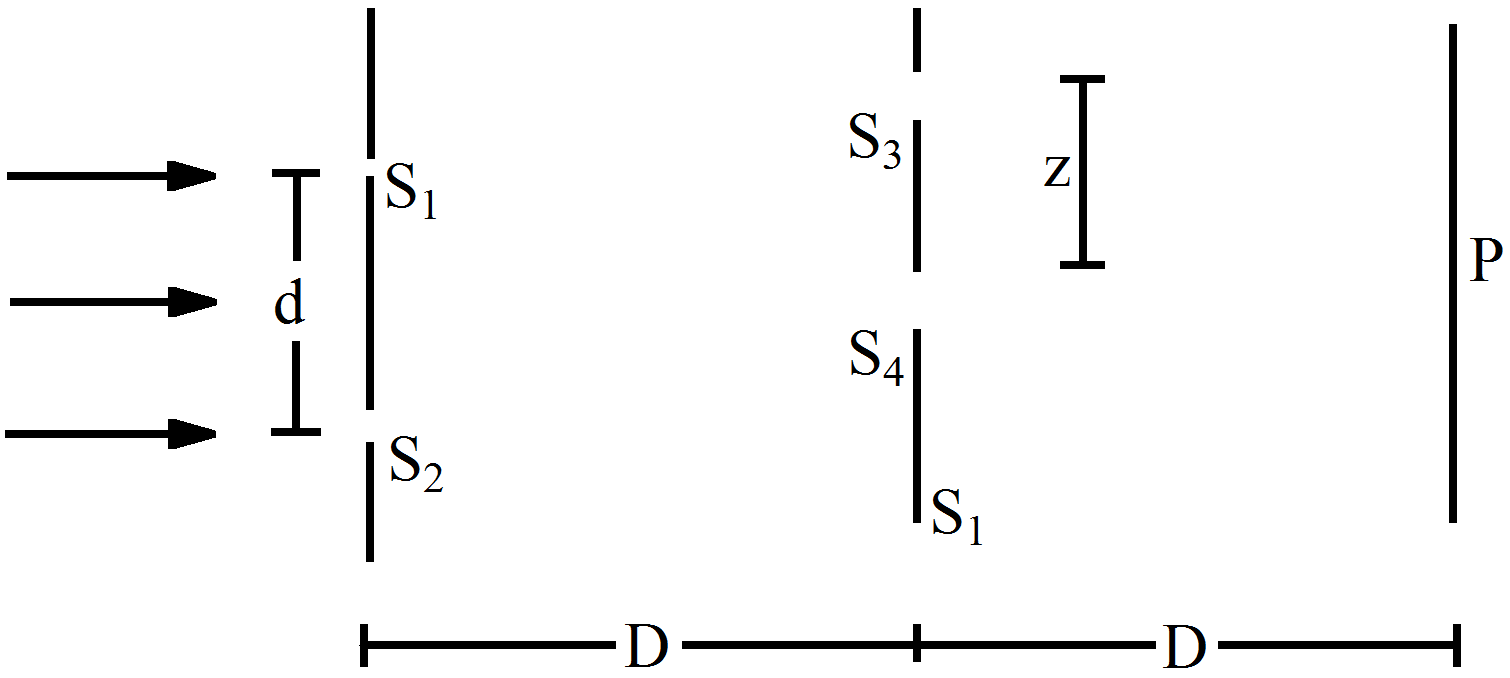
Consider the arrangement shown in figure. By some mechanism, the separation between the slits $S_3$ and $S_4$ can be changed. The intensity is measured at the point $P$ which is at the common perpendicular bisector

of $S_1S_2$ and $S_3S_4$. When $\text{z}=\frac{\text{D}\lambda}{2\text{d}},$ intensity measured at $P$ is I. Find this intensity when $z$ is equal to:
  1. $\frac{\text{D}\lambda}{\text{d}}$
  2. $\frac{3\text{D}\lambda}{2\text{d}}$
  3. $\frac{2\text{D}\lambda}{\text{d}}$
Two conductors are made of the same material and have the same length. Conductor $A$ is a solid wire of diameter $1\ mm.$ Conductor $B$ is a hollow tube of outer diameter $2\ mm$ and inner diameter $1\ mm.$ Find the ratio of resistance $R_A$ to $R_B.$
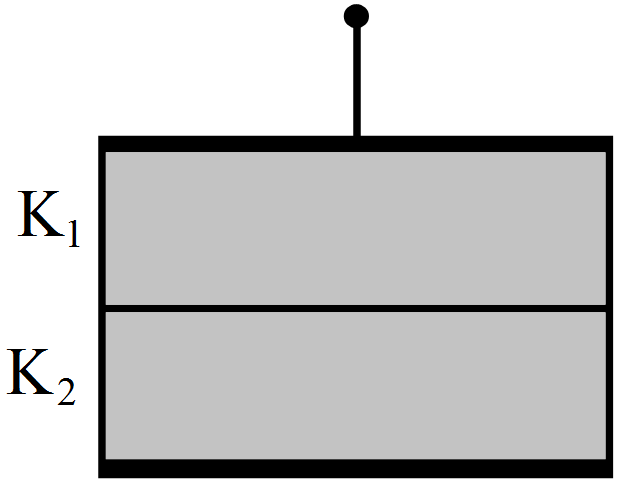
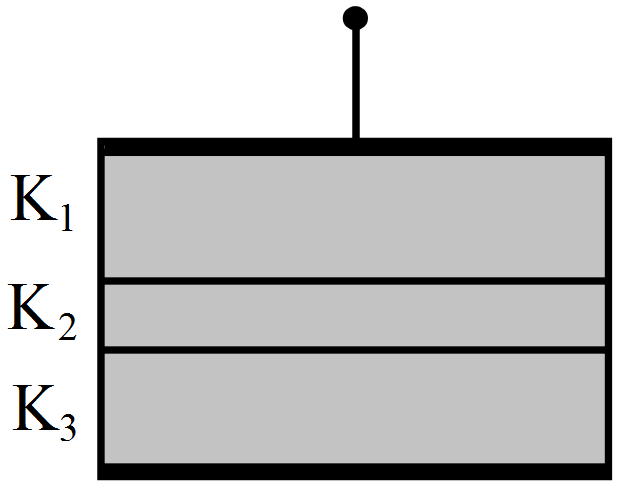
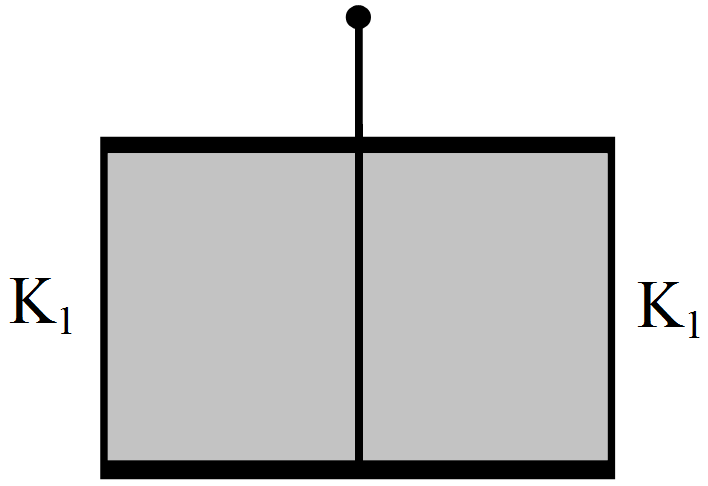
Find the capacitances of the capacitors shown in figure. The plate area is A and the separation between the plates is d. Different dielectric slabs in a particular part of the figure are of the same thickness and the entire gap between the plates is filled with the dielectric slabs.