MCQ
Angle that the vector $\vec{\text{A}}=2\hat{\text{i}}+2\hat{\text{j}}$ makes with y-axis is:
  • A
    $\tan^{-1}\Big(\frac{3}{2}\Big)$
  • B
    $\tan^{-1}\Big(\frac{2}{3}\Big)$
  • C
    $\sin^{-1}\Big(\frac{2}{3}\Big)$
  • D
    $\cos^{-1}\Big(\frac{3}{2}\Big)$

Answer

  1. $\tan^{-1}\Big(\frac{2}{3}\Big)$

Explanation:

As $\vec{\text{A}}=2\hat{\text{i}}+2\hat{\text{j}},$ therefore Ax = 2 and Ay = 3. If $\theta$ is the angle which $\vec{\text{A}}$ encloses with y-axis, then.

$\tan\theta=\frac{\text{A}_\text{x}}{\text{A}_\text{y}}=\frac{2}{3}$ or $\theta=\tan^{-1}\Big(\frac{2}{3}\Big)$​​​​​​​

Need a full question paper?

Generate a complete, print-ready paper with questions like this in minutes — across 16+ boards, with answer keys.

Start Generating Free

Similar questions

A horizontal circular loop carries a current that looks clockwise when viewed from above. It is replaced by an equivalent magnetic dipole consisting of a south pole S and a north pole N:
  1. The line SN should be along a diameter of the loop.
  2. The line SN should be perpendicular to the plane of the loop.
  3. The south pole should be slow the loop.
  4. The north pole should be below the loop.
$Henry/ohm$ can be expressed in
Two waves represented by $\text{y}=\text{a}\sin(\omega\text{t}-\text{kx})$ and $\text{y}=\text{a}\cos(\omega\text{t}-\text{kx})$ are superposed. The resultant wave will have an amplitude:
  1. a
  2. $\sqrt{2}\text{a}$
  3. 2a
  4. 0.
Soldering of two metals possible because of the property of:
The average degree of freedom per molecule of a gas is $6.$ The gas performs $25 \,J$ work, while expanding at constant pressure. The heat absorbed by the gas is ...... $J$
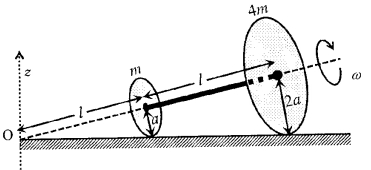
Two thin circular discs of mass $m$ and $4 m$, having radii of $a$ and $2 a$, respectively, are rigidly fixed by a massless, rigid rod of length $l=\sqrt{24} a$ through their centers. This assembly is laid on a firm and flat surface, and set rolling without slipping on the surface so that the angular speed about the axis of the rod is $\omega$. The angular momentum of the entire assembly about the point ' $O$ ' is $\vec{L}$ (see the figure). Which of the following statement($s$) is(are) true?

($A$) The center of mass of the assembly rotates about the $z$-axis with an angular speed of $\omega / 5$

($B$) The magnitude of angular momentum of center of mass of the assembly about the point $O$ is $81 m a^2 \omega$

($C$) The magnitude of angular momentum of the assembly about its center of mass is $17 \mathrm{ma}^2 \mathrm{\omega} / 2$

($D$) The magnitude of the $z$-component of $\vec{L}$ is $55 \mathrm{ma}^2 \omega$
Two particles are simultaneously projected in opposite directions horizontally from a given point in space, where gravity $g$ is uniform. If $u_1$ and $u_2$ be their initial speeds, then the time $t$ after which their velocities are mutually perpendicular is given by
In a test of subsonic Jet flies over head at an altitude of $100\,\, m$. The sound intensity on the ground as the Jet passes overhead is $160 \,\,dB$. At what altitude should the plane fly so that the ground noise is not greater than $120\,\, dB.$
If $R$ and $H$ are the horizontal range and maximum height attained by a projectile, than its speed of projection is ..........
You lift a heavy book from the floor of the room and keep it in the book-shelf having a height $2 \,m$. In this process you take $5\, seconds$. The work done by you will depend upon