Question
Answer the following questions:
  1. Define electric flux. Write its SI unit.
  2. Using Gauss’s law, prove that the electric field at a point due to a uniformly charged infinite plane sheet is independent of the distance from it.
  3. How is the field directed if:
  • The sheet is positively charged.
  • Negatively charged?

Answer

  1. Electric flux: It is defined as the total number of electric field lines passing through an area normal to its surface.
$\Phi=\oint\vec{\text{E}}.\vec{\text{dS}}$

The SI unit is $Nm^2/ C$ or volt-metre.
  1. Image
Let electric charge be uniformly distributed over the surface of a thin, non-conducting infinite sheet. Let the surface charge density (i.e., charge per unit surface area) be σ. We need to calculate the electric field strength at any point distant r from the sheet of charge.

To calculate the electric field strength near the sheet, we now consider a cylindrical Gaussian surface bounded by two plane faces A and B lying on the opposite sides and parallel to the charged sheet and the cylindrical surface perpendicular to the sheet (fig). By symmetry the electric field strength at every point on the flat surface is the same and its direction is normal outwards at the points on the two plane surfaces and parallel to the curved surface.

Total electric flux,

or $\oint\limits_\text{S}\vec{\text{E}}.\vec{\text{dS}}=\oint\limits_{\text{S}_1}\vec{\text{E}}.\vec{\text{dS}_1}+\oint\limits_{\text{S}_2}\vec{\text{E}}.\vec{\text{dS}_2}+\oint\limits_{\text{S}_3}\vec{\text{E}}.\vec{\text{dS}_3}$

$\oint\limits_\text{S}\vec{\text{E}}.\vec{\text{dS}}=\oint\limits_{\text{S}_1}\text{E dS}_1\cos0^\circ+\oint\limits_{\text{S}_2}\text{E dS}_2\cos0^\circ+\oint\limits_{\text{S}_3}\text{E dS}_3\cos90^\circ$

$=\text{E}\oint\text{dS}_1+\text{E}\oint\text{dS}_2=\text{Ea}+\text{Ea}=2\text{Ea}$

$\therefore$ Total electric flux = 2Ea

As $\sigma$ is charge per unit area of sheet and a is the intersecting area, the charge enclosed by Gaussian surface $=\sigma\text{a}$

Total electric flux $=\frac{1}{\in_0}\times$ (total charge enclosed by the surface)

i.e., $2\text{Ea}=\frac{1}{\in_0}(\sigma\text{a})$

$\therefore\ \text{E}=\frac{\text{p}}{2\in_0}.$

Thus electric field strength due to an infinite flat sheet of charge is independent of the distance of the point.
  1.  
  • If $\sigma$ is positive, $\vec{\text{E}}$ points normally outwards/ away from the sheet.
  • If $\sigma$ is negative, $\vec{\text{E}}$ points normally inwards/ towards the sheet.

Need a full question paper?

Generate a complete, print-ready paper with questions like this in minutes — across 16+ boards, with answer keys.

Start Generating Free

Similar questions

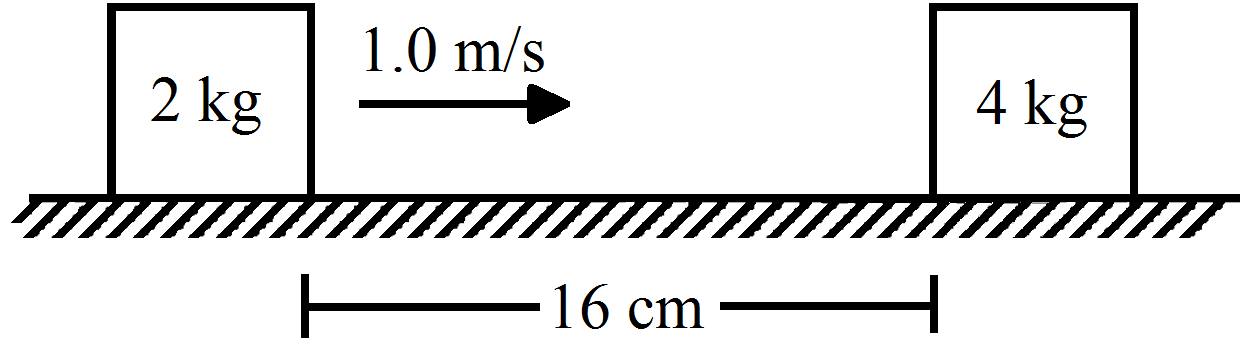
The friction coefficient between the horizontal surface and each of the blocks shown in figure is 0.20. The collision between the blocks is perfectly elastic. Find the separation between the two blocks when they come o rest. Take $g = 10 m/s^2.$
Two Polaroids are placed 90° to each other and the transmitted intensity is zero. What happens when one more Polaroid is placed between these two bisecting the angle between them. Take intensity of unpolarised light 10. How will the intensity of transmitted light vary on further rotating the third Polaroid?
In an agricultural experiment, a solution containing 1 mole of a radioactive material $\Big(\text{t}_{\frac{1}{2}}=14.3\text{ days}\Big)$ was injected into the roots of a plant. The plant was allowed 70 hours to settle down and then activity was measured in its fruit. If the activity measured was $1\mu\text{Ci},$ what per cent of activity is transmitted from the root to the fruit in steady state?
A 10g bullet with a charge of $4.00\mu\text{C}$ is fired at a speed of $270m/s^{-1}$ in a horizontal direction. A vertical magnetic field of $500\mu\text{T}$ exists in the space. Find the deflection of the bullet due to the magnetic field as it travels through 100m. Make appropriate approximations.
What will be the energy corresponding to the first excited state of a hydrogen atom if the potential energy of the atom is taken to be 10eV when the electron is widely separated from the proton? Can we still write $\text{E}_\text{n}=\frac{\text{E}_1}{\text{n}^2}?\text{ r}_\text{n}=\text{a}_0\text{n}^2?$
The uniform surface charge density of a thin spherical shell of radius $R$ is $\sigma$. Calculate the intensity of the electric field due it, in the following circumstances : $\square$(i) Elecric field outside the shell(ii) Electric field inside the shell.
Two audio speakers are kept some distance apart and are driven by the same amplifier system. A person is sitting at a place 6.0m from one of the speakers and 6.4m from the other. If the sound signal is continuously varied from 500Hz to 5000Hz, what are the frequencies for which there is a destructive interference at the place of the listener? Speed of sound in air = 320m/s.

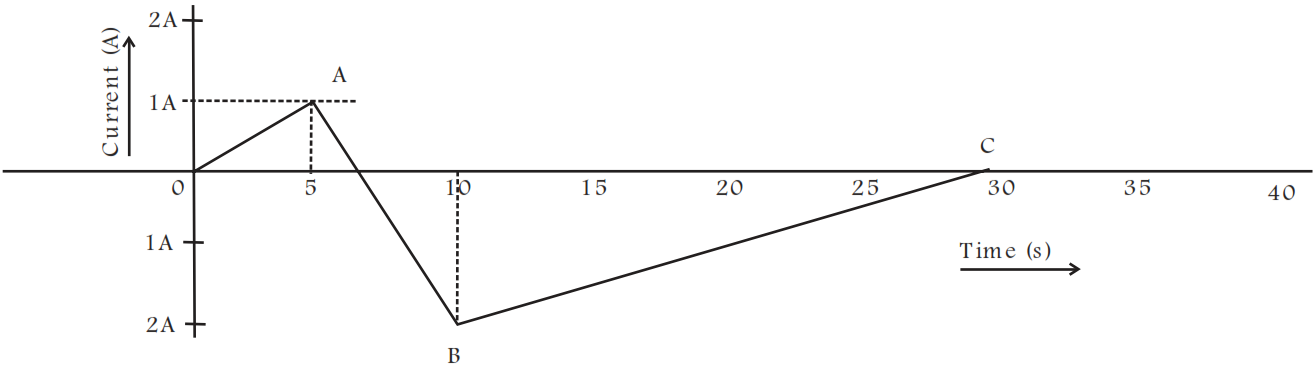
A (current vs time) graph of the current passing through a solenoid is shown in Fig. For which time is the back electromotive force (u) a maximum. If the back emf at t = 3s is e, find the back emf at t = 7s, 15s and 40s. OA, AB and BC are straight line segments.
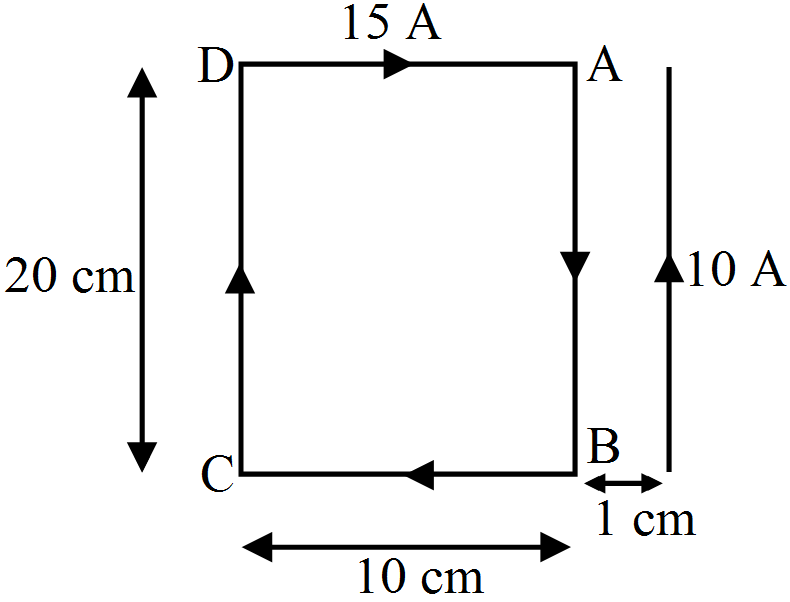
A rectangular current carrying loop is placed 1cm away from a long straight current-carrying conductor as shown.
  1. Will the net force acting on the loop due to straight conductor be attractive or repulsive in nature? Justify your answer. Calculate the magnitude of this force.
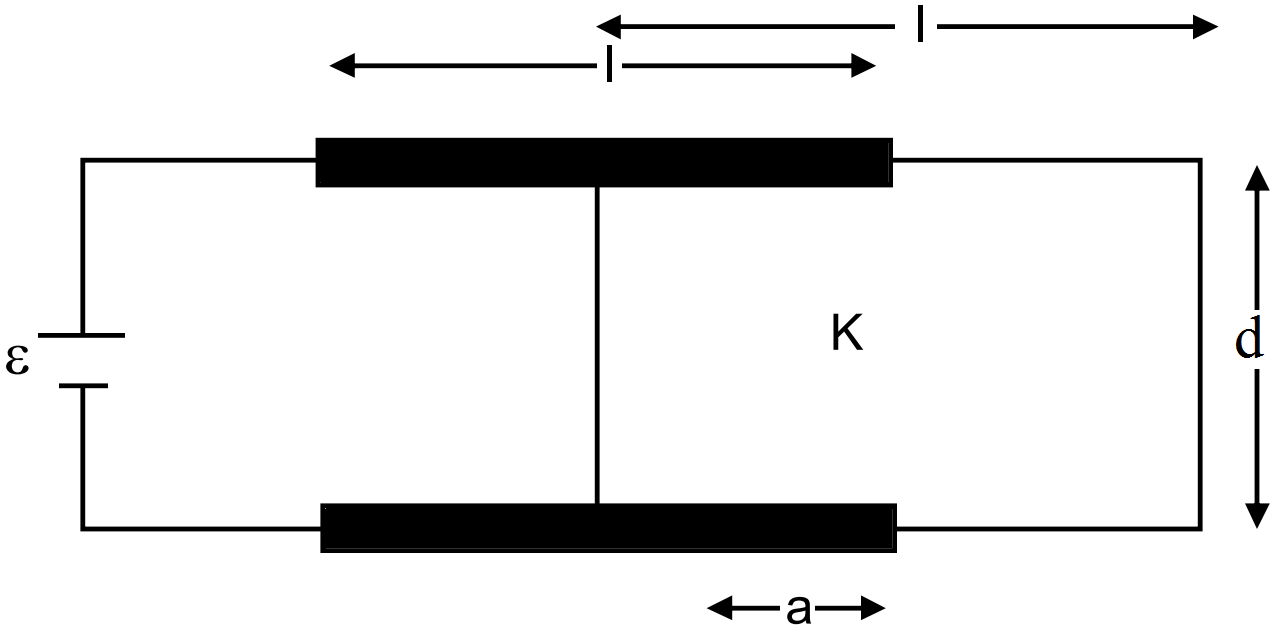
Consider the situation shown in figure. The plates of the capacitor have plate area A and are clamped in the laboratory. The dielectric slab is released from rest with a length a inside the capacitor. Neglecting any effect of friction or gravity, show that the slab will execute periodic motion and find its time period.