Question
Answer the following questions:
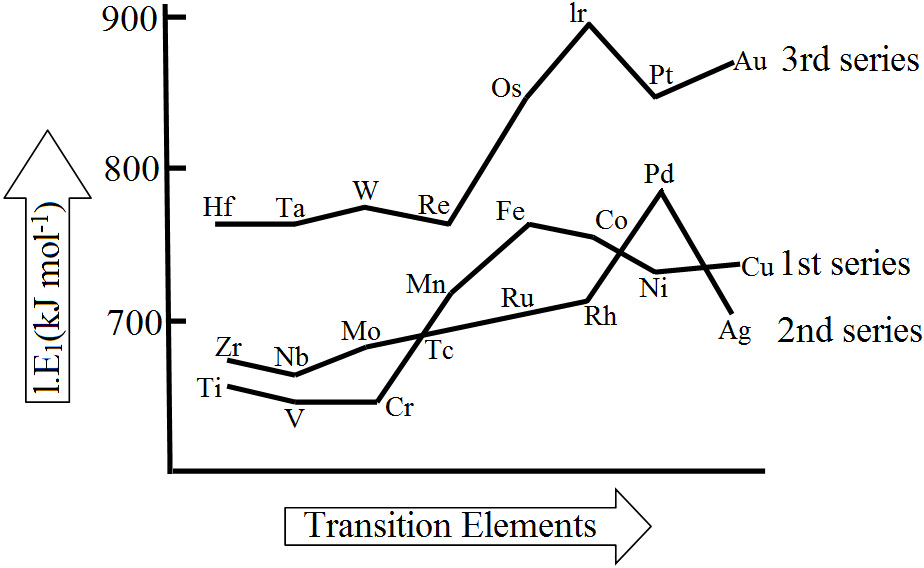
  1. The figure given alongside illustrates the first ionization enthalpies of first, second and third series of transition elements. Answer the question that follows:
  2. Which series amongst the first, second and third series of transition elements have the highest first ionization enthalpy and why?
  3. Separation of lanthanoid elements is difficult. Explain.
  4. $Sm^{2+}, Eu^{2+}$ and $Yb^{2+}$ ions in solutions are good reducing agents but an aqueous solution of $Ce^{4+}$ is a good oxidising agent. Why?
Answer

  1. Third series has the highest first ionization energy due to poorest shielding effect of the fully filled $4$fsubshell.
  2. This is due to lanthanoid contraction.
  3. $Sm^{2+}, Eu^{2+}$ and $Yb^{2+}$ ions are good reducing agents as they tend to acquire common oxidation state of $+3$ shown by lanthanoids by the loss of one electron while $Ce^{4+}$ gains one electron to attain $+3$. Hence, $Ce^{4+}$ is an oxidising agent.

Need a full question paper?

Generate a complete, print-ready paper with questions like this in minutes — across 16+ boards, with answer keys.

Start Generating Free

Similar questions

Differentiate between DNA and RNA.
Match the terms given in Column I with the units given in Column II.
 
Column I   Column II
i. $\text{K}$ a. $\text{I}\times\text{t}$
ii. $\wedge_{\text{m}}$ b. $\frac{\wedge_{\text{m}}}{\wedge^\circ_\text{m}}$
iii. $\alpha$ c. $\frac{\text{k}}{\text{c}}$
iv. $\text{Q}$ d. $\frac{\text{G}^*}{\text{R}}$
Specify the oxidation numbers of the metals in the following coordination entities:
i. $\left[ Co \left( H _2 O \right)( CN )( en )_2\right]^{2+}$
ii. $\left[ Pt ( Cl )_4\right]^{2-}$
iii. $K _3\left[ Fe ( CN )_6\right]$
iv. $\left[ Cr \left( NH _3\right)_3 Cl _3\right]$
Write the $\text{IUPAC}$ names of the following coordination compounds:
$a.\ \left[ Pt \left( NH _3\right)_2 Cl \left( NO _2\right]\right.$
$b.\ K _3\left[ Cr \left( C _2 O _4\right)_3\right]$
$c.\ \left[ CoCl _2( en )_2\right] Cl$
$d.\ \left[ Co \left( NH _3\right)_5\left( CO _3\right)\right] Cl$
$e.\ Hg \left[ Co ( SCN )_4\right]$
Match the coordination compounds given in Column $I$ with the central metal atoms given in Column $II$ and assign the correct code:
 
Column $I ($Coordination Compound$)$
 
Column $II ($Central metal atom$)$
$a.$
Chlorophyll
$1.$
Rhodium
$b.$
Blood pigment
$2.$
Cobalt
$c.$
Wilkinson catalyst
$3.$
Calcium
$d.$
Vitamin $B_{12}$
$4.$
Iron
 
 
$5.$
Magnesium
Code:

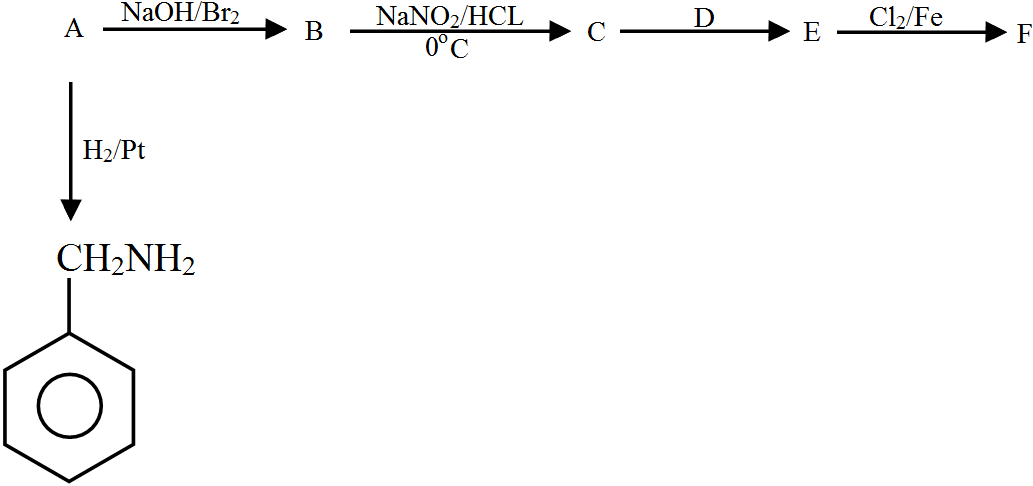
Write the structures of reagents/ organic compounds (A to F) in the following sequence of reactions:
Explain Lead Storage Cell.
Discuss the different chemical properties of amines.
  1. With reference to structural variability and chemical reactivity, write the differences between lanthanoids and actinoids.
  2. Name a member of the lanthanoid series which is well known to exhibit $+4$ oxidation state.
  3. Complete the following equation:
$\text{MnO}_{4}^{-}+\text{8H}^{+}+\text{5e}^{-}\rightarrow$
  1. Out of $Mn^{3+}$ and $Cr^{3+}$, which is more paramagnetic and why?
$($Atomic nos: $Mn = 25, Cr = 24).$
Explain the mechanism of rusting of iron.