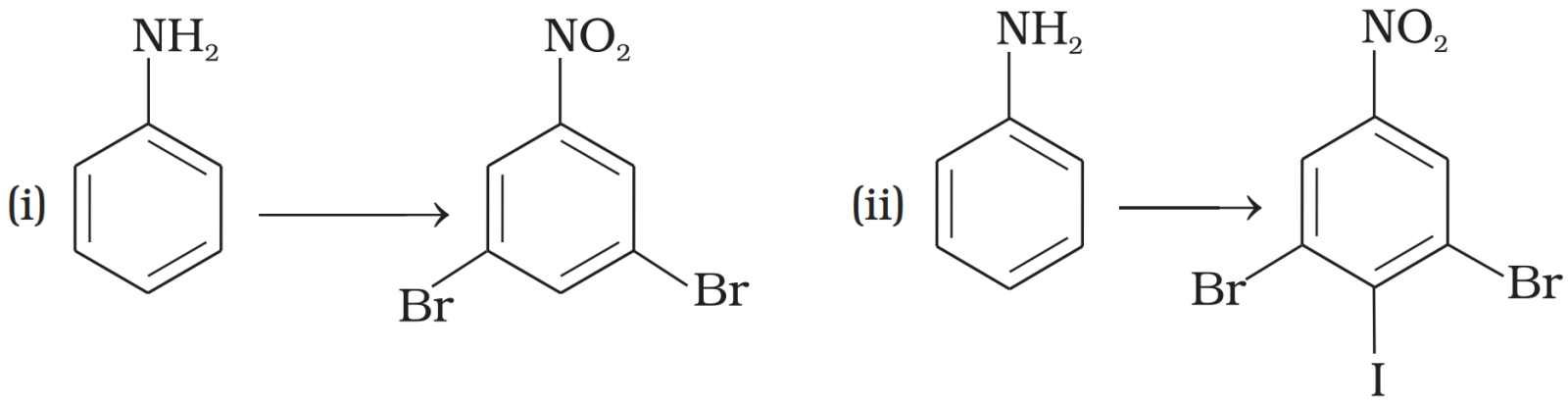
Question
Differentiate between DNA and RNA.
| DNA | RNA |
| 1. DNA is deoxyribonucleic acid. | 1. RNA is ribonucleic acid. |
| 2. DNA occurs in the nucleus of the cell in chromosomes. | 2. RNA occurs mainly in the cytoplasm of the cell. |
| 3. DNA has double-stranded helix and both the helical strands are coiled in opposite directions. | 3. Generally, RNA is formed of a single strand. Double-stranded RNA is also found but they are non-helical. RNA molecule may be coiled on itself. |
| 4. DNA nucleotides consist of deoxyribose sugar. | 4. RNA nucleotides consists of ribose sugar. |
| 5. The nitrogenous bases found in DNA are: Purine bases Adenine and Guanine. Pyrimidine bases: Cytosine and Thymine. | 5. The nitrogenous bases found in RNA are: Purine bases: Adenine and Guanine. Pyrimidine bases: Cytosine and Uracil. |
| 6. DNA is the genetic material. | 6. RNA when present with DNA is not the genetic material. |
Generate a complete, print-ready paper with questions like this in minutes — across 16+ boards, with answer keys.
| t/s | $10^{-2} \times\left[ N _2 O _5\right] / mol L ^{-1}$ |
| 0 | 1.63 |
| 400 | 1.36 |
| 800 | 1.14 |
| 1200 | 0.93 |
| 1600 | 0.78 |
| 2000 | 0.64 |
| 2400 | 0.53 |
| 2800 | 0.43 |
| 3200 | 0.35 |
|
|
Column $I ($Property$)$
|
|
Column $II ($Element$)$
|
| $(i)$ |
Lanthanoid which shows $+4$ oxidation state
|
$(a)$ | $Pm$ |
| $(ii)$ |
Lanthanoid which can show $+2$ oxidation state
|
$(b)$ | $Ce$ |
| $(iii)$ |
Radioactive lanthanoid
|
$(c)$ | $Lu$ |
| $(iv)$ |
Lanthanoid which has $4f^7$ electronic configuration in $+3$ oxidation state
|
$(d)$ | $Eu$ |
| $(v)$ |
Lanthanoid which has $4f^{14}$ electronic configuration in $+3$ oxidation state
|
$(e)$ | $Gd$ |
|
|
|
$(f)$ | $Dy$ |