Question
Answer the following questions
The observations made by Swarali while doing the experiment are given below. Based on these write answers to the questions;
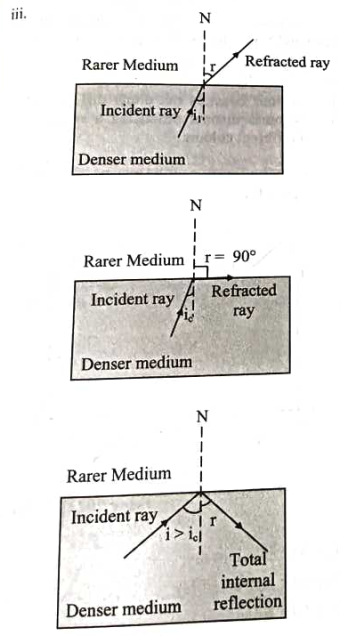
Swarali found that the light ray travelling from the denser medium to rarer medium goes away from the normal. If the angle of incidence (i) is raised by Swarali, the angle of refraction ( $r$ ) went on increasing. However, after certain value of the angle of incidence the light ray is seen to return back into the denser medium.

i. What is the specific value of $\angle i$ called?
ii. What is the process of reflection of incident ray into denser medium called?
iii. Draw the diagrams of three observations made by Swarali.
Answer

i. The specific value of $\angle i$ is called critical angle.
ii. The process of reflection of incident ray into denser medium is called total internal reflection.
Image

Need a full question paper?

Generate a complete, print-ready paper with questions like this in minutes — across 16+ boards, with answer keys.

Start Generating Free

Similar questions

A man bought a device X which could cook pulses, vegetables and rice without using any fuel like wood, coal, kerosene or LPG, etc. This device did not work at night. It also took a lot of time for cooking.
  1. Name the device X.
  2. What is the source of energy which cooks food in this device?
  3. What is the name of the process which traps energy in this device?
  4. State one advantage (other than saving on fuel) or using such a device for cooking food.
How can bio-diversity be conserved?
State and explain Maxwell’s right-hand thumb rule.
The farmers have been cultivating a food plant X for over two thousand years and have produced as many as five entirely different looking vegetables A, B, C, D and E from it.
  1. What could the plant X be?
  2. What are A, B, C, D and E?
  3. What is the process of evolution involved in this example known as?
There is a pair of bean-shaped organs P in the human body towards the back, just above the waist. A waste product Q formed by the decomposition of unused proteins in the liver is brought into organ P through blood by an artery R. The numerous tiny filters S present in organ P clean the dirty blood by removing the waste product Q. The clean blood goes into circulation through a vein T. The waste substance Q, other waste salts, and excess water form a yellowish liquid U which goes from organ P into a bag-like structure V through two tubes W. This liquid is then thrown out of the body through a tube X.
  1. What is (i) organ P and (ii) waste substance Q?
  2. Name (i) artery R, and (ii) vein T.
  3. What are tiny filters S known as?
  4. Name (i) liquid U, (ii) structure V, (iii) tubes W and (iv) tube X.
Write short notes on: Leaching method
Why is variation during reproduction beneficial to the species but not necessarily for the individual?
Write short notes on: Hydraulic separation method
Write down the following activities in the correct order for a simple reflex arc:
  1. Impulse travels in the motor fibre.
  2. Impulse travels in the sensory fibre.
  3. Effector organ stimulated.
  4. Impulse crosses the synapse.
When ethanoic acid reacts with sodium hydrogencarbonate, then a salt $X$ is formed and a gas $Y$ is evolved.
Name the salt $X$ and gas $Y.$ Describe an activity with the help of a labelled diagram of the apparatus used to prove that the evolved gas is the one which you have named. Also write the chemical equation of the reaction involved.